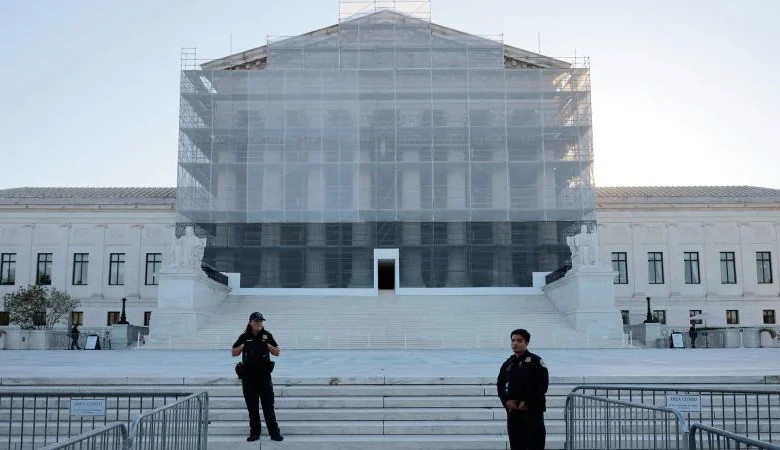
The Supreme Court on Monday will grapple with President Donald Trump’s power to capture control of independent agencies in an important case that could reshape large swaths of the federal government and unwind a precedent that has been on the books since Franklin D. Roosevelt was in the White House.
At issue is Trump’s decision in March to fire Rebecca Kelly Slaughter from the Federal Trade Commission, despite a federal law that attempts to insulate the agency from political pressure by permitting its members to be removed only for “inefficiency, neglect of duty, or malfeasance in office.” Trump has provided no such justification.
Trump’s appeal is a culmination of months of legal wrangling since he returned to power in January over his authority to fire the leaders of other agencies that enjoy similar protections. The court’s ruling is all but guaranteed to influence a slew of other pressing cases raising similarly weighty separation of powers questions.
Potentially at stake is a 1935 precedent that permitted Congress to set the terms of removal for independent agency leaders. That case, Humphrey’s Executor v. US, has been in the crosshairs of the court’s conservative majority for years and the liberal justices have complained that a series of emergency orders have effectively already left it for dead.
“Overruling a century of precedent at this late date … would profoundly destabilize institutions that are now inextricably intertwined with the fabric of American governance,” Slaughter’s attorneys have told the high court.
But Trump leans heavily on a theory that the founders envisioned a president with sweeping control over the executive branch. And the Justice Department has noted the government’s independent agencies – including the FTC – have more power than anything that existed when the Supreme Court decided Humphrey’s.
Solicitor General D. John Sauer, the administration’s top appellate attorney, framed independent agencies as a “myth.”
“Few things could be more perilous to liberty than some ‘fourth branch’ that does not answer even to the one executive official who is accountable to the body politic,” Sauer wrote, quoting from a concurring opinion written four years ago by Justice Neil Gorsuch, a member of the court’s conservative bloc.
The Supreme Court, where conservatives hold a 6-3 supermajority, has signaled skepticism in recent years about the for-cause protections Congress sometimes includes for executive branch officials.
Four years ago, the court’s conservatives held that such protections for the head of the Consumer Financial Protection Bureau violated separation-of-powers principles. The president’s power to “remove – and thus supervise – those who wield executive power” flows directly from the Constitution, Chief Justice John Roberts wrote for the majority.
But the court’s 5-4 decision left Humphrey’s in place, with Roberts noting that it applied only to independent agencies led by a single director rather than to multi-member boards.
There are a growing number of signs that Slaughter’s case could have wide consequences beyond the FTC. To begin with, when the court granted the case in September it agreed to decide whether any federal court may “prevent a person’s removal from public office.” The Humphrey’s decision involved back pay, not reinstatement, and so the justices could use that question to extricate courts from the business of ever ordering a president to reinstate fired employees.
In another notable move, the court last month tied a separate appeal involving a top official at the Library of Congress to the Slaughter case. That likely indicates that a majority of the court views an overlap between Slaughter’s situation and an official who claims she is not even part of the executive branch.
It was Trump who first placed Slaughter on the FTC in 2018. Former President Joe Biden nominated her for a second term, and the Senate confirmed her without opposition last year.
The FTC’s five members, appointed by the president, serve seven-year terms and no more than three commissioners can be of the same political party. The agency enforces anti-trust and consumer protection laws.
A federal district court ordered Slaughter’s reinstatement in July and an appeals court in Washington, DC, ultimately declined to overturn that ruling.
This year, the high court has allowed Trump to fire leaders of independent agencies who were appointed by Biden – many of whom were likely to be critics. In September, the Supreme Court allowed the Trump administration to keep Slaughter out of work while the case advanced.
The Humphrey’s Executor case dates to Roosevelt, who fired a commissioner of the Federal Trade Commission in 1933. The commissioner, William Humphrey, was appointed by President Herbert Hoover. He continued to argue he was a member of the commission until his death in 1934. His estate sought to recover his salary during the period after his firing and the Supreme Court unanimously agreed that his dismissal was improper.
“It is quite evident,” the court wrote then, “that one who holds his office only during the pleasure of another cannot be depended upon to maintain an attitude of independence against the latter’s will.”