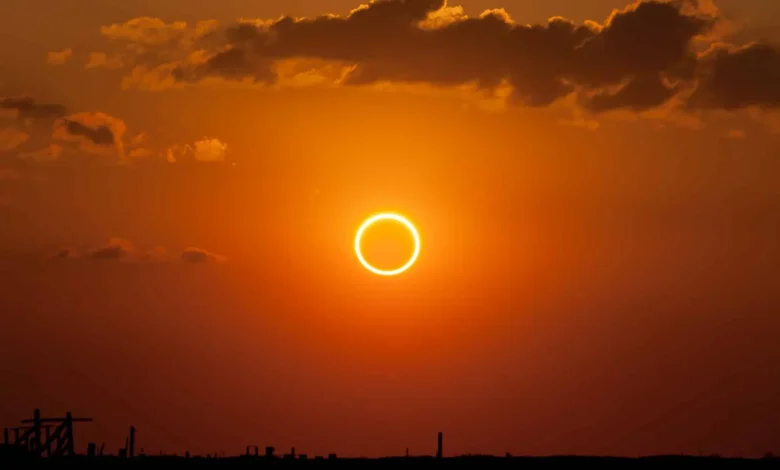
Perfect Ring of Fire – Annular Solar Eclipse, Mid-eclipse, perfectly centered ring of fire. At sunset. Credit: Kevin Baird – CC BY-NC-ND 2.0 via Flickr.
Skywatchers will witness a rare, extended total solar eclipse—set to be the longest in a century—visible from southern Spain and Morocco across North Africa and into the Middle East on August 2, 2027, according to NASA.
At peak totality, the moon will blot out the sun for about 6 minutes and 23 seconds, a span experts say is exceptional by modern standards. The point of maximum eclipse is expected in southern Egypt near the Nile cities of Luxor and Aswan, famed for their ancient temples, where observers will see daylight fall to near-night and the sun’s corona glow around the silhouetted moon.
The eclipse path, according to NASA, will begin over the Atlantic and move ashore in southern Spain and Morocco before advancing through Algeria, Tunisia, Libya, and Egypt and continuing into parts of Saudi Arabia and Yemen, with the moon’s shadow reaching the coast of Somalia. Areas outside that narrow corridor will witness a partial eclipse.
The longest solar eclipse in 100 years is a product of favorable alignment
Astronomers say the unusually long totality is the result of a favorable alignment as the moon will be relatively close to Earth, appearing slightly larger in the sky, while Earth will be a bit farther from the sun, making the sun appear marginally smaller. That geometry allows the moon to cover the solar disk for an extended interval, producing a longer period of darkness and an extended view of the corona.
By comparison, the April 2024 eclipse that crossed North America lasted about 4 minutes, 28 seconds, and a total eclipse visible in parts of Spain in August 2026 will last only about 1 minute, 43 seconds. The last substantially longer event was July 11, 1991, when totality reached about 6 minutes, 52 seconds, a mark not equaled in the decades since.
Scientists note the theoretical maximum duration of a total solar eclipse is about 7 minutes, 32 seconds, a limit set by the relative distances and motions of Earth, the moon, and the sun. Other long eclipses are predicted later this century, including on August 12, 2045, which is estimated to last about 6 minutes and 6 seconds, and May 22, 2096, which will last about 6 minutes, 6 seconds, but none are expected to exceed the July 1991 duration or approach the absolute physical maximum.
Officials urge careful viewing, as they advise never looking directly at the sun without certified solar filters except during the brief period of totality, and follow local guidance for safe observation. Observers under the path of totality should expect abrupt drops in temperature and surprising changes in light and animal behavior as the moon’s shadow passes.