‘At 13, I thought my leukaemia was incurable. But a new treatment has made me cancer-free’

Sign up for our free Health Check email to receive exclusive analysis on the week in health
Get our free Health Check email
Get our free Health Check email
Palliative care felt like the only option left for 13-year-old leukaemia patient Alyssa Tapley, until she became the first person in the world to take a treatment that edits healthy immune cells to fight cancer.
The teenager from Leicester was diagnosed with T-cell leukaemia in May 2021, after a long period of what her family thought were colds, viruses and general tiredness.
She did not respond to chemotherapy or a bone marrow transplant, and thought her cancer was “incurable” until the research opportunity was proposed.
When Alyssa received the therapy in 2022, she remained cautiously optimistic after her leukaemia became undetectable.
But three years later, aged 16, the treatment has proven to be life changing. She has been discharged to long-term follow up and has dreams of becoming a research scientist herself.
open image in gallery
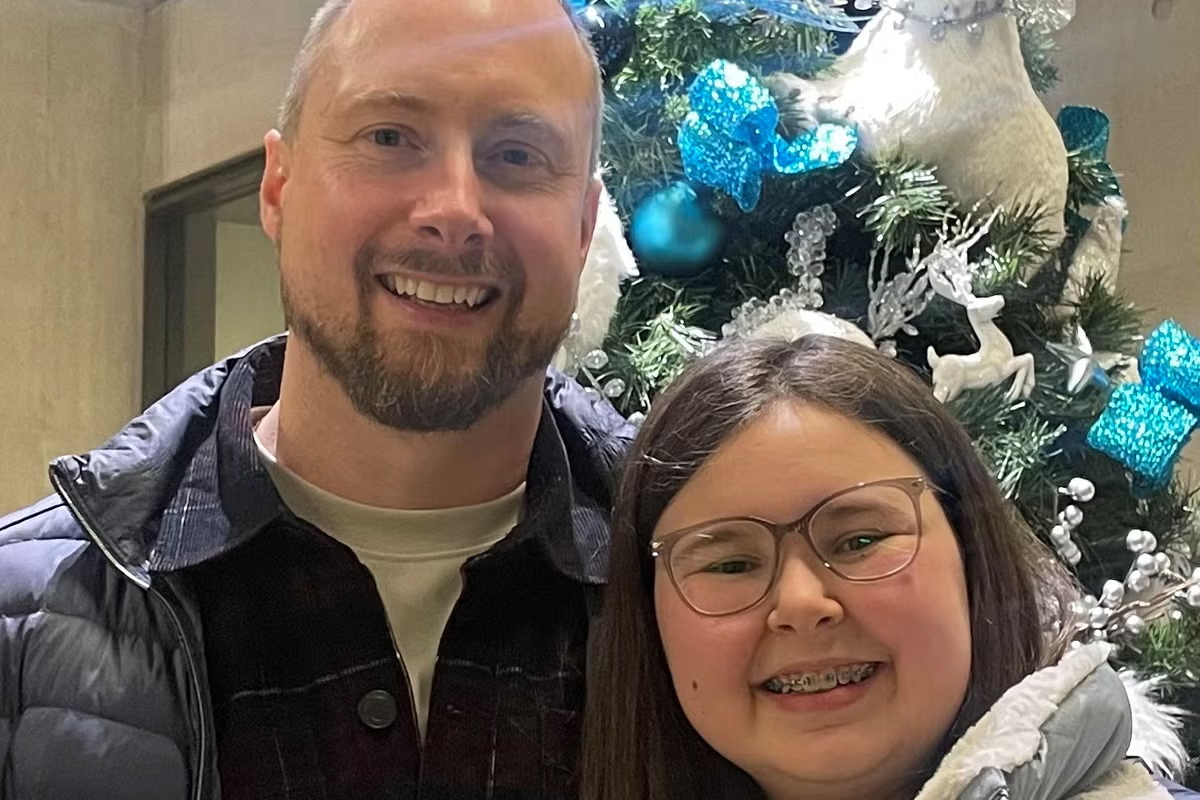
James Tapley from Leicester with his daughter Alyssa at GOSH after she received BE-CAR7, then aged 13, in 2022 (Family Handout/PA Wire)
“I chose to take part in the research as I felt that, even if it didn’t work for me, it could help others. Years later, we know it worked and I’m doing really well. I’ve done all those things that you’re supposed to do when you’re a teenager,” Alyssa said.
“I’ve gone sailing, spent time away from home doing my Duke of Edinburgh Award but even just going to school is something I dreamed of when I was ill. I’m not taking anything for granted.
“Next on my list is learning to drive, but my ultimate goal is to become a research scientist and be part of the next big discovery that can help people like me.”
A further eight children and two adults with an aggressive form of leukaemia that “seemed incurable” have since undergone the treatment at Great Ormond Street Hospital (Gosh) and King’s College Hospital (KCH).
Almost two thirds of patients with T-cell acute lymphoblastic leukaemia (T-ALL) involved in the clinical trial of the treatment – known as BE-CAR7 – now remain cancer-free.
open image in gallery
Alyssa, pictured with her parents James and Kiona Tapley and brother Liam, said she now dreams of becoming a research scientist to help other people like her (Family Handout/PA Wire)
BE-CAR7, which was developed by scientists at Gosh and University College London (UCL), is a ground breaking treatment which works by editing healthy immune cells to fight cancer.
Ordinarily CAR T-cell therapy involves a doctor collecting T cells from a patient, which are then modified in a lab with proteins called chimeric antigen receptors (CARs) placed on the surface to recognise and kill cancer.
These immune cells are then fed back into the patient’s bloodstream via a drip.
But using this concept for leukaemia, which has developed from abnormal T cells, is more complicated.
For BE-CAR7 researchers used healthy T cells from a donor and tweaked them using a method called base editing – which can be used to change single letters of DNA code inside living cells.
open image in gallery
Alyssa Tapley from Leicester, pictured on holiday, is now cancer-free and has long-term check ups (Family Handout/PA Wire)
It allows T cells to work after chemotherapy and disarms them to prevent attacks against normal cells.
When base-edited CAR T-cells are given to the patient they rapidly find and destroy all T-cells in the body, including leukaemia T-cells.
If the leukaemia is eradicated within four weeks, the patient’s immune system is then rebuilt from a bone marrow transplant over a period of several months.
Following this theory a clinical trial explored whether BE-CAR7 could clear leukaemia ahead of a planned bone marrow transplant in the hopes it could prevent the cancer returning.
For the study, nine children and four adults with T-ALL were treated with BE-CAR7 and just over half (64 per cent) are now disease free.
Deep remission was achieved by 82 per cent of participants who were able to go on to get a stem cell transplant without disease.
Although there were side effects, such as low blood count and rashes, these were manageable, according to researchers.
Waseem Qasim, a professor of cell and gene therapy at UCL and honorary consultant immunologist at Gosh, said: “We previously showed promising results using precision genome editing for children with aggressive blood cancer and this larger number of patients confirms the impact of this type of treatment.
“We’ve shown that universal or ‘off-the-shelf’ base-edited CAR T-cells can seek and destroy very resistant cases of CD7+ leukaemia.”
Dr Rob Chiesa, study investigator and bone marrow transplant consultant at Gosh, said: “Although most children with T-cell leukaemia will respond well to standard treatments, around 20 per cent may not.
“It’s these patients who desperately need better options and this research provides hope for a better prognosis for everyone diagnosed with this rare but aggressive form of blood cancer.”
The results of the clinical trial have been published in the New England Journal of Medicine and presented at the 67th American Society of Hematology Annual Meeting in Florida.