India–Nepal Joint Military Drill SURYAKIRAN-XIX: Drones, AI Tools, Mountain Warfare & More

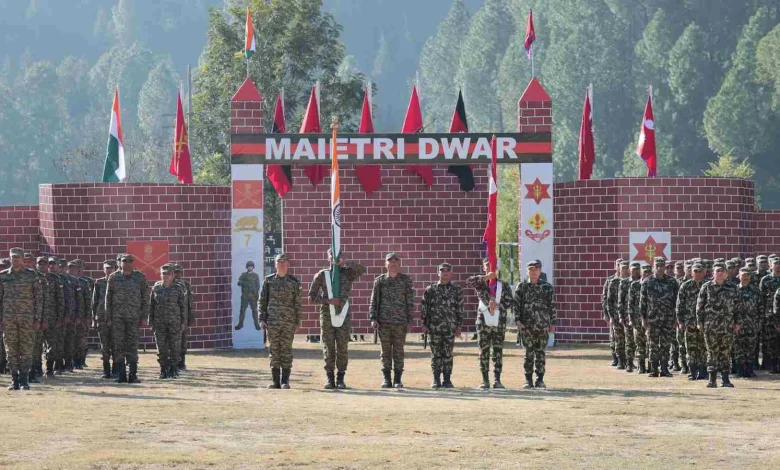
India–Nepal Joint Military Drill SURYAKIRAN-XIX: Exercise Suryakiran is a long-standing military drill between the Indian and Nepali armies, where the two forces come together once a year to work out together. Initiated in 2011, this exercise is held annually, with the hosting duties alternating between India and Nepal.
The exercise aims to build interoperability, mutual understanding, and camaraderie between the two armies enabling them to operate together effectively in times of conflict, counter-terrorism, disaster response or peacekeeping under the mandate of the United Nations.
India–Nepal Joint Military Drill SURYAKIRAN-XIX (2025)
The 19th edition, SURYAKIRAN-XIX, began on 25 November 2025 at Pithoragarh (Uttarakhand, India) and ran until 8 December 2025.
Each side Indian Army and Nepal Army deployed 334 personnel: the Indian contingent primarily from the Assam Regiment, and the Nepalese side mainly from the Devi Datta Regiment.
The exercise is designed to rehearse and enhance sub-conventional operations under Chapter VII of the UN mandate i.e., operations like counter-terrorism, peace enforcement, humanitarian assistance, disaster relief and stabilization missions.
Operational domains covered include:
- Jungle and mountain warfare in difficult terrain
- Counter-terrorism operations in mountainous terrain
- Humanitarian Assistance & Disaster Relief (HADR), medical response and casualty evacuation
Integrated ground–air operations, environmental-conservation awareness, and disaster-management drills. Some of the highlighted capabilities and assets:
- Unmanned Aerial Systems (UAS)
- Drone-based ISR (Intelligence, Surveillance, Reconnaissance) and AI-enabled decision-support tools
- Unmanned logistic vehicles and armoured protection platforms
Advanced weapons sights for both day and night operations, secure battlefield communications and coordinated use of air and ground assets for integrated ground-aviations operations.
The changes show a move away from conventional drills to contemporary warfare and counter-terrorism activities. The forces are being equipped with a combination of infantry tactics, drones, AI, and modern logistics to be able to deal with hybrid threats and unknown terrain.
What’s New in SURYAKIRAN-XIX?
This year’s edition was marked by a different change, a strong emphasis on modern and emerging technologies to adapt to evolving security challenges.
What Made SURYAKIRAN-XIX Stand Out?
The exercise ended with a large-scale, fast-paced, and intensive validation war game that was observed and confirmed by the Directors General of Military Operations (DGMOs) of both armies. The final drills recreated very close to real combat scenarios, and joint operations were conducted at battalion, company, and small-team levels.
India–Nepal Joint Military Drill SURYAKIRAN-XIX
The drills emphasized intelligence-led surgical operations in complex terrain and also included the insertion of airborne troops, rapid-response capabilities, counter-terrorism, and special operations to highlight the high-intensity nature of the wargame. The DGMOs planted a symbolic “Tree of Friendship” as part of the closing ceremony, thus sending a strong message of an enduring strategic partnership, mutual trust, and regional stability between the two armies apart from the combat drills.
In addition to the combat-oriented drills, the exercise featured a separate Humanitarian Assistance & Disaster Relief (HADR) segment that had rescue scenarios for flash floods, earthquake-like structural collapse, river-rescue operations, and disaster-response coordination. As the Himalayan region is seismically vulnerable and the two sides share river basins, this kind of preparedness has a lot of practical implications.
India–Nepal Joint Military Drill SURYAKIRAN-XIX: What’s Next?
With SURYAKIRAN-XIX successfully concluded, a few outcomes and implications emerge:
In the future, the enhanced tactics, experience and interoperability through this exercise could be used to support operations both bilateral (India-Nepal) and multilateral (UN/peacekeeping).
The integration of advanced technologies reveals a trend: in the next Indo-Nepal exercise, they might be more dependent on the use of drones, AI, unmanned systems and digital communications, indicating the modernization of bilateral military cooperation.
Disaster-response drills could become the means of ensuring better coordination during sudden disasters in the Himalayan or flood-prone regions, which is a demonstration of how military cooperation can be of help to the humanitarian and civil protection sectors.
Among others, symbolic actions such as the “Tree of Friendship” help soft-power, goodwill, and long-term strategic partnership beyond simple military collaboration.
Exercise SURYAKIRAN–XIX is more than just a “drill”; it is a strong demonstration of trust, cooperation, modernization, and readiness between the Indian and Nepalese armies. The mixture of traditional mountain and jungle warfare training along with the use of state-of-the-art technology, real-time disaster response drills, and high-tempo combat simulations exemplifies the acknowledgment that modern security challenges require agility, coordination, trust, and innovation.