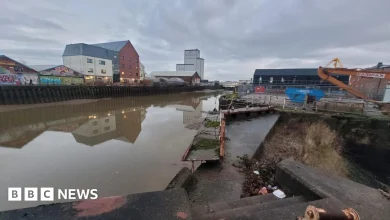
Water bosses say we need a lot more rain if we want to avoid trouble in 2026
Low water levels at Baitings Reservoir on October 16, 2025 in Ripponden
Yorkshire Water is lifting a hosepipe ban imposed on millions of households in the summer, following the recovery of reservoirs and water resources in the region. The company was the first major utility to impose restrictions on its customers in July, after much of England struggled with drought in the wake of the driest spring for more than a century and a record hot summer.
Reservoir levels are now at 91.6%, up from just 30.6% at their lowest point, and Hull aquifer levels are at 77% – up from 49% at the end of November following recent rainfall. It means water resources across reservoirs, rivers and groundwater sources are now above average for the time of year, at 85.1%, and restrictions can be lifted for 2.3 million households from Wednesday, Yorkshire Water said.
The hosepipe restrictions saved around 3.1 billion litres of water, the equivalent of 33 days of Sheffield’s average use. The firm said that without its drought management plan, which included the restrictions, efforts to fix 15,000 leaks, drought permits to abstract from rivers or hold water back in reservoirs, and a system of moving water round the region, they could have dropped to as low as 17.6%.
As it was, 22 reservoirs dropped to below 20%, including Scar House, Thruscross, Baitings and Broomhead. Dave Kaye, director of water and wastewater at Yorkshire Water, said: “When restrictions were first introduced and the weather was warm, customer usage went down by 10%, taking pressure off our reservoirs.
“Continuing those water-saving actions when we finally started seeing rainfall, as well as us making use of drought orders and permits, meant that our reservoirs could recover as much as possible – and it’s part of the reason why we’re able to end the restrictions earlier than we initially thought.
“While the restrictions are lifting it is important people continue to think about their water usage and consider using water wisely throughout the year, not just during periods of drought and hot weather.”
Much of England suffered from drought this year after the driest spring for 132 years, and a hot dry summer with record temperatures and repeated heatwaves. But a recent surge in rainfall has helped many of England’s regions recover their water levels, even as it brought flooding to many parts of the country.
The national drought group, which includes the Met Office, regulators, government, water companies, and other organisations, convened on Monday after November saw 149% of the long-term average rainfall. It said the Midlands had now moved out of drought status, after the East Midlands saw 218% of rain and the West Midlands had 185% of rain.
Meanwhile, the North West, which was the first to declare drought status in May, is now out of the recovery stage and back to normal. The North East has moved from prolonged dry weather to drought recovery.
Yorkshire, which declared drought status in June, is also showing good signs of recovery, the group said, adding that officials will decide on moving status later this week. The parts of Sussex served by South East Water remain in drought.
Even as the situation improves, the group said there still needs to be a typical rainfall until the end of March to avoid drought in some areas next year.