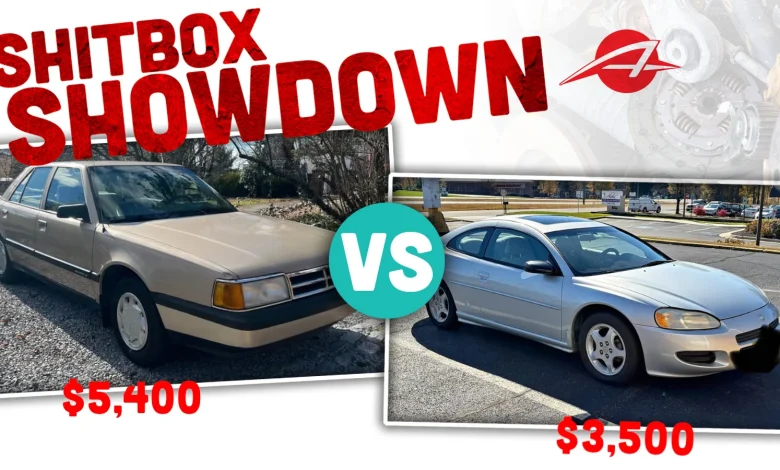
The history of Chrysler over the past fifty years or so is a long and sordid tale of joint ventures, bailouts, purchases, sales, and mergers, leading to its current situation as part of a giant conglomerate with a dumb name. All of these marriages and divorces left behind some strange step-kids, cars that wear the badges of old Chrysler brands, but have nothing to do with its current offerings. For your consideration today, I have found two clean low-mileage examples of such cars.
Friday’s final four were a motley bunch, with a little something for everyone. The Fiat 500 won, followed by the Plymouth Valiant wagon, then the world’s nicest Chevy S-10 Blazer, and the cheap New Yorker brought up the rear.
This is the order I’d put them in, too. That little Fiat looks like a lot of fun, but I’d be sorely tempted by the Valiant wagon too. The Blazer would be an interesting conversation piece, but I still don’t know what I’d do with it. And the Chrysler New Yorker would make a fine winter beater for someone, or first car for a kid, but it’s not something I want.
Vehicles with a Chrysler, Plymouth, or Dodge nameplate on them have been made by, or had components from, Mitsubishi, Renault, Mercedes-Benz, Hillman, Volkswagen, Talbot, and probably some others I’m forgetting. Not all at once, of course, but sometimes in the same showroom at the same time. The company’s boom-and-bust fortunes over the past several decades have left behind a trail of cast-off cars, some of which you probably remember, others you may have forgotten. Today we’re going to take a look at a couple of them, and dig into a little bit of the twisted history that created them.
Image: Facebook Marketplace seller
Engine/drivetrain: 3.0-liter OHC V6, four-speed automatic, FWD
Location: Emmaus, PA
Odometer reading: 24,000 miles
Operational status: Runs and drives well
Chrysler went from near-bankruptcy in 1978 to having enough money to buy AMC in 1987, thanks to the success of the K cars and the minivans. Jeep was the real prize, but a lot of other AMC products came along for the ride. Among those was a big sedan that AMC had been developing with its partner Renault: the Premier. Chrysler created a new division as a home for these AMC leftovers: Eagle. This car is exactly the same thing as an Eagle Premier, but it wears a Dodge grille, and a famous Dodge model name.
Image: Facebook Marketplace seller
The heart of the revived Dodge Monaco, and its whole reason for existing, is the infamous PRV (Peugeot-Renault-Volvo) V6 engine. As part of the AMC purchase deal, Chrysler had to fulfill a purchase contract for these infernal things. Eagle wasn’t selling enough Premiers, so Chrysler decided to sell a version of the car through its higher-volume Dodge dealerships. This Monaco is practically new; it has had two owners, each of whom put about twelve thousand miles on it. The seller says it runs and drives great, but the serpentine belt squeals when you turn on the air conditioning. A new belt and tensioner are probably in order.
Image: Facebook Marketplace seller
Inside, it’s as clean as you would expect for such low miles. These are really comfy cars, too. One thing I should warn you about, though, is that unlike Dodge’s own 1991 lineup, the Monaco does not have a driver’s side airbag to fulfill its passive-restraint requirement. Instead, it relies on automatic shoulder harnesses and manual lap belts. I know. I hate them too.
Image: Facebook Marketplace seller
The first owner kept it in the garage, while the second, it sounds like, left it out in a hailstorm. As a result, it has nice shiny paint, and a few dents. Adding to this car’s mixed pedigree is its styling: it was designed by Giorgietto Giugiaro, of DeTomaso Mangusta, Lotus Esprit, and VW Rabbit fame. If you’re playing the “six degrees of separation” game with cars instead of celebrities, the Dodge Monaco is the car equivalent of Kevin Bacon.
Image: Facebook Marketplace seller
Engine/drivetrain: 2.4-liter DOHC inline 4, four-speed automatic, FWD
Location: Mechanicsville, VA
Odometer reading: 72,000 miles
Operational status: Runs and drives well
Chrysler and Mitsubishi first crossed paths way back in 1971, when Dodge started selling the Mitsubishi Colt Galant as the Dodge Colt. In the mid-1980s, the two companies started a joint venture, called Diamond-Star Motors, and built a factory in Normal, Illinois to build a line of sporty coupes bearing both companies’ badges. Among these was this car, the Dodge Stratus coupe, not to be confused with the Dodge Stratus sedan, which was Chrysler’s own design, built in Sterling Heights, Michigan.
Image: Facebook Marketplace seller
Adding to the confusion is that both the Stratus coupe and sedan use 2.4-liter four-cylinder engines, but they’re different engines. This Stratus coupe is powered by a Mitsubishi engine, shared with the Mitsubishi Eclipse, also built at Diamond-Star Motors. This car was also first owned by an elderly driver, who took excellent care of it but didn’t drive it much. It has a little under 72,000 miles on it total, 20,000 of which were added by its seller. It has had a lot of recent work done, and it runs and drives great.
Image: Facebook Marketplace seller
It’s in decent shape inside, but the dash top has some cracks. The seller has covered it with one of those custom-fit toupees, but personally, I think I’d rather just see the cracks. I’ve never seen a car with dual airbags with one of those covers, and I get the feeling that being hit in the face by what’s essentially a floormat if the airbag goes off would be a bad idea.
Image: Facebook Marketplace seller
It was recently repainted, and it looks great. Yeah, it’s just boring silver, but it’s shiny. One fault that the seller does note is that the sunroof is non-operational; it will open, but they had to take it to a body shop to get it closed again. It doesn’t leak, but leave that button alone.
Dig back far enough in the history of almost any car company, and you’ll find some bizarre connections between them: engines bought by one company from a competitor, joint ventures that don’t seem to make sense, captive imports that were’t really imported at all. Neither of these two has anything to do with Dodge’s current offerings, and they didn’t have anything in common with any other Dodges in their own time, either. But that’s what makes them interesting, especially to someone like me with essentially zero brand loyalty and a love of oddball cars. Both of these are well-preserved examples of their type. Which one do you prefer?