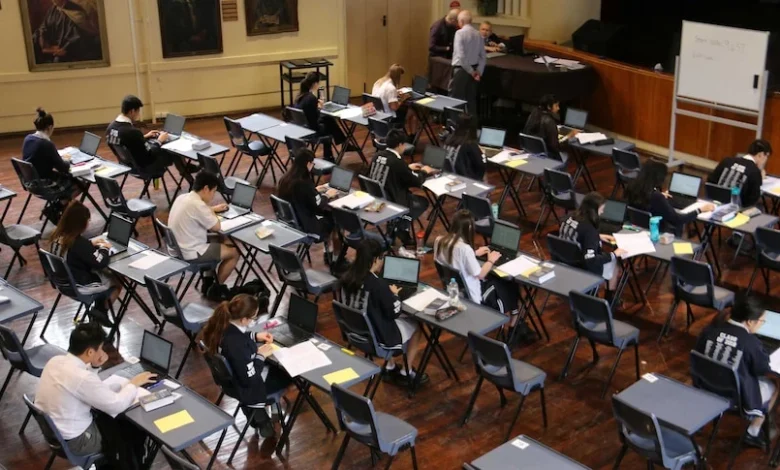
Sabra Lane: Year 12 students will receive their ATAR scores this week and next. ATAR stands for Australian Tertiary Admission Rank. Many stress over it because they think getting into their preferred uni course is based just on that result. Yet researchers at Victoria University have found many students got into the course they wanted without their ATAR even considered. Let’s reopen the debate about the relevance of ATAR scores as Kathleen O’Connor reports.
Kathleen O’Connor: It’s the magic number that most students spend majority of their school life anticipating or even fearing. Abby McEwen got her admissions rank five years ago.
Abby McEwen: It was quite stressful yeah, I think everyone’s trying to get into uni and stuff so you’re obviously trying to do your best.
Kathleen O’Connor: She was offered a position at her first choice of university. So did Alexander Bars.
Alexander Bars: Constant study, rote memorisation, constant panic about exams.
Kathleen O’Connor: An ATAR or the Australian Tertiary Admission Rank is how the education system ranks Year 12 students based on their grades over the year. They’re then compared with the hundreds of thousands of other Year 12s across the country and sorted into percentages. Since its inception around 20 years ago, it’s been seen as the best way to sort students into low, average and high performance categories so universities can decide who deserves a spot at their institutions. But a new study from Victoria University has found an ATAR rank may not be as important as people think.
Peter Hurley: Year 12 students across Australia will be receiving their ATARs this week and next and we thought it was worth taking a closer look about how ATAR is used, its evolving role and its relevance.
Kathleen O’Connor: Peter Hurley is an expert in higher education and is director of the Mitchell Institute. He compared admission data from universities across the country.
Peter Hurley: What we found is that even for many students who go straight from school to university, the ATAR is not always relevant. In 2023 among those who were using their school credentials as a basis for entry, 63% were admitted just on the ATAR, another 7% were admitted using the ATAR plus some other criteria such as test or portfolio and about 30% were admitted on basis other than what they scored on their final Year 12 results, their ATAR.
Kathleen O’Connor: Professor Hurley says the ATAR system is flawed.
Peter Hurley: People think about it in terms of how perhaps the performance of a school or whether or not an individual is worthy of going to university. It’s just a measure and it’s a very sophisticated measure in the way that it’s put together.
Kathleen O’Connor: Kelly McGlynn is a lecturer in education at Deakin University. She says she’s not surprised by the findings and suggests major reforms to secondary education.
Kelly McGlynn: A very large majority of Year 12 leavers, 2025, are getting offers before the ATAR even comes out. If we look at the context of the young person, less relevant now is exam-based curriculum. We would call it pedagogy that teaches to that sense and more relevant are applied learning approaches, so ensuring the student or the young person can collaborate, they’re adaptable, they have those 21st century skills, they can think critically and all of those things don’t necessarily measure up in exams.
Kathleen O’Connor: Scott Stanford has been a secondary school teacher for 27 years. He says there are better systems than the ATAR ranking and the higher education sector is already starting to see that.
Scott Stanford: There has to be some sort of system that ranks students because of the way that the universities are set up. I think universities are tending to get around the ATAR process and it’s not as important as it used to be.
Kathleen O’Connor: Mr Stanford says reform should also be considered.
Scott Stanford: Students are becoming more and more stressed in Year 12 because of the pressure that society puts on them about ATAR.
Kathleen O’Connor: Do you think we need to scrap the ATAR ranking altogether?
Scott Stanford: My gut says yes. It’s outdated but I just don’t know what to replace it with or how to replace it.
Sabra Lane: Teacher Scott Stanford ending Kathleen O’Connor’s report. We asked the Federal Minister for Education, Jason Clare, for comment but he was unable to respond in time as he was travelling overseas.