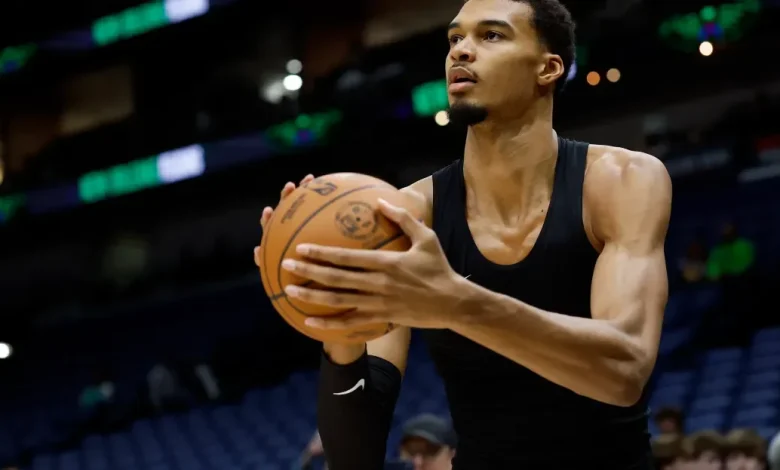
Victor Wembanyama started his third season on proverbial fire. However, this was dampened by what has become the second scariest set of words on any injury report: “calf strain.” This is of course because the words that strike the most fear are: “Achilles tear,” and after three stars went down with that injury last playoffs, teams approach any calf injury with an abundance of caution. The trepidation is even compounded by the fact that Wembanyama is the tallest player in the league, and previous players with that title don’t have the best injury history.
Wembanyama and the Spurs have done their due diligence though, and Vic has treated his body like a microchip long before his NBA career. Still, the Spurs are cautious. All this is well and good, and the Spurs have not only treaded water without their best player, but they’ve actually thrived with a record of 8-3 without him. So there hasn’t been a need to rush him back. That is, of course, unless end-of-season awards matter to you.
Victor was playing at a First-Team All-NBA level before he went down, averaging 26.2 points and 12.9 rebounds per game with a +4.4 (96th percentile) in Estimated Plus-Mines per dunksandthrees.com and was creeping into the MVP conversation.
Players must play in at least 65 games to qualify for end-of-season award ballots. That means a player can only miss 17 games all season. Wembanyama is set to miss his 12th game tonight in the Quarterfinals if the In-Season Tournament against the Lakers. If he were to come back as soon as the next game (which will depend on tonight’s results), he would only be able to miss 5 more games for the rest of the season to remain eligible.
Overall, end-of-season awards are most likely not the team’s or Wembanyama’s main concern, for a few reasons. First, health should take priority above all else, followed by winning; awards are then a byproduct of the latter. And while that is the case most of the time, it isn’t necessarily always true. In this CBA, player salary potential is directly tied to end-of-season awards. For Wembanyama, it’s the difference between max extensions at 25 percent of the cap and 30 percent.
Fortunately enough, Victor has found himself in a bit of a lucky situation nested within the unlucky injury. He is extension eligible at the end of this season, but don’t expect him to sign one just yet. In order to qualify for a 30 percent designated rookie max extension, Wembanyama will need to either win MVP this year or next year; receive Defensive Player of the Year honors either next year or both of last season and this season; or receive All-NBA honors either next year or both of last season and this season.
Considering last year’s results can’t be changed, what matters most is next season, leaving this season to have some breathing room to get his body correct. NBA awards are great, and Victor will win many throughout his career, but the pressure isn’t on until next season. Regardless of what happens this year, expect him to forgo the extension until the end of his rookie contract in 2027.
The good news is that by the most recent account from The Express News’ Jeff McDonald, Wembanyama is very close to returning, having practiced with the team this week. He’ll be back soon, and with his extra time to get to 100 percent, it’s clear the idea is to play the long game and look ahead to the Playoffs.