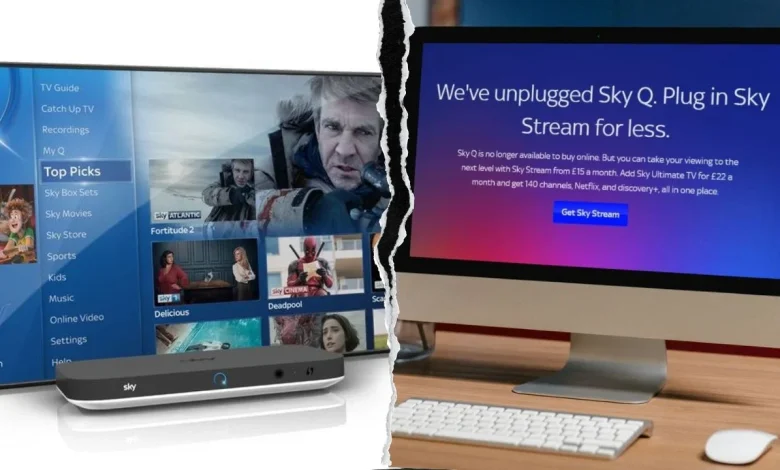
Sky Q has been scrubbed from Sky’s website in what may be the final step before the satellite service eventually disappears entirely.
As of yesterday (December 10, 2025), anyone trying to order Sky Q online will find it’s simply gone – replaced by a message pushing them towards Sky Stream instead.
The satellite box that’s been in millions of UK homes is now only available if you know to call Sky directly or visit a shop.
It’s another nail in the coffin for traditional TV boxes with proper recording, and it follows a similar move by Virgin Media TV earlier this year.
The Long Goodbye to Sky Q
Sky’s been edging away from Sky Q for a while now, even though millions of homes across the UK still use the satellite-based service.
Photo: Sky
Back in January 2024, the company announced major job cuts – around 1,000 roles, with satellite engineers taking a significant hit. The reason was straightforward: 90% of new Sky customers were already choosing Sky Glass or Sky Stream over the traditional satellite box.
As more customers moved towards streaming services that don’t require dish installations, the need for engineers to visit homes and set up satellite equipment was diminishing rapidly. Then, in September 2025, reports suggested Sky was planning to cut an additional 600 jobs.
The shift wasn’t exactly subtle. Sky Glass, the company’s 4K broadband-based TV launched in 2021, was already making waves.
Then came Sky Stream in October 2022 – essentially the same streaming experience as Glass but in a small box that works with any TV, rather than requiring you to buy a new television.
Both platforms operate purely over broadband, streaming all content directly without the need for a satellite dish.
Despite the obvious direction things were heading, Sky kept Sky Q ticking along throughout 2025. The platform even continued receiving new streaming apps – the U app from UKTV arrived in September after a year-long wait for Sky Q users (it had been available on Glass and Stream since September 2024).
Before that, My5 finally launched on Sky Q in January 2025, though Sky Glass and Stream users had enjoyed it since April 2023. The pattern was clear: Sky Q got updates, but sometimes months or years after the streaming platforms.
In 2024, Sky extended its satellite deal with operator SES until 2029, which seemed like good news for Sky Q users and gave the platform a definite lifeline.
Sky Q
At the time, Sky’s Chief Business Officer Nick Herm said the contract renewal provided “the reliability we need to continue to deliver our market-leading TV offer and broad mix of channels to Sky Q customers across the UK and Ireland.”
But actions speak louder than words. Throughout 2025, Sky’s promotional offers increasingly favoured Stream and Glass. Even when Sky Q was still featured on the website, the best deals – the ones advertised most heavily – were reserved for the streaming platforms.
Goodbye, Sky Q (Unless You Call)
Head to Sky’s website now and Sky Q has been scrubbed from the main menu, as first noticed by ISPreview.
The prominent sections for “TV,” “Broadband,” and “Mobile” no longer include any path to order Sky Q. If you somehow manage to find the Sky Q page through Google or an old link, you’re greeted with this message:
“We’ve unplugged Sky Q. Plug in Sky Stream for less. Sky Q is no longer available to buy online. But you can take your viewing to the next level with Sky Stream from £15 a month.”
Then comes the sales pitch for Stream. The messaging emphasises convenience, flexibility, and the fact that you can set everything up yourself without waiting for an engineer.
Here’s the thing though – Sky Q hasn’t completely disappeared. On that same page, there’s a section titled “Still want to chat about Sky Q?” with a phone number (03337595262) and a mention that you can visit your nearest Sky retail store.
So technically, you can still get Sky Q. You just need to actively seek it out, either by calling Sky’s customer service team or making a trip to a physical shop.
For anyone casually browsing Sky’s website to see what TV packages are available, Sky Q simply doesn’t exist anymore. The default assumption is that you’ll get Sky Stream, unless you know enough to specifically ask for the alternative.
Sky Stream
So Sky isn’t technically discontinuing Sky Q for now – they’re just making it invisible to most potential customers. Anyone who doesn’t know to ask for it will naturally end up with Sky Stream.
What This Means for Freesat
This slow death of Sky Q matters beyond Sky’s own customers – it has significant implications for the roughly 1 million homes using Freesat.
Freesat relies on the same satellite infrastructure as Sky to deliver free-to-air channels to households across the UK. It’s essentially piggybacking on Sky’s satellite system, which works because Sky maintains and pays for that infrastructure for its own satellite customers.
When Sky eventually pulls the plug on satellite broadcasting completely (the current deal runs until 2029), the economics change dramatically.
Keeping satellites operational and maintaining transmitter capacity becomes expensive when it’s only serving Freesat’s 1 million homes, rather than Sky’s millions of satellite subscribers plus Freesat users.
The BBC and other public service broadcasters have previously suggested Freesat could continue as a “nightlight” service during the transition to internet-based distribution, but nobody’s been clear about who would actually fund it.
The recent satellite contract extension gives everyone breathing room until 2029 (at least), but it doesn’t solve the fundamental problem – satellite TV is becoming economically unviable.
There’s Freely, of course – the new streaming platform jointly run by the BBC, ITV, Channel 4, and Channel 5 that launched in April 2024.
Freely is designed to eventually replace both traditional Freeview (aerial-based) and Freesat, delivering live TV channels and catch-up services purely through broadband connections.
But Freely has its own limitations. It requires decent broadband, which simply isn’t available in all the rural and remote areas where Freesat has traditionally been the preferred solution.
It also doesn’t offer recording functionality – instead relying on broadcasters’ catch-up services, which means programmes can disappear when licensing agreements expire.
When Everyone TV launched Freely, they promised satellite-compatible devices would follow for Freesat users, suggesting a gradual transition that wouldn’t leave anyone stranded.
Over a year later, there’s been complete radio silence on those satellite-enabled Freely devices, and it’s looking increasingly unlikely they’ll ever materialise.
The Pleio Freely box
The new Freely Pleio set-top box, which launched last month, doesn’t even have an aerial connection – it’s streaming-only, full stop.
Virgin Media Did the Same Thing
Sky’s not alone in quietly pushing customers towards streaming-only boxes. Back in July, Virgin Media made an almost identical move.
The cable company quietly switched to making their Stream box the default option for all new TV customers, relegating the TV 360 system (which has full recording capabilities) to “by request only” status.
Just like Sky, Virgin Media will still give you a TV 360 box if you specifically ask for it – and if you’re in an area where it’s still available. But you need to know to ask, and you’ll likely pay extra for the installation.
Virgin Media’s Stream box, like Sky Stream, doesn’t record anything. You get access to Freeview channels delivered over broadband and various streaming apps, but no way to capture programmes for later viewing or build up your own library.
The pattern’s becoming clear across the industry. Pay-TV providers want everyone on streaming boxes because they’re cheaper to ship out and maintain, don’t require expensive engineer visits for installation, and neatly sidestep the whole recording issue that broadcasters and advertisers aren’t particularly fond of.
The Reality of What’s Coming
For existing Sky Q customers, nothing changes immediately. Your service will keep working until at least 2029, when the current satellite contract expires. Sky’s made clear they’re not forcing anyone to switch, even if they’d prefer you did.
But for anyone looking to become a new Sky customer today, the options have narrowed somewhat. Sky Stream or Glass are the only packages Sky actively offers for sale on its website.
Getting Sky Q now means making a phone call or visiting a shop, potentially paying more for installation, and possibly facing questions about why you wouldn’t prefer the “modern” streaming option.
It’s worth thinking carefully about how you actually watch television before accepting whatever Sky offers by default. If you rarely record programmes, mostly watch things on catch-up anyway, and have reliable broadband, Sky Stream might work perfectly well.
The interface is modern, setup is straightforward, and you’re not locked into a lengthy contract if you choose the rolling monthly option.
But if you regularly record programmes to watch later, want to skip through adverts, prefer building your own library of content that won’t disappear at a broadcaster’s discretion, or simply value having TV that works when your internet goes down, losing recording functionality represents a downgrade.
For more updates on Sky, streaming and TV, Subscribe to our free newsletter.