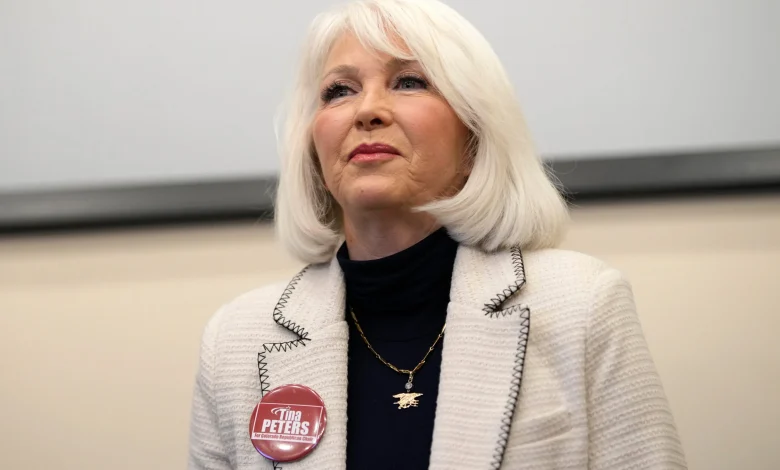
FILE – Candidate Tina Peters speaks during a debate for the state leadership position, Feb. 25, 2023, in Hudson, Colo. (AP Photo/David Zalubowski, File)
President Donald Trump claimed Thursday that he has issued a “full pardon” to Tina Peters — the Colorado election denier serving a nine-year state sentence — even though presidents have no constitutional authority to pardon state-level crimes.
Although the “pardon” is legally unenforceable, the announcement immediately heightens concerns about Trump’s ongoing attempts to override state sovereignty and intervene in criminal cases involving political allies.
“Today I am granting Tina a full Pardon for her attempts to expose Voter Fraud in the Rigged 2020 Presidential Election!” Trump declared on Truth Social. “Democrats have been relentless in their targeting of TINA PETERS, a Patriot who simply wanted to make sure that our Elections were Fair and Honest. Tina is sitting in a Colorado prison for the ‘crime’ of demanding Honest Elections.”
But under the Constitution, presidential clemency powers extend only to federal offenses — not state convictions like Peters’ — rendering Trump’s proclamation legally meaningless.
Peters, the former Mesa County clerk, was convicted last year in Colorado court for facilitating a breach of the state’s election equipment. Prosecutors said she allowed unauthorized individuals to access sensitive voting-machine software during a 2021 update, helped copy and circulate confidential election data and then misled investigators as the scheme unraveled. The data later appeared in fringe circles promoting Trump’s “Big Lie.”
Because Peters was prosecuted under Colorado law, only Colorado Gov. Jared Polis (D) has the authority to grant clemency.
“Tina Peters was convicted by a jury of her peers for state crimes in a state Court,” Colorado Secretary of State Jena Griswold (D) said in a statement following Trump’s declaration. “Trump has no constitutional authority to pardon her. His assault is not just on our democracy, but on states’ rights and the American constitution.”
The episode also comes on the heels of a sudden and unusual civil rights investigation into Colorado’s prison system launched by Trump’s Justice Department earlier this week. The probe — the administration’s first statewide civil rights review of any correctional system — will examine whether Colorado’s Department of Corrections and youth facilities are violating the constitutional rights of people in custody.
Assistant Attorney General Harmeet Dhillon framed the move as a response to “multiple reports of unconstitutional and legally insufficient carceral conditions.” The DOJ has not identified Peters as a factor in the probe, but the timing prompted concerns from civil rights advocates about federal pressure on state criminal processes.
Last month, Trump proclaimed he “pardoned” prominent figures tied to efforts to overturn the 2020 election, including former Trump lawyer Rudy Giuliani, former chief of staff Mark Meadows and dozens of others associated with the so-called fake electors scheme. Although the pardons were presented as sweeping clemency for election deniers, they applied only to federal matters and could not erase pending state cases, underscoring that presidential pardons do not reach state convictions like those against Peters.
For now, Trump’s assertion that Peters has been pardoned remains symbolic — a political rallying cry rather than a sincere legal act. But it underscores an escalating campaign to challenge state authority over its own criminal justice system, raising fresh questions about how far a second Trump administration is willing to go to shield political allies from accountability.