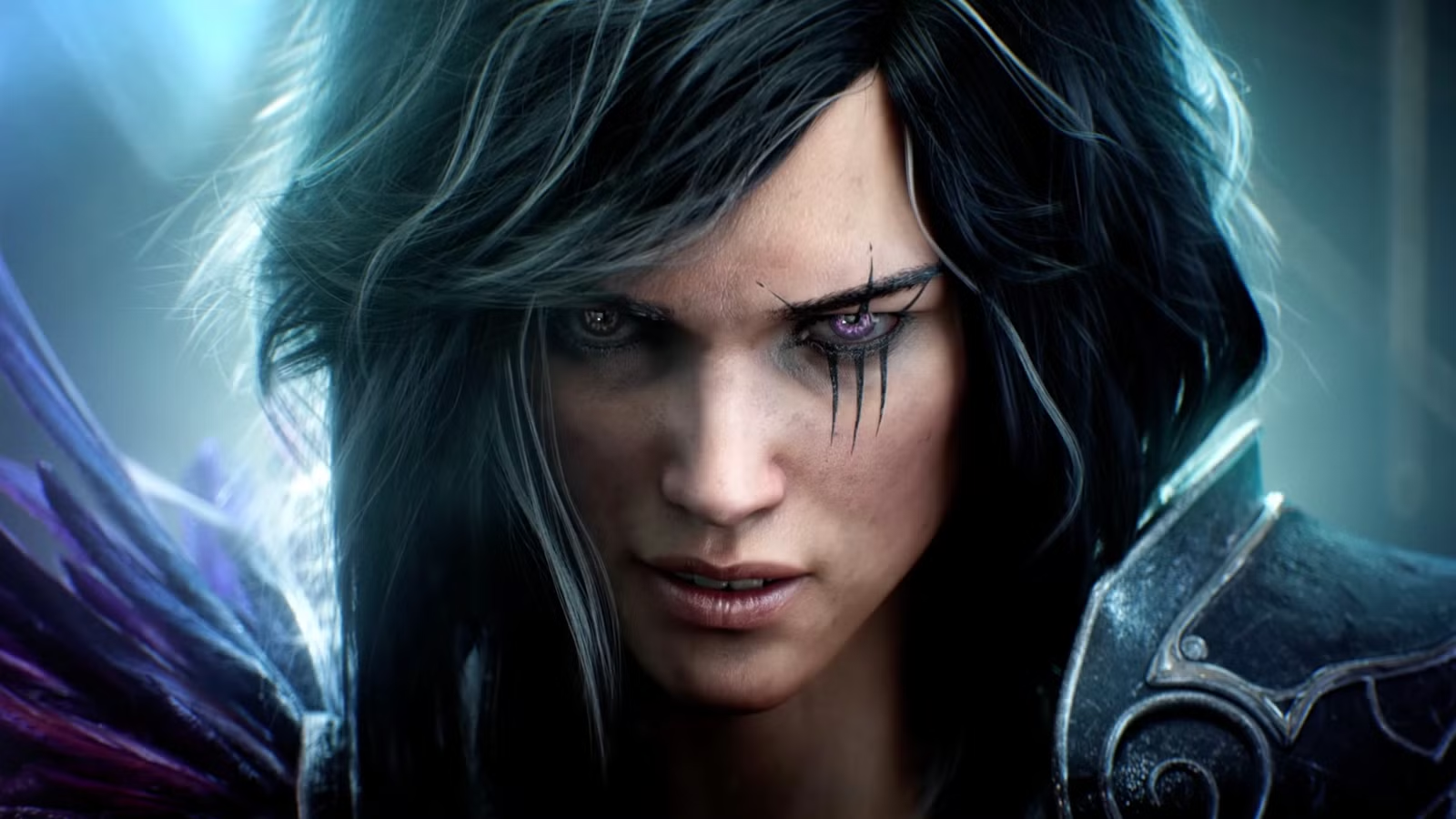
Can Wizards of the Coast turn Dungeons & Dragons into Star Wars, a singular universe where countless stories in countless genres can be told? Based on the number of in-the-works video games based on its tabletop property, there’s clearly a hope. Warlock: Dungeons & Dragons, revealed during the 2025 Game Awards, adds to the possibilities.
After the massive success of Baldur’s Gate 3 and a steady pipeline of reissues, the stage appears set for a wave of new games that depart from the obvious turn-based roleplaying formula. Wizards announced a new game from Jedi: Survivor director Stig Asmussen earlier this summer, and now there’s Warlock, from the in-house Invoke Studios. The Game Awards trailer introduces Kaatri (played by Battlestar Galactica’s Tricia Helfer), an original character and ex-weapons master who’s unlocked supernatural powers. The teaser features a brooding tone, a swarm of monsters — including a Death Kiss — and Tool’s “Forty Six & 2” thrumming underneath it all. But it was light on details; Invoke promises to show gameplay in 2026, with a planned 2027 launch.
So what is Warlock actually about? Ahead of The Game Awards reveal, Polygon sat down with Jeff Hattem, VP of creative at Invoke, to pull back the curtain on what the team is building, why it centers on a warlock, and how lessons from his previous D&D title, the polarizing Dark Alliance, are shaping this new adventure.
From Dark Alliance to awarlock’s more singular gameplay experience
Invoke Studios itself is relatively new but far from inexperienced. The Montreal-based developer is built from the team formerly known as Tuque Games, founded in 2012 and acquired by Wizards of the Coast as part of the publisher’s growing investment in AAA game development. The studio has grown to roughly 180 people, Hattem says, many of whom have spent years making action-adventure titles together. “That’s kind of in the DNA of the studio and our expertise,” Hattem says. “So we felt like taking the [D&D] brand into that space was a great way to make a quality game with our skillset.”
Their previous project, 2021’s Dungeons & Dragons: Dark Alliance, was pitched as a spiritual successor to the early-2000s Baldur’s Gate: Dark Alliance games. But it ultimately shared little DNA with its predecessors, and players found its ambitions stretching further than its execution. Wizards delisted the game earlier this year, making it playable only offline for existing owners — a short epilogue for a big swing.
With Warlock, Hattem emphasizes a much sharper focus from both gameplay and story. Instead of evoking the sprawling, improvisational freedom of a TTRPG, Invoke is honing in on a single-class fantasy and a brand new character. “If we try to do too much of what D&D can offer, then we get scattershot,” he says. “Focus is always something to strive for and being really on a clear vision for what we want to build […] it really is about finding the fun of what is specific to your game.”
You can only play as a warlock — but the magic systems will be everything
So why a warlock? For Hattem, the answer comes from decades of fascination. “In D&D, warlocks have a really high charisma [stat],” he says. “That kind of person that walks into a room and everyone stops talking and pays attention. They’re able to convince some of the most powerful beings in the world to bestow magical powers on them. What kind of person is this? I wanted to take that and craft that experience of becoming a warlock.”
That question shaped Kaatri, the game’s protagonist. She’s an ex-warrior and weapons master whose presence draws on characters like Furiosa from Mad Max: Fury Road and Vanessa Ives from Penny Dreadful — the latter especially for her “strange and unnatural and not very clean magic.” Hattem jokes the game’s dark fantasy vibe is “a far cry from Gandalf in a pointy wizard hat.”
Invoke isn’t confirming the exact location of Warlock just yet, though Hattem says longtime D&D players “are going to recognize potentially the location [and] some of the characters.” Newcomers, meanwhile, won’t need decades of lore to follow Kaatri’s story. “Everything you need to know to play the game is going to be taught with the game,” he says.
Where Warlock diverges sharply from similar-sounding games is how it treats magic. As Hattem sees it, many action titles boil spellcasting down to colored projectiles or area-of-effect blasts. Invoke wants something more systemic — closer to the improvisational spirit of tabletop, but still within a handcrafted framework.
“There’s always a straightforward way to use these spells,” Hattem explains. “But what we’re asking players to do is to think creatively with the magic. There’s utility baked into all of these spells that they can use to solve environmental challenges, traverse the world, uncover secrets, and fight monsters in unconventional ways.” The team’s favorite moments in testing come when players combine spells experimentally and solve challenges their own way. That blend of structure and agency is how Invoke hopes to honor the tabletop heritage without chasing an impossible one-to-one adaptation.
Despite working under Wizards of the Coast, where many projects are cooking at once, Invoke is building Warlock with both autonomy and access. Hattem describes strong internal support and direct communication with the D&D team to ensure authenticity. “We’re very well-supported,” he says. “We have access to some of the best developers in the world… and at the same time we’re autonomous to craft inside this world of D&D.”
And…well, he’s really excited about that Death Kiss. What’s a D&D game without some sick monsters? “I’m anxious to kind of showcase what we’re working on there with that one!”
Warlock is currently in development for PC, PlayStation 5 and Xbox.