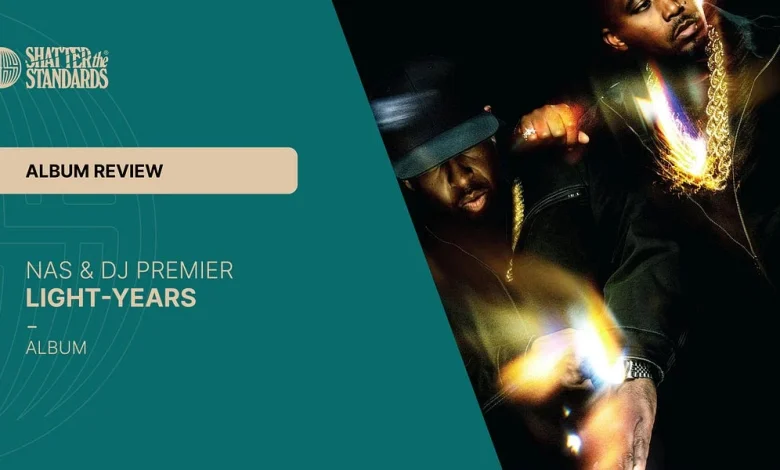
Courtesy of Mass Appeal.
“Already classic before you heard it/The spoiler was all my feature verses,” Nas announces early on “My Life Is Real,” and he’s right about the spoiler, if not the modesty. Everything Premier has built for him over three decades—the drums that feel carved from concrete and iron filings, the sample flips that locate grief inside soul records—has served as prelude to a record nobody was sure would actually exist. The project first got floated on the cover of Scratch magazine in January 2006. It resurfaced in 2011 as rumor. In 2022, Nas winked about it on “30.” Then came “Define My Name” in April 2024 for Illmatic‘s thirtieth anniversary. Now, closing out Mass Appeal’s Legend Has It… series alongside Ghostface, Raekwon, Mobb Deep, De La Soul, Big L, and Slick Rick, Light-Years arrives not as an artifact but as an interrogation: what happens when a rapper who openly measures his career in decades builds a record about the pressure of time itself?
The answer is a project that refuses nostalgia while being completely consumed by the question of what stays and what vanishes. Nas doesn’t chase the ‘90s, despite others wanting him and Preem to chase the sound of Livin’ Proof or Moment of Truth. He doesn’t need to. But he does ask, over and over, what it means to still carry the bridge when half the men who walked it with you are dead or gone. The album’s opening track invokes the departed—“Rest in peace, Polo, he see us” and “Big up Big L, Prodigy, Trugoy, they live/Martyrs, if you will”—then locates the living in a present-tense scramble of achievement and damage: “PTSD, project trauma still dwells/Happiness gotta be in you, money can’t help.” This is the tension that runs through all fifteen songs. Nas is rich, secured, globally celebrated, and also still walking through rooms where the walls remember what he came from.
Premier’s production strategy is unusually restrained for a record this long. He doesn’t flood the tracks with dense samples. Instead, he gives Nas space—but a variety of sounds with long pockets of air between the snares where every rhyme has to carry weight. On “N.Y. State of Mind Pt. 3,” he loops Billy Joel’s original “New York State of Mind” as a chassis device, then lets Nas load the verses with contemporary inventory: “Steel toe construct’ walk, Nike shorts at night it caught/Stress’ll cut your life short.” The Billy Joel chop operates as a counterpoint rather than a celebration. Where the piano man romanticized the city as return, Nas treats it as an endurance test, rattling off Rikers, MDC, Michelin-star restaurants, and chopped cheese in the same breath, insisting the streets are “cooking that beef stew” regardless of what condos developers keep stacking on former devil’s playgrounds.
The city as moral infrastructure shows up everywhere. “GiT Ready” places him “corner of 10th street” with VVS arm freezes and VSOP trees, but also in crypto boardrooms and Cabo silk, flipping “Ether to Ethereum” like the wordplay is proof of concept for a life lived between hustles. When Nas talks money on this record—and he talks money constantly—he doesn’t pretend it resolves anything. “From quantum computing to biotech ‘cause it’s life improvin’/Degradable plastic trash removin’/And when the market is down, it’s like a hustle when no coke is around.” The comparison is deliberate. He positions portfolio diversification as street logic repackaged, palms itching the same way they did when opportunity meant a different kind of risk. It’s self-mythologizing, sure, but it’s honest about what kind of self gets mythologized who learned patience and violence in the same hallway.
Where the record gains real texture is in the songs about authorship and permanence—craft memory made material. “Pause Tapes” traces the origin of his production instincts to his mother’s hall closet, digging through Johnny Taylor records and Grover Washington LPs, dropping the needle and pressing record-pause-restart to loop four bars on a ninety-minute tape until something resembling a beat emerged. “Record, loop, repeat/Do that ‘bout twenty times, yo, I made my first beat.” The detail is specific enough to trust. He mentions the Ron G cassette in the deck, the spray of something to hide the aroma, the fiend-needle memory of childhood where kids played with dope paraphernalia the way suburbs played with marbles. Nas isn’t explaining his credentials. He’s locating the moment when making became survival, when the loop became the way out.
“Writers” extends that impulse into cataloguing everyone who put their name on the city before the city erased them. The track opens personal—“Writin’ my name in graffiti/Yes indeedy, I wrote graffiti/I’m hard to read like graffiti”—then expands into a densely packed roll call of bombers and taggers, from Taki 183 to Lady Pink to Cost and Revs. What could scan as trivia parade becomes something else when you hear what Nas is actually saying about documentation: “So let’s salute the highly gifted Krylon mystics/This is homage to the ghetto hieroglyphics.” The graffiti writers and the rappers share an impulse. They mark surfaces that will be buffed or demolished. They insist on presence against erasure. The mic, he says, is a marker, and he’s tagging up names—not just citing them but committing them to the record before they disappear entirely. Henry Chalfant’s Style Wars gets a shoutout because it did the same thing with film.
AZ appears on “My Story Your Story,” and the chemistry is still there, still easy, the two of them trading street memoir and grown-man exhaustion like they’re back on the “Life’s a Bitch” session, despite the slow bounce of the production. “Fuck a orgy, touch her face, two mouths kissin’ on me/Fuck off me, can’t fuck ‘em all, that’s too costly.” The language slides between hedonism and discipline, pleasure acknowledged then bracketed. AZ’s voice remains the perfect foil—smoother, less jagged, balancing Nas’s density with glide. When the track breaks into an interlude, the two of them talk over the beat: “This feel like Delancey Street, this feel like Albee Square Mall… This is 2030 right now.”
“Bouquet (To the Ladies)” risks collapsing into list-poem territory—Nas namechecks everyone from Sha-Rock to Sexyy Red, from Queen Latifah to Ice Spice—but what keeps it grounded is the structural argument underneath the tribute. “What would the world be without beautiful, powerful women?/The Meemaws, the grandmas, the nation buildin’.” He thanks Faith Newman, the A&R who signed him to Columbia in 1991 and co-executive produced Illmatic, because she “created a movement.” It’s not empty applause. It’s an attempt to credit the labor that made his career possible—something the genre has historically undervalued.
The record’s most revealing self-portrait might be “Junkie,” which casts Nas’s relationship to hip-hop as addiction. “Bruh, I’m supposed to big kick this habit/Done with it, had my fun with it/Hard to let it go, how could you when you in love with it?” He describes needing the music every morning, playing it loud while ironing his outfit, zoning out in his car. He can’t function on Suboxone—the substitutes don’t work. He describes sitting in a circle at treatment: “Hi, I’m a rapaholic, only been sober since my last installment/Need music with substance, so it’s abuse they call it.” The metaphor could be cute, but he pushes past cuteness into genuine confession. The dependence isn’t only on making music. It’s on a specific kind of music—gritty, raw, intense, the kind that “keeps calling me” and stays in his arteries. Premier responds with drums that pulse like circulatory pressure.
A prequel to “Daughters,” “Sons (Young Kings)” tries to distill what fatherhood has taught him, and here the writing gets more vulnerable than Nas usually allows. “One day the words may come out the mouth of a reverend/By the power vested in me,’ loud at his wedding/Give flowers while you can smell them, I try to tell him.” The address to young Black boys expands from his own son to a generational plea: stand tall, know you’re glorious, don’t let the world shrink you. It’s direct without being corny, which is harder than it sounds. And then he pivots to autobiography—remembering the crossing sign he used to look at as a child, a silhouette of a grown-up holding a smaller figure’s arm. “I saw it as a little boy who was the baddest, like don’t let ‘im run in traffic.” He thought the sign was specifically about him and his mom. He was wrong, but the wrongness is the point. That’s how childhood works. You assume you’re the center because the alternative is terror.
Picking up the pieces from Stillmatic, “3rd Childhood” closes the record with an argument about aging in a form that treats age as disqualification. “Is it time to take off the scully, the Timbs, and the fitted caps?/Time to let go of the weed, can’t let the jeans sag?/Ozzy Osbourne still got his fingernails black / Rock ‘n rollers is still rebels, any age that they at/But with rap, it’s a time limit? Never.” He names Rastas still smoking in seclusion, pimps still wearing derbies, old men rocking their hats ace-deuce. Continuity isn’t embarrassment. It’s fidelity to origin. He returns to Queensbridge—“Resurrect through the birth of my seed”—and claims the bridge as permanent address. “Hope we get dessert, that’s the cherry on top/Peaceful Sundays, but we still carry the Glocks registered.” Even the guns are legal now, which might be the most middle-aged line on the whole project.
The production never oversells its own importance. Premier scratches and cuts with the fluency of someone who invented the grammar, but he doesn’t showboat after years of onslaught of criticism. The beats serve the writing. The drums hit hard without overwhelming the voice. He leaves room for Nas to stack clauses and shift registers, moving from street reportage to tech-mogul flexing to father’s-blessing softness, sometimes within a single verse. That flexibility is the album’s primary achievement. Nas can be arrogant, tender, paranoid, grateful, and profane across the same sixteen bars, and Premier’s production accommodates all of it without flattening the contradictions, but do not expect the rehash of what you’re expecting.
The record isn’t perfect. Some of the mogul bars land with less force the second or third time—the crypto talk, the Maybach descriptions, the multiple variations on “I’m still the illest.” But even the repetition serves a function. Nas is reassuring himself as much as the listener. He’s saying these things because he needs to keep saying them, because stopping would mean conceding ground. As mentioned about Preem’s production, there are a select few that would’ve benefited from sonics and drums, but at least they hit better than “Prayer Hands.”
“Nasty Esco Nasir” stages an internal argument between three selves—the street persona who robs you, the CEO who whispers in your ear about not caring, and the man who signs his birth certificate Nasir. “My name is not as common as Muhammad or as popular/Or as praiseworthy, so I adopted a moniker/I’m Nasty Nas, I was destined to be here/In Grandmaster Caz’s atmosphere, to breathe/Kool Moe Dee’s air.” The genealogy is explicit. He positions himself as an inheritor and continuer.
“Phase four, the fourth dimension
The legacy’s here, and other things I won’t mention
I’m winning when I’m not even trending
Trailblazing, the message I’m sending.” — Nas on “Nasty Esco Nasir”
Light-Years doesn’t pretend the wait was worth it in some cosmic sense. The album simply exists, finally, twenty years late and completely aware of its own belatedness. Nas is 52. Premier is 58. They made a record that sounds like they meant it, and they didn’t soften the edges or chase relevance. Whether that’s triumph or stubbornness probably depends on what you came for. “I’m my great-great-grandfather’s dream,” Nas says on “Junkie.” “One thing when you make yourself too accessible/Some could lose respect and think less of you.” He’s talking about the music industry, but he’s also talking about survival. You don’t get to fifty-two in this game without understanding when to withhold.
Great (★★★★☆)
Favorite Track(s): “Pause Tapes,” “Writers,” “Junkie”