The Stephen King novel The Running Man has had movie adaptations in 1987 and 2025. Let’s see why the new film is better than the original!
When remaking the classics, there’s always the question, “Why bother?” The new attempt is almost never better than the original. But in the case of 1987’s The Running Man, my response is, “Really? That’s a classic?” Make no mistake; this movie adaptation of the Stephen King novel, directed by Paul Michael Glaser, is a staple of the 1980s and Arnold Schwarzenegger’s career. On its own, it’s an okay action flick that ticks off all the boxes of watchability, but that’s as far as I’d go. Luckily, in 2025, a new Running Man was released that, as far as I’m concerned, easily is better than the original.
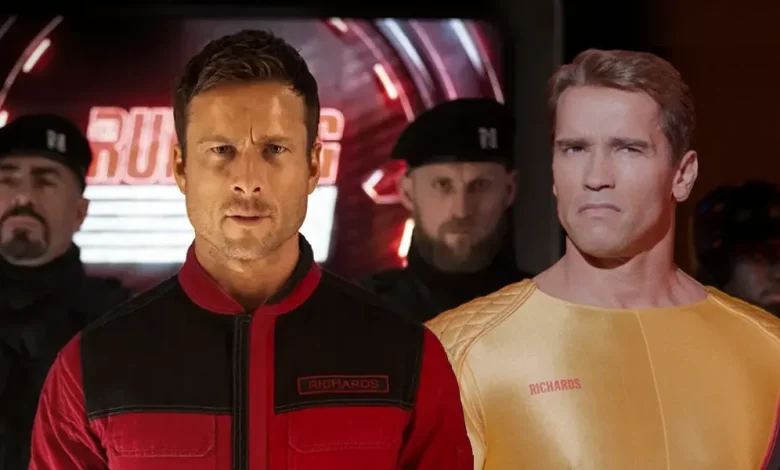
In the Glaser film, Ben Richards (Schwarzenegger) is a military captain in a dystopian future who’s arrested for refusing to fire on innocents. He’s then forced to play the life-or-death game show The Running Man with a pair of resistance fighters and ousted broadcast worker Amber Mendez (María Conchita Alonso), hosted and run by Damon Killian (Richard Dawson). In the new Running Man, directed by Edgar Wright, Ben Richards (Glen Powell, Top Gun: Maverick) is a working man in a similarly dour future, who signs up for the titular game to earn money for his struggling family at the insistence of Killian (Josh Brolin, Weapons).
Though Wright’s retelling isn’t perfect itself, it has so much more of the bite, brain, and overall impact that I’d expect from this base idea. Why? Let’s find out. And just to be safe, we’ll keep everything spoiler-free aside from the penultimate section, which will begin with a clear spoiler warning. All that said, here’s why the new Running Man is better than the original!
How the Protagonist Differs in the Running Man Films
Why the New Running Man movie is Better Than the Original – Glen Powell in a still from the film (Ross Ferguson, © 2025 Paramount Pictures)
Famously, the 1987 Running Man makes major deviations from the book, right down to who Ben Richards is. Schwarzenegger’s character definitely gets our sympathy by refusing to use his power position wrongly, losing that power, and being tricked into participating in The Running Man (believing he’s taking the place of the resistance fighters). It’s “technically” his choice to play, but he only has to make it after his whole life is shattered, so you could argue he has less control and is therefore easier to root for.
Ben in the 2025 version, on the other hand, chooses to play the game completely of his own free will. And while Arnold’s Ben gets points for wanting to save his friends, he can’t compete with Powell’s Ben wanting to save his sick, dying infant child. Yet he’s fully aware that he likely won’t even survive the game, which would leave his wife to raise their child alone in a harsh environment. It’s a somewhat greyer situation with higher stakes that makes you think about Ben with more uncertainty, which makes the story a lot more interesting.
In terms of characterization, Ben in the new Running Man is a gruff person with a good heart but an increasingly angry, hostile outlook on the world. He’s blacklisted from the workforce for stepping out of line and partaking in union activism, and he lashes out at every bit of opposition sent his way. In that sense, he’s bringing a lot upon himself. But you also see how much the oppressive and corrupt future is beating him down while he refuses to become one of its cold, self-serving monsters. Again, the viewer’s outlook on him can vary.
In the 1987 original, Ben is a more straightforward good guy. His one questionable act is taking Amber hostage to escape his pursuers, and he initially values his own survival over taking a bigger, rebellious stance. But there are otherwise few ethical dilemmas sent his way. We don’t even know what his life is like before he’s imprisoned, so we don’t quite know how much he risks losing. As for Arnold’s performance… It’s an Arnold performance. He’s got the endearingly awkward delivery, the one-liners, and a few angry moments to break up his stoic nature.
Even by Arnold standards, other films like Total Recall and Predator spin his unique presence into something more charismatic. He feels more default here; not awful, but nothing special. The only reason you believe Killian would want this guy on The Running Man is that he’s been framed for killing civilians and is therefore satisfying to root against.
In the 2025 film, not only is Glen Powell’s performance laced with white-knuckled aggression and rugged charm, but his intense, furious, yet well-meaning drive makes him even more ideal and exploitable for Killian. I see what he sees here, as Powell’s version just has a lot more to him.
How the Story Differs In The Running Man Films
Why the New Running Man movie is Better Than the Original – Arnold Schwarzenegger in the 1987 film (TriStar Pictures)
In the 1987 film, Running Man participants are sent to an abandoned industrial zone to run through a gauntlet, hunted by various “stalkers.” The 2025 film sticks to the book’s version: participants are free to roam the world, but they must survive 30 days as they’re pursued by the show’s hunters. Even normal civilians are incentivized to track down and report players for a cash prize of their own, meaning Ben can never let his guard down. Do I even need to explain why that’s more fun to watch?
There’s some fun you can have with the gladiatorial combat in the original movie, with Schwarzenegger fighting colorful bad guys while working to rig the game and expose the lies told about him. But it’s mostly the same song-and-dance in the same uninteresting ruined location. Shakeups like fist fights, a car chase, and weapons like chainsaws and lightning bolts keep you from getting bored, but Wright’s version offers much more variety when it comes to settings, tension, and challenges to overcome.
In the new movie, Ben sometimes needs to don a humorous disguise, discern who is and isn’t trustworthy, climb across building ledges, jump out of speeding cars, sneak past hunters, get dirty in the sewers, and even fight in an airplane. And through it all, we see that he’s resourceful enough to get the drop on goons, but he’s not immune to screwing up royally. He’ll leave mountains of destruction in his wake, but he’ll also give those he puts in harm’s way the chance to back out. He’ll troll and mug to the audience, but he’ll also try to genuinely win them over when he’s at his wit’s end.
With all this variety, you’d think the new film would risk underserving each of its set pieces. But it compensates by being half an hour longer than the original, which gives everything more time to stick with you. Yet despite that, 2025’s The Running Man remains one of the fastest-paced movies I’ve seen in years, flying by much faster than the original ever has for me. But it gets across so much detail in so little time that very little feels rushed.
Every sequence in the Wright movie adds something to Ben’s outlook on the entire situation, whether it’s knowledge of how the game works, an attachment to the cause of rebellion, or an opening to set up his endgame. The original is much simpler, but its characters and world aren’t nearly as developed despite theoretically having more room to breathe, so that simplicity doesn’t pay off like you’d think. And it definitely doesn’t convey any urgency in a game called The Running Man.
The Supporting Characters of The Running Man Movies
Why the New Running Man movie is Better Than the Original – Colman Domingo in a still from the film (Ross Ferguson, © 2025 Paramount Pictures)
In both versions of The Running Man, the biggest standout supporting character is Killian. In the book, Killian is the show’s producer while Bobby T. is the host, but the 1987 film combines these characters into one. This is one of the few changes I understand, especially since Richard Dawson is hands-down the best part of the Glaser movie. It’s so entertaining to see the classic Family Feud host play such a transparently vile scumbag with the exact same mannerisms as the real Dawson. Except here, he’s allowed to go over-the-top in riling up the raucous Running Man audience, twisting everything that goes wrong into a reason to keep cheering and jeering.
Wright’s movie keeps Bobby T., played by Colman Domingo (The Color Purple) in a performance that’s equally infectious but much edgier. He doesn’t just get the crowd excited; he gets them pissed off, knowing that anger is as important as joy. As Killian proper, Brolin excellently embraces the character’s manipulative nature who loves seeing Richards hateful if it gets more ratings. His way of getting “sincere” with Ben to keep him in his pocket is so convincing that even you’ll start wondering how much he really means. So, while Dawson’s Killian is the most memorable of these three characters, Domingo and Brolin cumulatively match him.
As for Ben’s allies, the two resistance members in Glaser’s version have almost no personality, depth, or presence. Amber fares a lot better as a no-nonsense person whose cushy life is destroyed, going from being Ben’s enemy to his fellow fighter and – because they share an obligatory kiss – lover. But even she’s nothing too special, and Alonso’s somewhat stiff performance doesn’t do her many favors. The two resistance members Ben meets in the new Running Man are normal citizens, played by Michael Cera (The Phoenician Scheme) and Daniel Ezra (A Discovery of Witches) . Neither are in the movie for long, but they each give Ben a better understanding of what he’s up against, and their performances are uniquely heartfelt despite them being written as generic “fight the power” civilians.
Amber’s closest equivalent in the 2025 film is Amelia (Emilia Jones, CODA), a citizen whom Richards carjacks in the third act. She’s initially privileged and ignorant but winds up helping Ben after realizing how bad he has it. This is where the film does feel rushed, as I don’t buy that she would make the bold choices she does after so little time with Ben. But her arc is still decent, boosted by Jones’s performance. And she’s far more involved than Ben’s wife Sheila (Jayme Lawson, Sinners), who has two early scenes and then disappears until the ending. Considering she’s so pivotal to Ben’s motivation, that’s a letdown. But her scenes are acted and written well enough to convey her love and turmoil, and they still give more insight into Ben’s personal life than anything in the Glaser film.
Unlike the heroes, the hunters have way more of an identity in the 1987 movie. They’re big, loud, gleeful thugs brandishing outlandish weapons like chainsaws, flamethrowers, electricity, and – I’m not kidding – killer hockey pucks. The new version’s hunters are your very basic goons whose faces I can’t even remember. Except, ironically, the one whose face is mostly concealed: the hunters’ leader (Lee Pace, The Hobbit: An Unexpected Journey). You eventually learn that he’s much more of a foil to Ben than what’s initially shown. He’s fully aware of where he stands in The Running Man’s endless cycle, but he’s desperate to be the best he can be within that entrapment.
All in all, neither movie handles the supporting “good guys” remarkably well, but there’s more to say about them and their roles in the 2025 film on average. The original’s baddies are more fun as gimmicks, but Pace’s character alone tips the scales in the retelling’s favor.
The Worldbuilding of The Running Man Movies
Why the New Running Man movie is Better Than the Original – A still from the film (Ross Ferguson, © 2025 Paramount Pictures)
I can somewhat understand finding the original Running Man better than the new one as a whole, but I see no way its worldbuilding could compete without the thickest pair of nostalgia goggles. The 1987 film gives us a look at bits and pieces of its world, including a military prison, a community of homeless people, and Amber’s high-end apartment. That’s all a fine start, but what about average, everyday life? What’s the world like in general? From what little we end up seeing, like an airport or outside the Running Man building, it looks pretty normal, hard to even distinguish as part of an impoverished sci-fi future. We’re told about how bad things are more than we’re shown.
Meanwhile, the new movie’s opening alone shows you almost everything you’d want to know about its future. The first scene between Ben and Sheila indicates that something as basic as flu medication is out of reach for working-class families, and even socks take effort to acquire. Ben then walks through the slums of his city, where people in hoods are lining up around the corner of a non-branded drug store. Everything looks run-down but still functional, which clashes with the sleeker, cleaner, more spacious network district.
We know that safety regulations are worse, hence why Ben is in the position he is. He gets into physical altercations that would have him arrested in our time but instead get him sent to the back of a line at worst. Hell, he’s invited inside the network building after punching a window at the front booth. This all says to me that violence in the future is not only more common, but more accepted.
Throughout the rest of the movie, every location generally looks like our reality, but with stylistic flourishes and bits of unreal technology that show the passage of time, which itself could just as easily be ten years or fifty years from 2025. We know what highways, low-income housing, high-income apparel, wild spaces, Vegas-style casino towns, and legacy cities look like in this future because they’re shown to us. Even unknown details, like how “New Dollars” differ from our dollars, help the matter-of-fact immersion. And what isn’t visually shown is explained through natural dialogue these characters would say in their regular lives.
I think people really underestimate how big a difference this all makes. While Ben’s resolution to fight the power is understandable in the original film, it doesn’t resonate strongly because we only briefly see what he’s fighting for. He’s so isolated from the rest of the world that it often doesn’t feel like he’s part of it, and we don’t feel what it means to be a part of it. But with Ben in the new film, his eventual drive to join the resistance is more powerful because we see and feel him living in this hellscape, finding others everywhere in the same situation, and finally having enough of it all. It boils down to the golden rule of filmmaking: show, don’t tell.
The Action and Tone of The Running Man Movies
Why the New Running Man movie is Better Than the Original – A still from the 1987 film (TriStar Pictures)
You’d think this would be a real battle of the titans: an 80s Schwarzenegger movie versus an Edgar Wright movie. But surprisingly, the original Running Man doesn’t even have great action going for it. The setups are pretty good, including a prison break, an airport chase, and obviously the death arena with freakish killers. But the creativity is surprisingly low. The stalkers make pretty minimal use of their crazy weapons before they’re taken out, and most of the other action is the kind of running and/or shooting you can see elsewhere.
I could forgive this simplicity if it was shot in an eye-pleasing way, but Thomas Del Ruth’s cinematography goes for a very standard point-and-shoot approach. It keeps you in close quarters without capturing the rush of actually being there, shots often don’t have the exact right flow to maintain momentum, and there’s not that much of the grisliness or excess that you’d want from the film’s R rating. The filmmaking is never confusing or sloppy, but it rarely elevates any of the material.
Like all of Wright’s movies, the action in the new Running Man bursts with a kinetic thrust that never lets up no matter the setting. A crappy apartment may not sound as cool as a dystopian wasteland, for instance, but you get a great sense of the confined space Ben has to work with, and cinematographer Chung-hoon Chung’s camerawork weaves seamlessly between slow-building and explosive encounters.
Later, you’re treated to a home invasion filled with traps that would make Kevin McCallister swoon, and then a car chase that’s claustrophobically captured through the perspective of a helpless, trunk-stashed Ben. Even his final confrontation with Pace’s character is oozing with more bloody grit and nail-biting choreography than anything in the original. The new Running Man not only has a lot more going on, but it visually captures and edits together those extra moving parts with perfect fluidity and focus.
Each version of The Running Man has a very different tone as well. While they both incorporate humor and satire, the original wears its camp a lot more on its sleeve. Aside from the turmoil of its grim setting, it’s a mostly lighthearted affair, the kind that will pause its story to let The Running Man’s scantily clad dancers strut their stuff. The new Running Man is much dourer, angrier, and insistently urgent. Steven Price’s score mixes tinges of synthy sheen with an industrialized, persistent thrust of desperation. You’re meant to feel the desolation that surrounds Ben at every corner, like the film is furiously yelling how bad things will be if we let this future happen.
But Wright still incorporates his usual quick-witted, satirical dialogue. Even at a character’s lowest point, a biting jab or bit of harsh slapstick may be there to complement it. A lot of people found these tones to not mesh well, but they work for the same reason the humorous banter in fellow King adaptation The Long Walk works. The levity doesn’t take away from the darkness; it’s more of a means to cope and smile through the pain. Except instead of the characters in the movie doing that, the movie itself is.
The Endings of The Running Man Movies
Why the New Running Man movie is Better Than the Original – Emilia Jones in a still from the film (Ross Ferguson, © 2025 Paramount Pictures)
This is where we talk at length about how these movies end, so spoilers will be present throughout this section until the final paragraph. Especially since, for once, both movies deviate from the book. In the original, after stalker Captain Freedom (Jesse Ventura, Predator) refuses to take out Ben if not on his terms, the network fakes Ben’s death at Freedom’s hands. But Ben joins the resistance, the real footage of his arrest is shown to the world, and his team storms the studio and takes out Killian.
In the retelling, Ben and Amelia have bluffed their way onto a network-controlled plane, where Killian fakes the deaths of Ben’s family to push him down a revenge path to being the show’s next hunter. When Ben refuses, Killian steers the plane into network headquarters, but Ben fakes his own death by ejecting himself from the plane. He reunites with his family, the truth is leaked to the public, and Ben leads an attack on the studio in which he murders Killian.
Though their climaxes have some parallels, the original Running Man’s is much more straightforward and coherent. All the complications are over, leaving only the big finish that gives you what you’ve been waiting for. The 2025 climax rapid-fires through so many changing plans and deceptive maneuvering that it becomes hard to even see straight. To me, though, that’s what makes it more fun. It’s the explosive pinnacle of chaos that’s been building throughout the movie, where everyone fires off every physical and psychological weapon they have.
Where things get rougher for the retelling is its resolution. While both movies discard the book’s dark conclusion for a more triumphant ending, it feels more fitting and warranted with the Glaser film’s tone and attitude. Because the Wright film is so much harsher, and because Ben’s victory is so abrupt, the ending comes across like a cop-out to not have us leave the theater depressed. So, in terms of execution, I’d actually say the original handles its ending better. However, the new film’s ending still works overall, for a couple of reasons.
For starters, the new Running Man pulls the same trick on us that Ben pulls on the network and world. We’re led to believe his journey will end grimly, only to be thrown way off. In a meta sense, that’s a fun little bit of trolling. The broader issue still remains that a “happy ending” is safer and less believable, but even that’s a little questionable. The resistance’s closing attack may give Ben the last laugh, but the film’s bitter tone is still there even as he pulls the trigger on Killian. There’s an underlying sense that this is just the start of a longer, more gruesome conflict.
Has Ben won the war, or just the battle? If this is the start of a war, is he doing the right thing, or will his actions tear him down like the rest of the good he tried to do? You could possibly say this about the original too, but the uncertainty is much more pronounced in the new one. I still think the 1987 ending is easier to appreciate and has fewer flaws, but I’d in no way say the new ending is bad or does much harm to the film as a whole.
The New Running Man is The Overall Better Movie
Despite an uneven ending, 2025’s version of The Running Man still completely outshines the original. Whether you value accuracy to King’s story or just look at the films on their own, Edgar Wright’s iteration gives us a more engaging group of characters, a more thrilling story, a richer and darker world, better action, and more wiggle room for you to take away something unique. Both films can obviously coexist and be enjoyed for what they are. But if you ask me which one is better, I’d say it’s incredibly clear that the new one runs away with the win.
The Running Man (2025) will be available to watch on digital and on demand from December 16, 2025.
The Running Man: Trailer (Paramount Pictures)