Imagine it, said Mark Rutte, secretary general of Nato, in his speech in Berlin: “A conflict reaching every home, every workplace; destruction, mass mobilisation, millions displaced, widespread suffering and extreme losses.”
Even allowing for his attempt to shock his audience to gain their attention, and even allowing for it being his job to persuade member nations to spend more on defence, his warning made me shudder.
He got the headlines he wanted with this sentence: “Russia has brought war back to Europe, and we must be prepared for the scale of war our grandparents or great-grandparents endured.” There cannot be many people who read those headlines or saw that clip on TV who were not alarmed.
“We are Russia’s next target, and we are already in harm’s way,” he said.
But is it true?
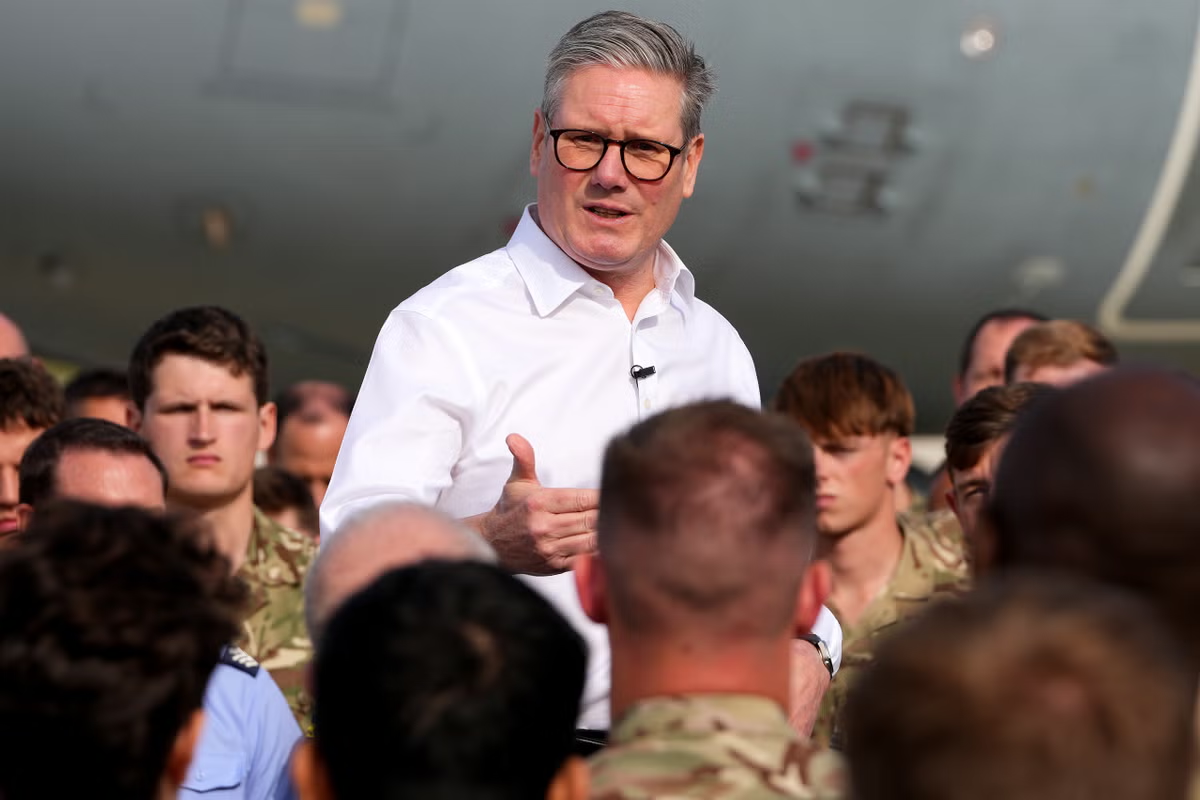
‘‘Is Keir Starmer like Stanley Baldwin or Neville Chamberlain? I don’t think he is like either of them’ (Kirsty Wigglesworth/PA Wire)
We know that Vladimir Putin wants the war in Ukraine to go on until he has subdued the entire country. We know, too, that this would not be the limit of his ambition for a greater Russia. We know that he regrets the break-up of the Soviet Union and sees the Baltic states, Belarus, Moldova, Georgia and all the other former Soviet republics as territory that should never have been “given up”.
And we know that he sees Nato as the enemy, an expansionist empire that threatens Russia – even if the reality is that this “threat” consists of the free peoples of central and eastern Europe choosing to be part of a defensive alliance. And even if his paranoid semi-mystical nationalism thinks of itself as defensive, we cannot be sure that he wouldn’t think that an aggressive war beyond the boundaries of the old USSR is the best form of defence.
Rutte’s speech was also chilling because he invoked our grandparents and great-grandparents. The debate about appeasement in the 1930s still has the power to move us – and the French, and the people of the smaller nations that were occupied in the Second World War, including Rutte’s Netherlands.
Is Keir Starmer like Stanley Baldwin or Neville Chamberlain? Baldwin refused to rearm because public opinion wouldn’t tolerate it. Chamberlain did rearm, but sought to negotiate with Hitler, partly to buy time but partly because he thought Hitler would stick to the deal.
I don’t think Starmer is like either of them. He has taken a leading role in the coalition of the willing in support of Ukraine, and whatever similarities Rutte is trying to scare us with, the situation is different. Starmer has been accused, specifically, of failing to increase defence spending by enough – and it was notable that Rachel Reeves in the Budget last month, having increased planned spending from 2.4 to 2.6 per cent of national income, announced no further increase towards the end of the five-year forecast period. But I will come back to the money in a moment.
Is British public opinion similar to that in 1933 when the Oxford Union voted that it “will under no circumstances fight for its King and country”? I don’t think so, even if I was surprised to hear Mark Dolan, a presenter on Talk TV, ask his audience if they were “prepared to fight to defend Starmer’s Britain”. Public opinion is strongly supportive of the Ukrainian people in resisting Putin’s aggression, and prepared to pay its share of the bill to help them do so, but few people want to send British forces to fight what is still seen as someone else’s war.
Rutte warned that it could become our war sooner than we think. But there are many reasons to doubt it, and even he, further into the speech, said only that “Russia could be ready to use military force against Nato within five years”.
Putin certainly seems to lack the capacity to launch a fast surprise assault, as we saw when that column of clapped-out tanks got stuck on the road to Kyiv in 2022, and in the war of attrition since.
So, on balance, I think Rutte is overdoing the Second World War comparison for effect. He is right that we need to be prepared in order to deter. And it is right that European nations should pay more for their own defence and America less.
But the UK is already one of the bigger Nato defence spenders. Perhaps Rutte’s message was aimed more at the laggards.
In the end, my view is that the best protection against a wider war in Europe is economic strength, or what might be seen as “potential defence spending”. Russia’s annual GDP, the size of its economy, is $2.5 trillion. The UK alone is £4 trillion. The UK plus the EU is $25 trillion, 10 times the size of the Russian economy.
That is not a war that Putin can win.