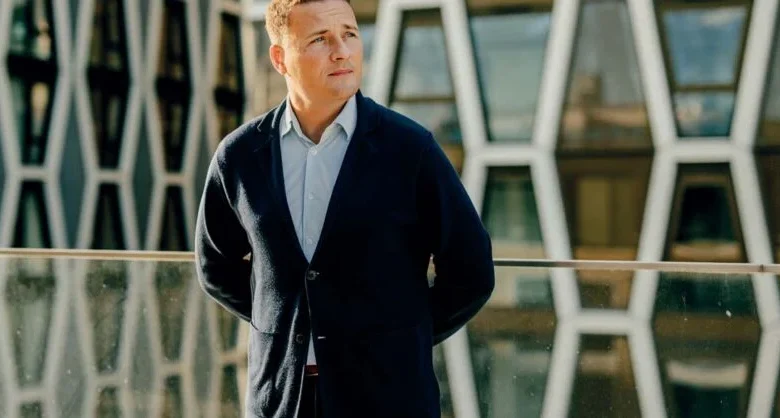
Photo by Peter Flude For The New Statesman
Wes Streeting is still finishing his Friday lunch when I walk into the café. He and his adviser are deep in conversation, their heads close together, when they meet my gaze and abruptly stop. I have arrived early, to get a table and prepare my thoughts. Streeting clearly had the same idea.
It is an awkward start. We make small talk as the Health Secretary polishes off his grilled chicken, rice, salad and halloumi; the staff here know his order. He comes to the same place every Friday, and returns with his partner, Joe Dancey, at the weekend. This is his home – the east London constituency of Ilford North, on the border with Essex. Suburban and diverse, it’s only half an hour from central London on the Tube, but it’s a different world to the Christmas soirées of Westminster where I have been bumping into him all week. Streeting is slightly less gregarious today than the showbiz, larger-than-life character who is often among the last to leave a party. He is fun, self-deprecating, quick-witted – but there’s a seriousness too. I get the sense during our conversation he is remembering the points he wants to hit: on the economy, on Nigel Farage, on where Labour is going wrong. This is someone thinking seriously about Labour’s predicament.
Our meeting takes place nearly a month after Streeting faced an attempted political assassination. In one of the worst weeks for Labour since entering office, Keir Starmer’s allies accused Streeting of an imminent plot to overthrow the Prime Minister. Their accusations landed the evening before Streeting was due to face TV and radio interviewers on the morning broadcast round. “It sort of came from the blue,” Streeting says. “I couldn’t understand what on Earth they were thinking. Putting to one side the attempted drive-by on me, I could not understand the political strategy of people who purport to be the Prime Minister’s allies going out and saying he’s fighting for his job.”
Streeting counter-attacked on TV and radio the next morning, denying the accusations with colourful references to Celebrity Traitors and taking swipes at a “toxic culture” in No 10. “He had them on toast,” one Labour MP joked of his performance. Streeting insists he’s barely given the incident another thought. “I’ve just sort of cracked on with the job since,” he shrugs. “It’s water off a duck’s back.” Sure.
Treat yourself or a friend this Christmas to a New Statesman subscription for just £2
The reality, laid bare by that messy week, is that Starmer is indeed fighting for his job and everyone knows it. Labour, languishing in the polls, is having a torrid time in office and a leadership contest is widely expected at some point in 2026. Privately, cabinet ministers barely pretend that the party isn’t in deep trouble. Over the course of our interview, Streeting doesn’t either. “I’m pretty frustrated, to be honest,” he tells me. “I feel like on one hand, since we’ve come into government, we’ve actually done a huge amount that we said we’d do… But that’s not reflected in the polls, and I don’t think it’s even reflected in our storytelling. I think we sell ourselves short.”
Labour is in danger of presenting itself as the “maintenance department for the country”, he says. “The problem with that kind of practical, technocratic approach is that if someone else comes along and says, ‘Well, I’ve got a maintenance company too, and mine’s cheaper,’ why wouldn’t people go, ‘OK, well, we’ll give that maintenance team a try’?” He doesn’t name Starmer, but the critique of the Prime Minister’s “practical, technocratic” leadership is clear.
Streeting has denied plotting against the Labour leader. But when we speak, he strikes me as someone planning for what may lie ahead. I meet a cabinet minister ranging beyond his brief, thinking seriously about what his party needs to do to win the next election – and beginning to outline an alternative to that “maintenance department” approach.
Streeting grew up in poverty in Stepney, east London. His mother, who was born in prison, had him at the age of 18. He remembers, aged seven or eight, watching her putting items back on the shelf at the supermarket because she couldn’t afford them. He had a fiver in his pocket that his grandfather had given him. “I could see she was really anxious about it. So I gave my mum my [the] £5 note… and she just burst into tears.” He pauses. “It’s quite a horrible position for a parent to be in where your kids are helping you pay for the shopping.” His mother “always made sure we didn’t go without”, often forgoing things herself to provide for him and his siblings. But his childhood was marked by visits to his maternal grandfather in prison, embarrassment at being on free school meals, cockroaches and an empty fridge at home. One winter, his mum left her partner the night before Christmas Eve, and they bundled into a car in search of somewhere to stay. They spent Christmas Day on a bleak, empty caravan site in Kent. His presents that year were a Star Trek mug and a satsuma.
“It’s no coincidence that in the cabinet, among the people pushing hard to abolish the two-child limit, were me and Bridget [Phillipson, the Education Secretary], because we have both lived through child poverty,” he says. “For all the ups and downs of recent months, lifting half a million children out of poverty by lifting the two-child limit is something I will always be proud of.” He is clear-eyed about the reality that it isn’t a politically popular move. But he says there’s not just a moral case for it but also a pragmatic one, of which he is proof: “Here I am as the living evidence of what happens when you invest in kids and give them a chance.”
Streeting was a gregarious, confident child, despite all that was going on at home. He jokes about donning a little tunic and a cardboard sword for his stage debut, starring in The Nutcracker at primary school, “swashbuckling with this kid in the year below”. The following year he played Scrooge in the Christmas play. At secondary school, he had high hopes for a major role again, and was cast as Tiny Tim. “I was quite pleased, because I’d obviously heard of the character… Except it turns out Tiny Tim only has two lines, and they are both the same: ‘God bless us, everyone.’ I was absolutely fuming.”
Streeting says he has “never really had” that “voice in the back of your head that says you’re not good enough”. Instead, his background has given him “a bit of a chip on my shoulder” and a determination to prove he can do anything the posher kids can. He visits schools in his constituency and tells the pupils “not to ever feel held back by their backgrounds or the conditions they’re living in”. He went into politics for them, “to make sure that children from backgrounds like mine have the same choices and chances in life as those from the most privileged backgrounds”.
With that determination, Streeting has risen and risen, from a high-performing state academy school, to Cambridge University, to the cabinet. He has a certain star quality. “He’s showbiz,” as one admirer put it to me recently. “He is far and away our best communicator,” said another. No one denies his strengths as a performer, but some colleagues dislike his politics, seeing him as too centrist. The question is whether Labour members would elect a leader from that tradition. If there is a leadership contest in 2026, opponents to his left say he is the wrong person to unite progressives in the way that will be needed to fight Farage.
He makes his counter-argument over the course of our conversation. Labour has “the right answers, because we have the right values”. The key is communicating those, he says, “so that people understand the choice that they face at the next general election”. This is his alternative to the “technocratic approach” he worries Labour is currently taking. On healthcare, he says the next election will not be about “who’s going to be more effective at cutting the waiting lists. This is going to be a question of who believes in a National Health Service and its fundamental values.” Only Labour believes in the core principle of care based on need rather than the ability to pay, he says.
“Labour performs at its best when we are a party of both the left and the centre,” he says, returning to the point again and again. “We’ve got to be a party that is about investing in public services, but also modernising public services so they change with the times and meet changing needs in our society.” Labour should champion attracting global talent and welcoming refugees, while also being “a party of strong borders”. It is unmistakeably Blairite, a “Third Way” vision. Now, as then, that involves difficult messages for his party.
Streeting strikes a similar note on the economy. Zack Polanski “would take us on a left-wing joy ride”; both he and Farage are “big risks to this country and to our economy”. In a swipe at Polanski that could be equally applied to Andy Burnham, Streeting says he has been “frustrated” by the way some people talk about markets as a “binary choice between helplessness and recklessness” – either “you have no flexibility to make your own political choices, or you say: ‘Sod the markets, borrowing doesn’t matter, you don’t have to repay debt.’” He says neither “is serious or true. Markets are rational actors. If they think you’re a country that doesn’t pay its debts, your borrowing costs go up and your ability to do progressive things is diminished.”
Streeting wants to push for growth, in part because Labour should not be “complacent about the tax burden in this country”, and taxes can only be cut for working people “if we get the economy really motoring”. He is unapologetically pro-business: “Governments can help create the conditions for growth, but it’s business, enterprise and innovation that really drives [it]… We’ve got to make sure as progressives that we recognise that in order to redistribute wealth, you’ve got to create it.” Again, it’s strikingly reminiscent of Blair.
But Streeting, like his probable opponent, Angela Rayner, has a different backstory to the New Labour leader, and can speak from experience in his attacks on Farage. Coming from a working-class family, “It sticks in my throat,” he says, “to see someone who hasn’t got the first clue about the lives that we lead, acting as a sort of spokesperson for… Britain’s working class.”
For all that Streeting makes arguments that parts of his party won’t necessarily love, he has made overtures to the left in recent months, becoming one of the most vocal members of the cabinet on Gaza and in calling out racism. “We’re certainly not going to win by out-reforming Reform,” he says. “And we will certainly not be true to our values and our soul if we try and out-reform Reform. We can take them on and beat them with values-driven Labour arguments. We can reunite the centre and the left, and I think that is the historic responsibility that we have.” He launches into the most rousing part of his vision: “It will be Labour or Reform, and that is a battle not just between left and right, but between right and wrong, between progressives and reactionaries, and between hope or hate. We cannot let them win.” Everyone in the Labour Party agrees with the sentiment. The question is whether they believe he has the right answers.
Christmas these days is a world away from the satsuma and the Star Trek mug in a Kentish caravan park. Not least because, as Health Secretary, it’s the busiest time of the year. Streeting is worried about the “irresponsible”, “unnecessary” strikes by resident doctors over five days in the run-up to Christmas. They represent “a different order of magnitude of risk” compared with past strike action, because of the pressures on the health service at this time of year. “I am really worried about patient safety,” he says.
He will spend Christmas Day with family in Essex, then he and Joe will visit more family in Cornwall, Sheffield and Lancashire, taking “a bit of a busman’s holiday” by popping in to local hospitals “on very low-key visits, just to see, warts and all, what the pressures are like over winter”.
Streeting nearly lost his seat last year, his majority slashed to 528 by an independent standing in protest against Labour’s position on Gaza. He wasn’t allowed to mount a concerted fight locally after he got “a proper bollocking from one of the leaders of our general election campaign”, threatening “to turn off our access to the voter contact base”. Morgan McSweeney, the head of the campaign, ran an aggressive strategy focusing only on target seats: incumbents were not to door-knock in their own patches. Streeting says his “mistake was listening to the national machine when I should have followed my own gut instinct. I will not make that mistake again.” Nor will he make a “chicken run” to a safer seat at the next election. To speculate like that is to “totally misunderstand me”, he says. “I’m not someone who cuts and runs. I am not going to give in to that kind of reactionary sectarian politics we saw here.” He is not leaving. “I live here. I care about this community… I’m determined to make sure we take on [independents] at the ballot box in May, and I’ll be here taking them on at the next general election as well.”
“My life now is completely unlike so many of the things I experienced growing up,” Streeting reflects. He will take his niece to see the musical Wicked over the Christmas holidays. Last week, he brought her “a massive bag of presents and a big, massive chocolate advent calendar”. He doesn’t take it for granted, being able to afford such things. “I’m now in this privileged position where I can not only pay back my debt to society and to the British taxpayer who funded me, fed me, clothed me, educated me; I can also pay it forward to the next generation as well, both through my taxes but also through public service.”
It prompts the question: is 2026 the year he becomes prime minister? Streeting laughs. Then there is a long pause. “I’m definitely not indulging any of that. I think we had quite enough of that with the drive-by the other week. The level of silliness we saw [then] was like panto season come early. So I think the answer to your question is: oh no, he’s not.” Streeting knows his panto, though. And he knows what the audience shouts back.
[Further reading: Nigel Farage’s American dream]
Content from our partners