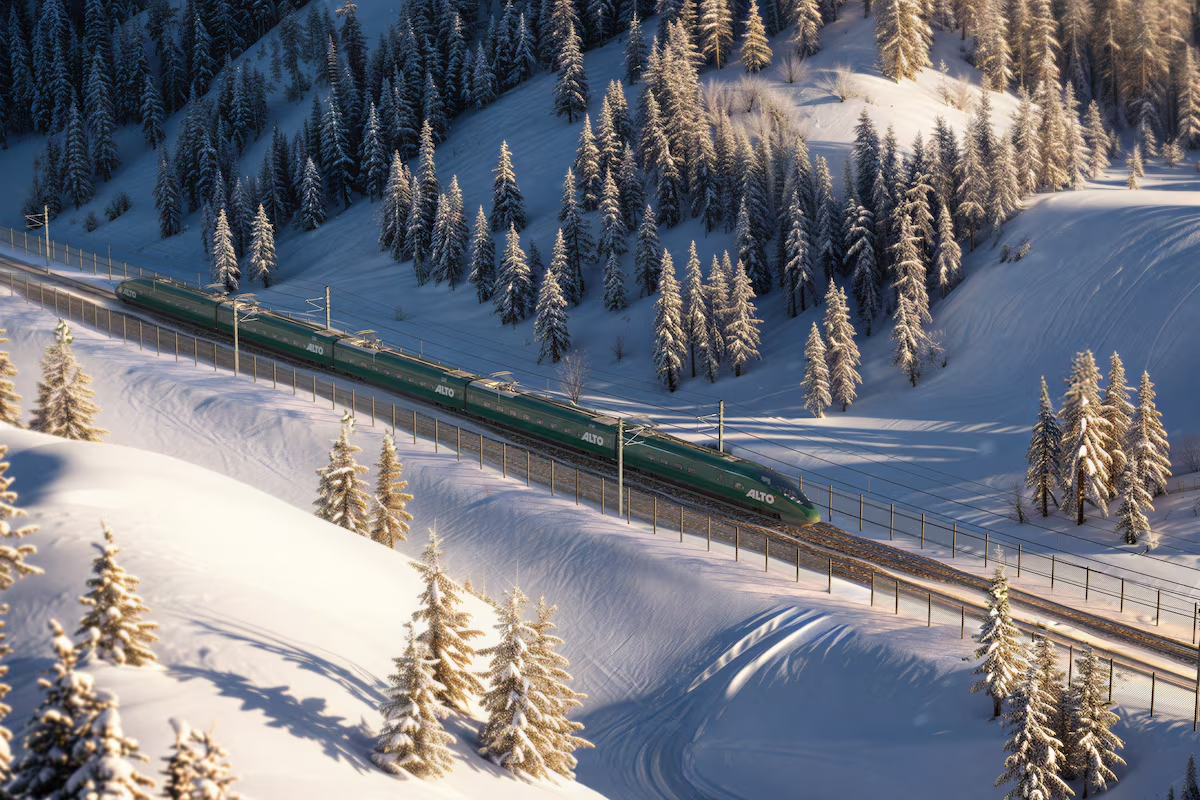
Open this photo in gallery:
A rendering of the proposed first high-speed rail line between Quebec City and Toronto that, sources say, will start with a shorter segment linking Montreal and Ottawa.Supplied
Canada’s first high-speed rail line, between Quebec City and Toronto, will start with a shorter segment linking Montreal and Ottawa, sources say.
Two senior government officials told The Globe and Mail that the plan will be announced Friday by Transport Minister Steven MacKinnon and Martin Imbleau, the CEO of Alto, the Crown Corporation responsible for overseeing the project.
The Globe is not identifying the officials as they were not authorized to comment publicly on the plan.
The project promises to cut current travel times in half, meaning the 200-kilometre trip between Montreal and Ottawa will be about an hour instead of two hours. The plan includes a stop in Laval, a suburb north of Montreal.
High speed rail from Quebec City to Toronto could cost between $60-billion and $90-billion, says project CEO
The federal government has yet to give the entire project a final green light to proceed with construction, but it did select Cadence, a consortium of high-profile international companies, in February to develop the plan and has approved billions of dollars to develop the rail line.
Alto has estimated that the full line will cost between $60-billion and $90-billion, which would be funded by a mix of government money and private investment.
The officials said public consultations about the entire route will begin in January and run for three months. This will include open houses in communities along the route as well as online information, and will involve revealing the projected corridor for the route.
They also said the plan is for the first segment to be built by a Quebec-based team starting from Montreal and an Ontario-based team that will start in Ottawa.
If approved, the sources say, construction is projected to start around 2029 and the Montreal to Ottawa segment would open around 2037.
In September, Prime Minister Mark Carney announced that the new Major Projects Office will work with the high-speed rail project to accelerate regulatory approvals.
Mr. Carney said at the time that this would allow construction to start in four years, down from eight.
Opinion: Speed, comfort, low emissions: Europe’s expanding high-speed rail networks offer lessons for train laggard Canada
The Major Projects Office is part of a federal effort to advance large infrastructure projects. Mr. Carney’s Liberals campaigned on spurring economic growth and attracting investment at a time of trade tensions with the United States.
Via Rail already owns some of the right-of-way between Montreal and Ottawa, which would ease construction. The relatively short distance between the two cities also has the advantage of shortening the amount of time before at least part of the high-speed rail line is in public use.
The government’s budget bill, C-15, contains new powers related to expropriating land that could be needed for the route.
The exact route has not yet been announced, but Alto has said the full line will run north of the existing Via Rail line. The new line would link Toronto, Peterborough, Ottawa, Laval, Montreal, Trois-Rivières and Quebec City.
Construction on the rest of the high-speed line is expected to start later than 2029 but won’t wait for the completion of the Montreal to Ottawa segment.
Traditional passenger service would continue to operate along the existing southern line, which serves cities such as Kingston and Drummondville.
Via Rail has long said its on-time performance and frequency are hindered because it shares track with freight traffic. The existing lines are primarily owned by CN Rail, which gives priority to its freight trains.
Opinion: Why a transit megaproject in Montreal should be a model for Canada
The new high-speed rail line would be for the exclusive use of passenger trains that can travel at speeds of 300 kilometres an hour or more.
Current Via trains are technically able to reach speeds of 200 km/h but are restricted to no more than 160 km/h because of the type of track.
During an appearance before a Senate committee Tuesday, Vincent Robitaille, Transport Canada’s assistant deputy minister for major projects, said the government is aiming to make a final funding decision on the project in 2029.
He appeared with Mr. Imbleau and Linda Jenkyn, a director-general with Public Service and Procurement Canada who is responsible for the national capital area.
The officials discussed how the project would be broken up into segments, or “city pairs,” but did not reveal then that the Montreal to Ottawa route would be the first one.
In response to questions from Senators, the officials said no decisions have been made with respect to the location of the stations.
Senator Donna Dasko asked if the high-speed trains will go to Toronto’s Union Station.
“I have a preference, but I’m not going to share it today,” Mr. Imbleau said. “It is still a work in progress. The objective would be to have a station in the vicinity of Union Station.”
Mr. Robitaille said the government has asked Alto to have stations in the downtowns of the cities it will serve.
“We’re not talking about a station that would be very far, like in the suburbs or something like that,” he said.
While the current plan is focused on Quebec City to Toronto, Mr. Robitaille said they are also considering options to extend the service to Windsor and London.
“Right now, the project is from Toronto to Quebec City. But, in parallel, Alto is working with Cadence to present options and proposals for improvement that would include high-speed rail options to London and Windsor,” he said.
“Based on that information, the government will be equipped to consider the potential to improve the service, and it is going to be included in the decision-making as the project proceeds.”