The Ending of This Oscar Favorite Is Making People Uglysob. I’ve Been Thinking a Lot About Why It’s So Powerful.

To spoil or not to spoil? This article discusses the ending of Hamnet.
Among the words that never appear in Maggie O’Farrell’s 2020 book Hamnet: A Novel of the Plague, two in particular are notable for their absence: William Shakespeare. A historical note prefacing the text informs us that in the 1580s, a couple living in Stratford-upon-Avon had three children, that one, an 11-year-boy, died in 1596, and that “four years or so later, the father wrote a play called Hamlet.” And though even readers who flip past the first few pages might quickly guess the book’s subject, O’Farrell herself never lets the penny drop: To the last paragraph, the most famous author in the history of the English language is referred to only with common nouns: the father, her husband, the glover’s son.
Chloé Zhao’s film of Hamnet isn’t quite so circumspect. Although the subtitles play coy for a little while—Paul Mescal’s character is, at first, identified simply as “Tutor”—it’s clear by the time his three children are running dialogue from Macbeth whom we’re dealing with. The screenplay, by Zhao and O’Farrell, carries over the novel’s temporal slippages and shifting points of view, albeit in circumscribed fashion. (The novel, for the space of a paragraph, views the action through the eyes of a passing owl; the film does not.) But while the book keeps Hamlet itself under wraps until its very end, the movie devotes its final quarter to the staging of Will’s newest work, and his wife Agnes’ reaction to it. The play’s the thing.
Why would a man mourning the death of his son write a play about a son mourning his father?
Placing Hamlet center stage is a substantial step in the direction of Hollywood convention. O’Farrell’s novel resists the temptation to build the story around the play, to suggest that although Agnes’ grief at the loss of her son is terribly sad and all that, what really matters is its effect on the work of a great man. (Agnes is usually known as Anne Hathaway, but O’Farrell chose to use the name given in her father’s will, perhaps because her more familiar moniker is currently in use.) Of course, none of us would be here without that work. In the 16th century, especially during the years when the bubonic plague ravaged Europe, the death of a child was so commonplace as to be almost banal; indeed, as Stephen Greenblatt writes in his 2004 article “The Death of Hamnet and the Making of Hamlet,” some scholars have argued that the play could not have been inspired by Shakespeare’s grief over the death of his son, because a 16th-century parent would not have spent much time mourning him. Without Hamlet, most of us would never know that Hamnet existed at all.
The recorded details of Shakespeare’s life are so sketchy as to make biographical interpretation difficult. As Greenblatt notes, Shakespeare’s “passionate life—his access through personal experience and observation to the intense emotions he represents—is almost completely mysterious.” And the string of plays immediately following Hamnet’s death include several antic comedies, thwarting the reductive idea that Shakespeare was simply giving voice to his most present emotions. But it seems impossible that his son’s death would have had no effect on his work, so the question is not whether but how it influenced him, and why. Specifically, why would a man mourning the death of his son write a play about a son mourning his father?
Hamnet, in both versions, attempts to answer that question. In the novel, one of the perspectives O’Farrell adopts is that of Hamnet himself, who wanders through the narrative like the ghost at the heart of his father’s play. For much of his time on-screen, so to speak, he is preoccupied with his twin sister Judith’s illness, which he eventually comes to fear so much that he decides to trick death by changing places with her—a ruse that, at least in Hamnet’s mind, succeeds. When death carries him off, readers experience the moment through Hamnet’s own eyes.
Focus Features
Like most staged productions of Hamlet, the Bard’s longest play, any interpretation can hope only to break off a manageable chunk of the whole, and in Zhao and O’Farrell’s case, it’s the chunk pertaining to the prince of Denmark and his treacherously murdered father, whose death the young Hamlet must both absorb and avenge. For Zhao and O’Farrell, this is a story about survivor’s guilt, the sorrow and the anger felt by those left behind. From Hamnet’s perspective, death seems almost peaceful, like going to sleep in the snow. But for the living, still mired in anguish and instability, that passage to a place beyond all worldly cares might seem almost like something to envy—a consummation devoutly to be wished.
Hamlet, in this telling, is grounded in the desire to understand what it’s like beyond the veil—a mystery that preoccupies both the play’s protagonist and his creator. And though the movie includes a scene of a distraught Will working out the beginning of “To be or not to be” as he approaches a ledge overlooking the Thames, O’Farrell’s most audacious insight is to imagine Shakespeare inserting himself into the play, not as the brooding, tortured prince, but as the specter of the prince’s late father—not the one contemplating death, but the one who has already experienced it. Hamnet trades with his twin, and Will swaps places with his son. As O’Farrell writes in the book, “He has taken his son’s death and made it his own.”
Dana Stevens
This Year’s Other Oscar Front-Runner Is Here. I Have Tragic News.
Read More
That observation belongs to Agnes, whose perspective governs, if not quite dominates, O’Farrell’s novel. It’s Agnes’ shaky understanding of her husband’s profession that accounts for the book’s vagueness on the subject—she notes at one point that he and his friends in far-off London “have just performed a historical play, about a long-dead king,” but not which play, or which king. It’s implied, in fact, that she’s never seen a play at all. Agnes is lettered enough to read the playbill a malicious relative shoves in her face but can grasp neither why it would bear a variant of her son’s name—according to Greenblatt, the two spellings were interchangeable—nor what her husband could possibly mean by the choice. And so she makes her way to the theater, to understand just what all this is about.
O’Farrell’s novel is virtually finished at this point—from the moment Agnes steps through the doors of the Globe, only eight pages remain. But in Zhao’s movie, the best is yet to come. As in the novel, we encounter the play alongside Agnes, but keeping company with Jessie Buckley is very different from reading O’Farrell’s prose. The 35-year-old has made a little more than a dozen movies in the past eight years, but it took almost no time at all to vault her into the ranks of her generation’s greatest film actresses, and any few minutes of her live-wire performance in Hamnet is enough to establish why. Rumored to be the daughter of a forest witch, Agnes is a wild creature herself; when her first child comes, she sprints from the house and into the woods so she can give birth, alone, on a carpet of leaves. But despite her familiarity with herbal remedies—which, in the 16th century, makes her as able to cure an ailment as any doctor—she’s powerless to stop “the pestilence” from taking her only son. She has devoted her life to nature, and it has betrayed her.
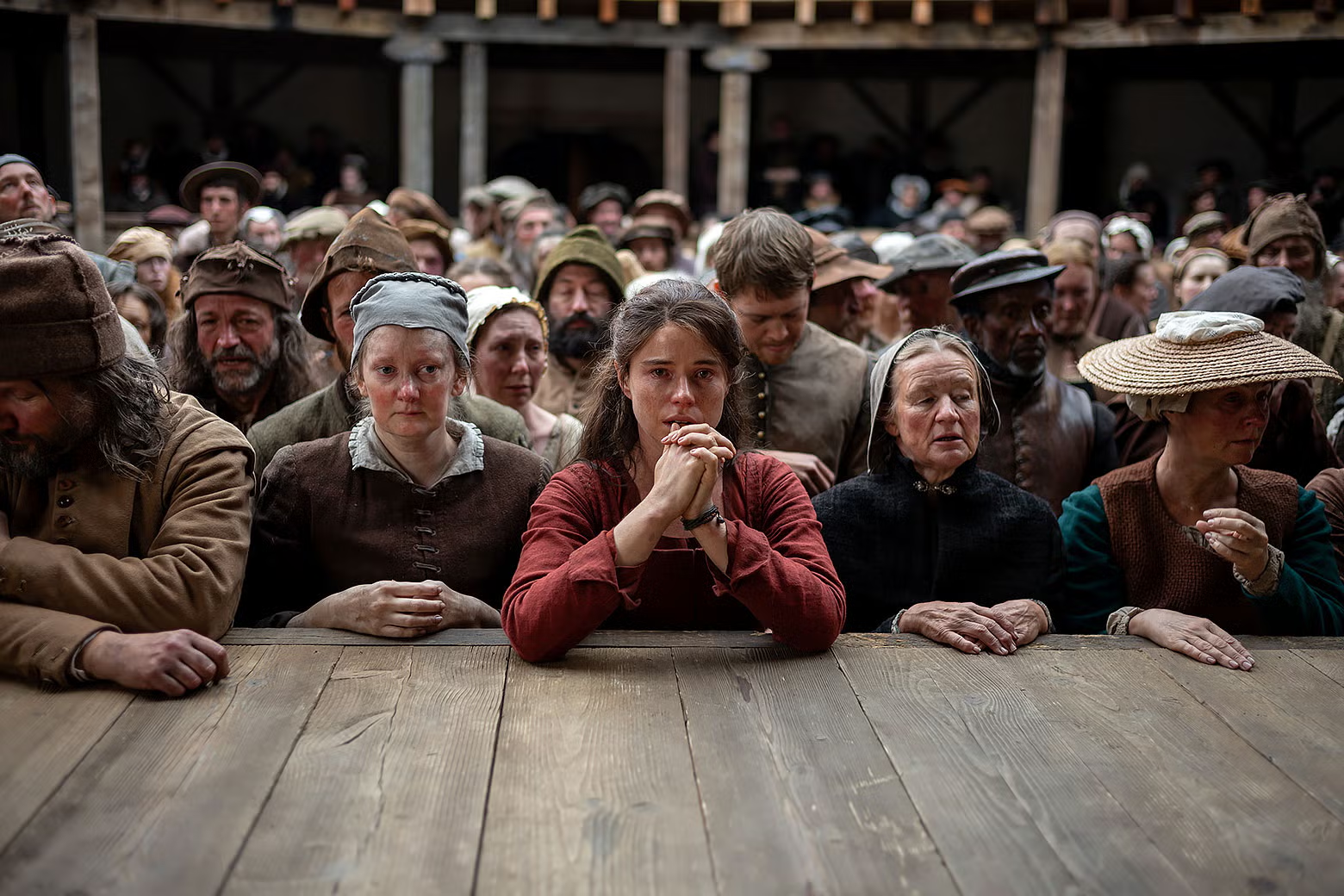
Buckley plays Agnes’ bafflement without a hint of condescension, and her lack of preconceptions allows us to regard what may be the most scrutinized text this side of the Bible with fresh eyes. What is this peculiar spectacle, where people put on strange clothes and speak in rhyming couplets, and what do any of them hope to gain from it? We see how her husband has woven fragments of their lives into the play, not just obviously dramatic moments but tiny, hitherto unremarkable snippets; the lessons Agnes taught their children about the uses of different plants resurface through the haze of Ophelia’s madness, and her reference, years earlier, to an “undiscovered country,” must have lodged somewhere deep in her husband’s memory, materializing when he needed the words most. There are aspects so intimate that no one else could perceive them, like the way Hamlet resembles what Hamnet might have looked like had he lived just a few years more. (The movie deepens the resemblance by drawing on real-life kinship: Hamlet is played by Noah Jupe, Hamnet by his younger brother Jacobi.) And yet the correlation is never so straightforward that it robs the play of its complexity.
Why, after all that effort to bring his son back to life, would Shakespeare then subject him to such a cruel fate? Hamnet never answers that question. But Hamlet might. What troubles the prince, in a monologue so often cited that we may forget to think it through, is not the possibility of death but its uncertainty. Life, he has earlier informed us, is unending misery: stale, flat, unprofitable. (It helps that, as played by the 20-year-old Noah Jupe, he looks like the fresh-faced college student as which Shakespeare wrote him.) The unending sleep of death might seem like a viable alternative, except that there’s no way to guarantee it won’t be worse: Better the misery you know than the potential damnation you don’t. The afterlife of which Hamlet’s father brings word—a place of “sulph’rous and tormenting flames”—hardly seems like an improvement.
-
It Used to Be the Coolest Band in the World. How Did It Get So Cringe?
-
To Fully Appreciate the Brilliant New Knives Out, It Helps to Understand the Subgenres It’s Riffing On
But Hamlet allows Agnes to imagine something better for her son, and she shares that moment with her fellow theatergoers, even though they may not understand what they’re experiencing. Rather than addressing his “To be or not to be” to the heavens, Jupe’s Hamlet sits on the edge of the stage, as if he’s inviting the audience for a chat, and for Agnes, already pressed as close to him as she can get, it’s as if the invisible boundary between theater and life has thinned just enough to allow her hand to pass through the veil, reaching out to comfort this vision of her loss. For an instant, Jupe’s actor seems alarmed by the breach in protocol, but he decides, in the best tradition of live performance, to roll with it. The other audience members likewise seem to realize they’re witnessing a singular moment, something that, while not quite the play they’ve come to see, isn’t not the play either. They’re looking through a window, sharing an experience made up of a hundred private ones, feeling something beyond even Shakespeare’s words. The rest is silence.