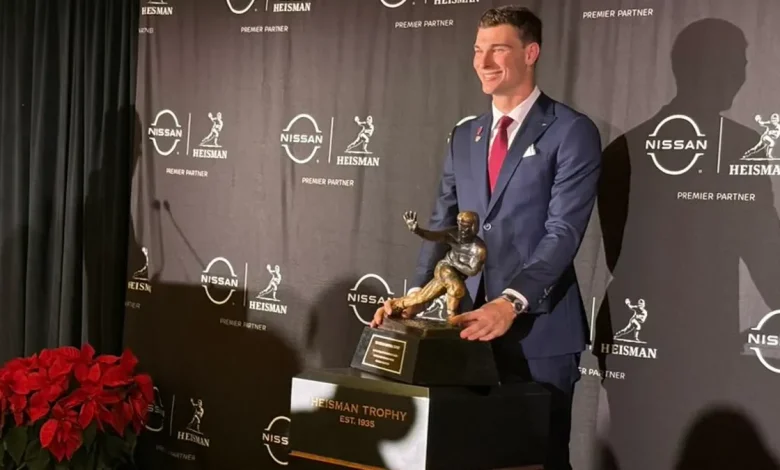
Fernando Mendoza balked at entertaining the Heisman Trophy ceremony as an assured outcome Friday, even as he arrived in New York a comfortable betting favorite to win the award.
As of an afternoon press session, Mendoza hadn’t even finished his speech.
Yet even as he artfully sidestepped suggestions the award was already won, Mendoza did have a firm answer for where the 45-pound bronze trophy should live, if he is selected as its winner Saturday night.
“I would want to keep the trophy in Bloomington,” he said. “It belongs there.”
Mendoza does not need to worry on that score — each winner’s school is presented a separate copy to keep for itself. His answer, though, and with it the fundamental possibility that by bedtime Saturday night Indiana football might have a Heisman winner, struck a chord nestled deep within the IU question being posed to college football right now.
We have for the last several years witnessed how Indiana rose. What we are seeing now is how Indiana stays.
Fernando Mendoza awards won brings IU football history
By Friday evening, Mendoza was assured he would not be leaving New York empty handed.
Indiana’s quarterback swept a clutch of honors during ESPN’s annual awards show, including the program’s first Davey O’Brien Award (best quarterback) and second Maxwell Award (player of the year). This in addition to his being named Walter Camp player of the year earlier in the week.
These are individual honors — though Mendoza might suggest otherwise — but they nevertheless convey something important onto Indiana football that was not there previously.
They are the mark of a serious program. Of the last eight winners of the Maxwell Award, Mendoza included, only one did not come from a school currently in the Big Ten or the SEC. Seven of the last eight also led their teams to College Football Playoff appearances.
Of course, awards are not the sole currency of college football. If anything, they are a blunt and sometimes unwieldy instrument in measuring success and seriousness.
If you want to measure a program’s potential reach and importance in modern college football, look no further than that holiest of metrics:
Television ratings.
IU football’s rise could pay millions in Big Ten funding
Fox Sports announced this week that the Big Ten championship game, a 13-10 IU win over Ohio State on Dec. 6 in Indianapolis, was the most-watched conference title game in league history. It was also the most-watched such game on any network this season.
Across its duration, the 1-vs-2 clash averaged 18.3 million viewers in prime time, with a peak just shy of 20 million viewers in the 15-minute window starting at 11 p.m. ET.
It was Fox’s third most-watched non-bowl college football game ever.
When it comes to television ratings, networks love the brag almost as much as they love the number they can take into their next round of ad sales and commercial negotiations. For fans, they’ve often served as something of a phony war — my program is more serious/beloved/popular/appealing than yours, etc.
They are probably about to become much, much more important. And data points like this one will matter greatly if they do.
Earlier this year, USA TODAY was the first to report the Big Ten’s potential consideration of moving for the first time to unequal revenue distribution.
Historically, the conference has shared all its revenues — bowl, television, media rights, etc. — equally, pooling them annually, carving off a share to pay the conference and then handing each fully fledged Big Ten member a piece.
Other conferences have started to break from this practice, most notably the ACC, which in the wake of legal action by some of its members redrew its distribution model to more directly emphasize television viewership and brand value.
When the Big Ten was considering a billion-dollar private capital arrangement with the investment arm of the University of California retirement fund, its proposed split of that capital infusion was not equal. Had the plan been adopted by its member schools, the Big Ten would have paid Ohio State, Michigan and Penn State the largest share, with Oregon and USC receiving less, and the rest of the league taking less still than that.
Everyone would have received a nine-figure windfall, but the message behind the plan was clear: The Big Ten is comfortable entertaining an unequal revenue distribution model for the first time.
Should such an arrangement come to pass, it would almost certainly emphasize the same television reach and branding strength other conferences already utilize. The richest schools would come first, and after them, anyone who could make a compelling case they draw eyeballs on TV, thereby adding value to the league’s billion-dollar media rights package.
That deal expires in 2030. If you’re wondering where the wind is blowing, it’s toward the next contract being richer, but the money beginning to split unevenly. Given the league will sit down for renegotiations within the next 2-3 years, now is a good time to have big ratings numbers next to your name.
These things add up.
Financial investment into IU football seeing its fruits
So at this point do Bryant Haines’ extensions, and raises.
Indiana’s defensive coordinator received another one Friday, locking into a new three-year deal expected to pay him in the region of $3 million annually. That would make him among the highest-paid coordinators in the country.
Athletic director Scott Dolson and president Pam Whitten have made it clear IU is prepared to spend to stay where it has arrived in football.
That spend arguably started 15 years ago, when Fred Glass started pouring resources — through projects both big and small — into football with the goal of a more competitive program. Glass was rewarded with two bowl berths under Kevin Wilson, and a third on Tom Allen’s watch, just before Glass retired. Dolson inherited Allen and enjoyed IU’s then-historic, COVID-affected 2020 season.
Curt Cignetti, though, has in the last 24 months taken Indiana football higher and farther than anyone believed possible. In the world we once lived in, that might have eventually priced IU out of staying on this course. Cignetti and his staff might have already left.
Not anymore.
Now, the Hoosiers are paying their coach and their potential Broyles Award-winning defensive coordinator roughly as much as anyone in either man’s position makes across the sport. Revenue sharing and NIL dollars are funding Indiana’s roster past the $20 million mark (maybe well past it), with another fundraising boost likely given this season’s success.
IU spent 15 years fighting for football relevance. It’s been widely suggested the university discovered that relevance when it needed it most, and that’s probably true.
But it also reached this point in the moment when — thanks to both internal persistence and external upheaval around the sport — Indiana was better positioned than at any other point in its modern history to sustain it.
So many of the old conventions that have been torn down to clear the road for the success of programs like this one were also the obstacles to allowing places like Indiana, Vanderbilt, Texas Tech and others to maintain that success.
Now, a posterchild for this brave new world, Indiana places a brick in the wall of its brighter future seemingly every day.
We have watched, witnessed and dissected how Indiana football rose. What we are seeing now — provided it is managed correctly — is how Indiana football stays.
Want more Hoosiers coverage? Sign up for IndyStar’s Hoosiers newsletter. Listen to Mind Your Banners, our IU Athletics-centric podcast, on Apple Podcasts, Spotify or wherever you get your podcasts. Watch the latest on IndyStar TV: Hoosiers.