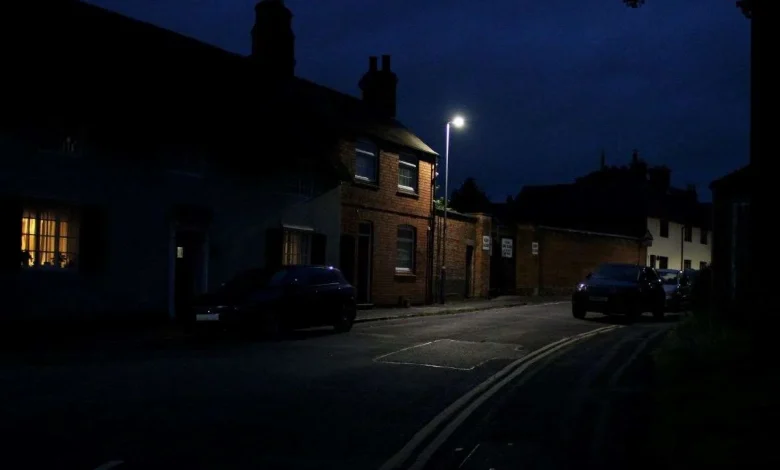
Hertfordshire County Council (HCC) is to review its street lighting policy after more than 1,000 people backed a resident’s petition calling for all lights to be left on at night.
For 13 years, most of the county’s lights have been switched off between 1am and 5am, having been dimmed from 9pm. Major roads remain lit throughout the night, but these lights are dimmed between 11pm and 6am.
Hertfordshire resident John Dowdle presented his petition, calling for the so-called ‘part-night lighting’ policy to be scrapped, to a meeting of the county council on Tuesday (December 9),
In response, HCC agreed to review its policy, assessing the impact on public safety, accessibility and its contribution to CO2 (carbon dioxide) emissions.
Mr Dowdle launched his petition in August after the council signalled that 1,293 lights that had remained on during the night were to be switched over to part-night lighting. Over an eight-week period it was backed by 1,042 Herts residents.
Mr Dowdle highlighted the impact of street lighting on those with conditions such as agoraphobia and nyctophobia, the fear of darkness.
He suggested the savings the policy brought to the council were “tiny and piffling” when set against the heightened fear and anxiety it caused to women and men across the county.
In response to the petition, executive member for highways Cllr Stephen Giles-Medhurst said that the street lights in question should have been adjusted to part night lighting in 2012 but had been overlooked.
He suggested there had been “misinformation” surrounding the petition, with some signatories believing lights were going to be turned off at 9pm, which he said was not the case anywhere.
“I want to make it very clear: this is not turning street lights off at night,” said Cllr Giles-Medhurst.
“No street lights are turned off before 1am. And indeed, in some instances they can stay on, at the request of the local members, until 2am.
“I am afraid that information that has gone out is not exactly accurate.”
Nevertheless, at the meeting, after a motion proposed by Cllr Giles-Medhurst was backed by the council, it was agreed there should now be a review of the policy that would include consultation with others, including the police.
The motion stressed that part-night lighting turned off selected lights only between 1am and 5am – “high trafficked pedestrian areas” remain on all night.
It said that the approach had avoided costs to the council of around £3.6 million a year and cut carbon emissions by around 30% over 14 years.
And it noted that “as reported by police, there has been no negative effect on crime rates”, suggesting that should there be a request from Hertfordshire Constabulary the lights would stay on in any area all night.
According to an officers’ report to the council, the 1,293 lights that were switched to part night lighting earlier this year should already have been operating under that policy. It is anticipated the change will save around 8.6 tonnes of carbon emissions and avoid energy costs of £14,000 a year.
“The county council acknowledges the concerns of residents regarding safety on Hertfordshire’s streets and has developed a modern street light system that is flexible to meet the needs of varied and changing requirements across the county,” says the report.
“This also supports safe, active and sustainable travel such as walking and cycling.
“The county council actively monitors that system to ensure it works reliably and helps people feel safe when out after dark.”
According to the report, crime rates were monitored in the early years of part night lighting and there was “no increases in crime due to the lack of lighting”.
“Continuous monitoring since then has showed that, overall, there is no evidence to suggest that part night lighting has exacerbated crime levels at night,” it says.
“Hertfordshire Constabulary reconfirmed this position in October and identified that street lighting can alleviate the fear of crime.
“Hertfordshire Constabulary has made only a small number of requests to switch from part night lighting to full night lighting.
“All of these were approved and implemented, based on police evidence of night-time crime or disorder, in line with the county council’s street lighting policy.”