Culture & Style / Celebrity
Inspired by one historic blue diamond and the driving force for the plot of Titanic, the Heart of the Ocean necklace is one of the most influential pieces of jewelry in film history.
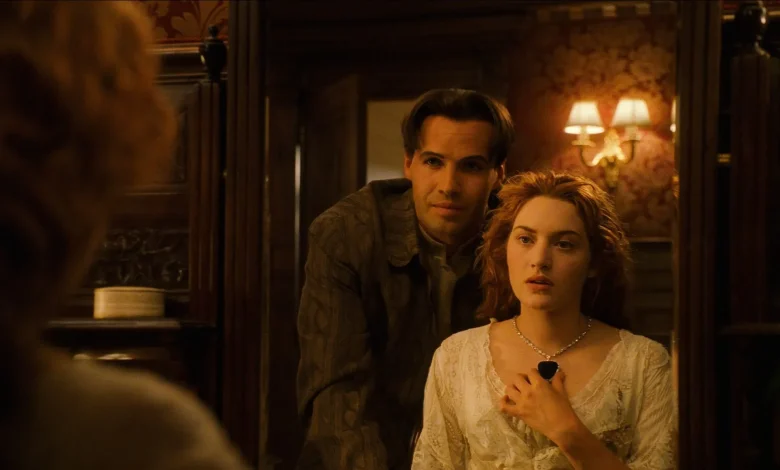
Billy Zane and Kate Winslet star in James Cameron’s 1997 film, Titanic. (Source: Alamy)
One of the most memorable jewels in cinematic history, the Heart of the Ocean necklace had a starring role in the beloved 1997 film Titanic and has maintained an enduring impact ever since it was first draped on Kate Winslet’s neck.
Since the golden age of Hollywood, iconic film jewels have stolen the spotlight, captured our hearts, and proved themselves stars worthy of an Oscar. But this fictional blue diamond has found itself to be a pertinent film reference to this day. Here, learn all about the real, natural blue diamonds that inspired its tale, and the lasting impact the Heart of the Ocean has had on pop culture.
Meet the Expert
- Colleen Caslin is now the President of Sidney Garber, but was once the Vice President of Marketing at Asprey, where she worked on the Titanic‘s Heart of the Ocean necklace.
- Previously, she has held executive positions at jewelry houses like Graff, Verdura | Belperron, and Jessica McCormack.
- She has also led her own Consulting Group for the last nine years.
How the Heart of the Ocean Shaped the Plot of Titanic
Kate Winslet wears the Heart of the Ocean as Rose DeWitt Bukater in James Cameron’s 1997 film “Titanic”, released December 19, 1997. (Paramount Pictures/CBS via Getty Images)
James Cameron’s 1997 epic tells the tale of a tragic love story set aboard the RMS Titanic. The luxurious British passenger liner famously sank in the North Atlantic in April 1912 after colliding with an iceberg on its maiden voyage.
Kate Winslet stars as the young debutante Rose DeWitt Bukater, who is engaged to the son of a Pittsburgh steel tycoon, Cal Hockley (Billy Zane), when she falls in love with the penniless artist Jack Dawson, played by Leonardo DiCaprio.
In modern times, we follow the journey of treasure hunter Brock Lovet (Bill Paxton) and his research team while they explore the wreck of the RMS Titanic, looking for any signs of the Heart of the Ocean necklace. In the opening scenes of the film, the team lifts a safe out of the ship’s wreckage on the ocean floor, only to find just a sketch of the coveted jewel, rather than the diamond itself.
When an elderly Rose DeWitt Bukater (Gloria Stuart) contacts the team to provide a first-person assist, she identifies herself as the woman wearing the Heart of the Ocean.
“Good gracious,” exclaims Rose when Cal opens the jewelry box. “It’s overwhelming.” Cal tells her, “Well, it’s for royalty. We are royalty, Rose.”
Once her relationship with Jack blossoms, Rose decides to wear the necklace (wearing only the necklace) when he sketches her portrait, “like one of his French girls.” He asks if the blue stone is a sapphire when Rose explains that it’s “a diamond. A very rare diamond.”
The extraordinary gem continues to drive the plot when Rose includes a note with the necklace and the nude sketch in the vault for Cal to find. “Darling, now you can keep us both locked in your safe.” Then, Cal’s valet, Lovejoy, slips it in Jack’s pocket to frame him for theft.
When Rose goes down with the ship wearing the jacket holding the Heart of the Ocean, we learn she’s had possession of the jewel for 84 years. As a 101-year-old woman, Rose climbs up the ships railing once again and dramatically decides to pluck the jewel into the Atlantic Ocean, proving she has never depended on Cal’s wealth to lead a rich life.
But the 56-carat Coeur de la Mer diamond (Heart of the Ocean) was purely fiction in more ways than one. The blue diamond featured in the film was actually cubic zirconia.
Titanic production designer Peter Lamont commissioned British luxury jewelers Asprey & Garrard to craft multiple iterations of the prop. He told People that the cost of a natural stone of that size, “would have been prohibitive, despite our budget.”
How Asprey Brought the Heart of the Ocean to Life
The Re-Created Titanic Necklace “Le Coeur De La Mer” (Heart of the Ocean) On Display At Asprey, in The Beverly Hills Hotel.(Getty Images)
After Titanic wrapped filming, Asprey created a remarkable real version to be auctioned for charity, featuring a 171-carat blue Sri Lankan sapphire with 103 natural diamonds. The jewel hit the auction block in Beverly Hills at a star-studded gala in 1998, selling for $2.2 million to an anonymous bidder. All proceeds went to Southern California’s Aid for AIDS Foundation and to the Diana, Princess of Wales Memorial Fund, honoring the late royal, who died the previous summer.
Early in her career, renowned jewelry executive Colleen Caslin worked as the Vice President of Marketing at Asprey. Caslin previously told Only Natural Diamonds, “Earlier in my career, my brainchild was the creation of a ‘Titanic necklace.’” She explained, “Originally, it was a prop made of synthetic stones for the film Titanic. When I worked for the Bond Street jeweler, we created a real version, which was auctioned for a great cause at the late Princess of Wales Gala Charity.”
She went on to explain, “It was worn at the Academy Awards by Celine Dion when she performed the song, “My Heart Will Go On.” That day, I had a grand slam victory at the ceremony, dressing the Best Actor, Best Actress, Best Supporting actress, and garnered over 4 million in editorial equivalency, putting the brand on the map.”
The Heart of the Ocean Influenced the 1998 Oscars Red Carpet
Gloria Stuart at the 70th Annual Academy Awards Red Carpet on March 23, 1998. (Getty Images)
Celine Dion holds a replica of the Heart of the Ocean necklace at the 1998 Academy Awards.(Getty Images)
For its moment in the sun (and out of the depths of the sea), the anonymous buyer agreed to allow Celine Dion to wear the Heart of the Ocean necklace to the 1998 Oscars. The songstress walked the red carpet with the natural replica of the film’s prop to perform the film’s famed love song, “My Heart Will Go On,” which won the Academy Award that year for Best Original Song. ”It’s my tribute to the Titanic,” Dion told Entertainment Weekly on Oscars night. “It just makes me feel like me. The necklace came first, and we built my outfit around it.”
The $2.2 million necklace reportedly required 12 bodyguards who closely followed the singer throughout the evening.
Gloria Stuart, who played Rose as an old woman in the film, set an Oscars jewelry record at the 1998 ceremony. As the oldest person to ever be nominated for Best Supporting Actress at 87 years old, the actress wore a 15-carat blue diamond necklace from Harry Winston, paying homage to the Heart of the Ocean necklace. Reminiscent of the iconic Hope Diamond, the piece remains one of the most expensive pieces of jewelry to take a trip down the red carpet, valued at an incredible $20 million.
The Heart of the Ocean Was Inspired By the Hope Diamond
The Hope Diamond (National Museum of Natural History)
The 1997 film describes the 56-carat Coeur de la Mer blue diamond (Heart of the Ocean) as having been owned by King Louis XVI of France and even compares the fictional rare gem to the Hope.
“Louis XVI wore a fabulous stone that was called the Blue Diamond of the Crown, which disappeared in 1792,” Lovet explains in the film. “About the same time, old Louis lost everything from the neck up.” He says, “The theory goes that the Crown Diamond was chopped, too. Recut into a heart-like shape that became known as the Heart of the Ocean. Today, it would be worth more than the Hope Diamond.”
Just like the Heart of the Ocean, the Hope Diamond was owned by the French monarchy – Kings Louis XIV through XVI during its long and allegedly cursed lifetime.
Mrs. Oscar Chapman, wife of the Secretary of the Interior, displays the Hope Diamond at the premiere of the $20,000,000 “Court of Jewels” benefit at the American Security and Trust Co. (Bettmann / Getty Images)
The Hope Diamond’s legacy began with the legendary French merchant Jean Baptiste Tavernier, who purchased the then 112-carat diamond from the Golconda region of India.
At the time, it was triangular and crudely cut. In 1668, Tavernier sold the diamond to King Louis XIV, who had the stone recut and set it in a necklace, naming it the “French Blue” after its rich color. By 1791, Louis XVI and Marie Antoinette attempted to flee France, turning over the diamond to the government, when it was ultimately stolen. Though Marie Antoinette’s beheading was the first of great hardships—and even deaths—that the diamond’s many owners have suffered, leading to what is now thought to be the curse of the Hope Diamond.
The Blue Heart Diamond: The Heart of the Ocean’s Real-Life Doppelgänger
The Blue Heart Diamond (Courtesy of the Smithsonian)
The Blue Heart Diamond (Courtesy of the Smithsonian)
While the creation of the Heart of the Ocean drew inspiration from the Hope Diamond, one incredible natural stone holds an even closer resemblance. The Blue Heart Diamond was discovered as a 100.5-carat deep blue rough stone at the Premier Mine (now the Cullinan mine) in South Africa in 1908. The next year, the Premier Transvaal Diamond Mining Company purchased the stone, and had it faceted by French jeweler Atanik Eknayan in 1910, who shaped it into the 30.62-carat heart-shaped, brilliant-cut blue diamond we know today.
The Blue Heart Diamond would go on to be acquired by the French jeweler, Pierre Cartier, and then, the Unzue family of Argentina. After that, Van Cleef & Arpels would purchase the diamond in 1953 before it was sold to Swiss industrialist Baron Hans Heinrich Thyssen-Bornemisza. In 1959, the Blue Heart Diamond was sold once again – this time to Harry Winston, Inc. It was Winston who mounted it in its present platinum ring setting, surrounded by 1.63 carats of 25 round brilliant cut white diamonds.
Ms. Marjorie Merriweather Post was the last private owner of the Blue Heart Diamond. She purchased the ring from Winston and eventually gifted it to the National Gem Collection in 1964. The Blue Heart Diamond might only be about two-thirds the size of the Hope Diamond, but its heart-shaped brilliant cut and rich blue color make it one of the collection’s most extraordinary gems.
In 1997 (the same year as Titanic’s theatrical release), the Gemological Institute of America (GIA) graded the Blue Heart as a natural fancy deep blue diamond with a clarity grade of VS-2 (very slightly included). According to the Smithsonian, its blue color is due to trace amounts of boron replacing some of the carbon atoms in the diamond’s crystal structure.
The Heart of the Ocean’s Lasting Influence on Pop Culture
The influence of the Heart of the Ocean has reached far past the film, even inspiring a segment in Britney Spears’ “Oops I Did it Again.” The track’s music video featured an interlude where she falls in love with an astronaut, who gifts her the Heart of the Ocean diamond necklace. “But I thought the old lady dropped it into the ocean at the end,” she says of the 1997 film. After he says he went and retrieved it just for her, she responds, “Awe, you shouldn’t have.” Sabrina Carpenter even included the audio of the interaction, playing it over her performance at the 2024 MTV VMAs before she sang “Taste.”
Luxury fashion house Vetements, founded by Georgian fashion designers Demna Gvasalia and Guram Gvasalia, has even gotten in on the action. The brand’s Spring/Summer 2020 collection was filled with pop culture references, including a recreation of Titanic’s Heart of the Ocean necklace.
Near, far, wherever you are, the Heart of the Ocean’s impact remains unmatched.