The EU’s plan to use frozen Russian sovereign assets to fund Ukraine’s war effort is becoming “increasingly difficult”, the EU’s top diplomat has said, just days after multiple countries said they supported Belgium’s calls for alternatives to the so-called ‘reparations loan’.
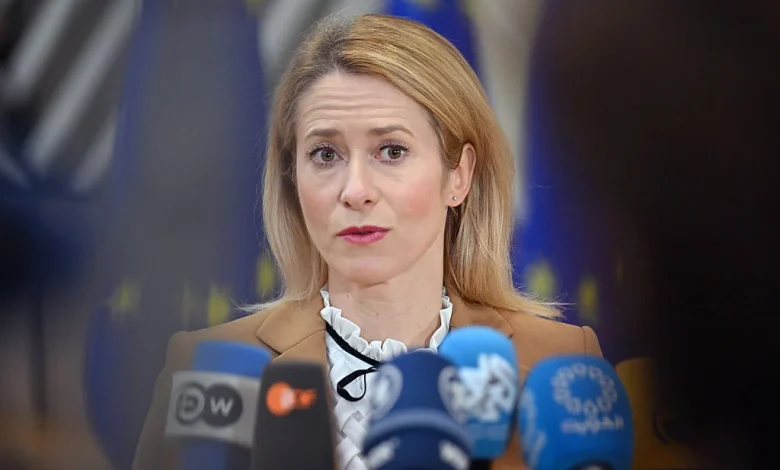
“The most credible option is the reparations loan, and this is what we are working on,” Kaja Kallas said ahead of a meeting of EU foreign ministers in Brussels on Monday. “We are not there yet, and it is increasingly difficult, but we’re doing the work.”
Kallas added that EU officials “still have some days” before Thursday’s crunch summit of leaders, where they hope to persuade Belgium to back the loan despite months of staunch resistance.
Euroclear, a Brussels-based securities depository, holds the vast majority of the €210 billion in immobilised assets that would be used to finance the loan, making Belgium a key player in negotiations.
Belgian Prime Minister Bart De Wever has repeatedly called on the EU to issue joint debt backed by the bloc’s long-term budget to support Kyiv instead of proceeding with the loan, which he has denounced as “fundamentally wrong”.
De Wever has also argued that the plan poses severe legal and financial risks.
On Friday, Italy, Bulgaria, and Malta issued a joint statement with Belgium, urging the EU to consider “alternative options” to the loan, including issuing common debt. Their calls were echoed over the weekend by Czechia.
Hungary’s pro-Moscow leader, Viktor Orbán, is also fiercely opposed to the loan scheme, while Slovakia’s similarly Kremlin-friendly leader, Robert Fico, has said he would not support any use of Russian assets to finance Kyiv’s military expenditure.
Kallas, however, noted that other ways of financing Kyiv “are not really flying”, with Orbán also vetoing any efforts to issue common debt to plug Ukraine’s yawning budget gap.
Ukraine is set to run out of money in April next year and faces a total budgetary and military financing shortfall of €135 billion in 2026 and 2027, according to the Commission.
EXCLUSIVE: Belgium demands ‘autonomous’ guarantees from EU for €210 billion Ukraine loan
Belgium is demanding “independent” and “autonomous” guarantees from EU countries in return for its support…
2 minutes
Legally, the joint debt option requires unanimity among all EU 27 member states, while the reparations loan only requires the support of a ‘qualified majority’ of countries, or 15 nations representing at least 65% of the bloc’s population.
Despite noting its technical feasibility, Kallas suggested it would not be politically possible to proceed with the loan if Belgium is not on board.
“Without Belgium, I think it wouldn’t be very easy because they have the majority of the assets, and I think it’s important that they are on board with whatever we do,” she said.
Her remarks were echoed by other EU foreign ministers on Monday, including Ireland’s Helen McEntee.
“I think it’s really important that we work together, and I think it’s important that we work through any concerns that colleagues would have,” McEntee said.
Other ministers, meanwhile, suggested that they would refuse to even contemplate alternatives to the loan scheme. “The reparations loan is not the major and the best, but the only option for how we can mobilise finances for Ukraine’s needs,” said Lithuanian Foreign Minister Kęstutis Budrys.
EU ambassadors will also meet in Brussels on Monday on the sidelines of the foreign ministerial meeting, where they will discuss European Commission amendments to the loan proposal that seek to address Belgium’s numerous concerns, according to multiple EU diplomats.
(mm, jp)