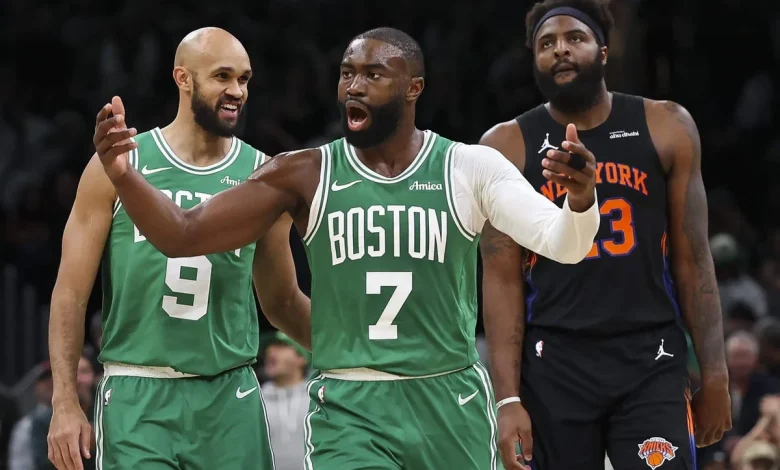
Following his first three-game losing streak in two years, Jaylen Brown reiterated a belief he had stated several times before. This was in late October, after a frustrating road loss to the Detroit Pistons. At 0-3, Brown and the Boston Celtics were in an unfamiliar situation. He still wanted to give his young team time.
“Obviously, it’s not what people want to hear, especially in Boston,” Brown said, “It’s not an excuse, but it takes time. It does. I said that before the season. Like, it takes time to figure it out. And this is a part of it.”
When he spoke that day, with a towel draped over his neck, Brown thought the Celtics would need significant time to piece their puzzle together. They have surprised him by speeding up the process. Despite Thursday night’s disappointing loss to the Milwaukee Bucks, which saw the Celtics miss 16 straight 3-pointers in the second half, they have climbed to third place in the Eastern Conference at 15-10.
With 10 wins in their last 13 games, they have been one of the NBA’s hottest teams outside of Oklahoma City. Over the full season, the Celtics now rank third in offensive efficiency and fifth in net rating. They have discovered enough early success that Brown recently said he wants to make sure they don’t let it get to their heads.
After an offseason overhaul, what has allowed the Celtics to fast-forward their development and emerge as one of the Eastern Conference’s better teams?
Finding a new path to winning the possession game
Over the last few years, the Celtics had a blueprint for winning the possession game. They rarely forced turnovers, but rarely committed turnovers themselves. They didn’t get to the free-throw line a lot, but hardly ever fouled. They didn’t rank among the league leaders in offensive rebounding, but handled business on the defensive glass. That combination allowed them to create more scoring opportunities than their opponents much of the time.
Head coach Joe Mazzulla has not abandoned his love of the possession game — which he calls “the margins” — but the Celtics win it differently now. They have dropped from seventh in defensive rebounding rate to 29th, but have made up for that by jumping from 18th in offensive rebounding to seventh. While the crash rate, the number of players a team sends to the offensive glass per possession, is not a publicly available statistic, Los Angeles Lakers coach JJ Redick recently said the Celtics top the league in it. That’s one way they have harnessed the length and athleticism of their young wings.
In part because they wanted to force more turnovers (they rank ninth in opposing turnover rate), they have changed their philosophy about fouling. They have dropped to 27th in opposing free-throw attempt rate after preventing fouls better than any team last season. The constant fouling has put more pressure on the Celtics in other areas, but they believe the trade-off is worthwhile. One of their biggest strengths has carried over even after they lost five former All-Stars, including the injured Jayson Tatum: They lead the league in turnover rate for the second time in the last three seasons.
The new formula kept the Celtics’ offense producing at a high rate even when Derrick White and Payton Pritchard slumped from behind the arc at the same time early in the season. Boston has flourished since more outside shots started to fall, scoring a ridiculous 126.8 points per 100 possessions over this 13-game stretch. Parts of the streak have probably been unsustainable. Josh Minott, Jordan Walsh and Hugo González each probably won’t hit more than 45 percent of their 3-point attempts over the rest of the season. Brown might not shoot midrange jumpers like Dirk Nowitzki and Kevin Durant forever. Still, because of how regularly the Celtics’ offense wins the possession game, they don’t necessarily need to shoot well to score well.
“I feel like with them,” Redick said, “it’s a lot of math.”
That doesn’t just mean three is greater than two.
“There’s a lot of things you have to be worried about playing this team,” Redick said.
A work in progress, Josh Minott has been a pleasant surprise for the Celtics this season. (Sean Gardner / Getty Images)
The small lineups work
The Celtics have dominated Neemias Queta’s minutes all season, but they ran into early-season issues when he hit the bench. It’s ironic they found the solution to that problem after he sprained his ankle against the Orlando Magic on Nov. 23. Even with Queta injured, Mazzulla kept Luka Garza on the bench that day, turning to Minott and Walsh as the backup centers.
Given how badly the minutes without Queta were going at the time, Mazzulla might have been itching to try the small lineups anyway. Queta’s brief absence gave Boston one more reason to tweak the rotation. Mazzulla realized the small lineups needed to become part of his regular plans.
Boston has gone 7-2 since shifting consistently to small ball when Queta exits the floor. The Celtics have scored 133.2 points per 100 possessions with Minott at center, according to Cleaning the Glass. Though those lineups have been susceptible on the glass and on defense, the strengths of the small units have outweighed the weaknesses.
As promising as the new rotation has been, the Celtics’ small lineups are likely due for some shooting regression. With Minott at center, the team has shot 46.3 percent on 3-point attempts. Still, the offense during those stretches has been dynamic enough to survive a bit of shooting slippage.
Even while playing small for long stretches of every game, the Celtics have ranked fourth in opposing points in the paint per 100 possessions through this 13-game stretch. They have been able to protect the rim extremely well as a unit. Still, it’s no surprise they have dipped in that category without Queta on the court. They have given up 39.3 points in the paint per 100 possessions with him on the floor (that would rank second this season behind the Thunder) and 47.7 points in the paint per 100 possessions with him on the bench (that would rank eighth).
Young Celtics have grown quickly — and fit with the veterans
One more benefit of the small lineups: They often allow Mazzulla to play his young wings more often. From Walsh to Baylor Scheierman, they have all impacted winning.
Walsh began the season outside of the rotation, but quickly earned a starting spot by defending at a high enough level to grab attention from players and coaches around the NBA. Lately, he has also given the Celtics an offensive lift. Over the last five games, he has shot 30 for 37 from the field (81.1 percent), including 9 for 12 (75 percent) on 3-point attempts. Walsh has shown talent as the roll man. He has knocked down spot-up jumpers. He has converted at the rim with plenty of efficiency. He has been active crashing the glass. Combining his newfound scoring production with his ability to take on the most challenging defensive matchups, he has helped change the Celtics’ fortunes. The starting five with him has regularly built leads, outscoring opponents by 14.6 points per 100 possessions.
The Celtics’ depth was a big question mark entering the season. It has become one of the team’s strengths. Behind Walsh, Gonzalez, Minott and Scheierman have all been helpful, harnessing their youthful energy to fill in the cracks around the team’s leading scorers. Mazzulla deserves credit for the way he has approached the young wings’ development. He has been hard on them all, letting them know the importance of every possession. Now, with Sam Hauser also in the mix, the Celtics have an abundance of capable wings.
Once Jayson Tatum returns from injury, Mazzulla will have all sorts of options at his disposal. Heck, he already does. At the beginning of the season, there was no promise that any of the young wings would emerge as viable options. They all have. Queta has also been steady from day one, proving himself worthy of a starting spot after filling the fourth-string role last season.
None of it would have led to so many wins without the Celtics’ veterans shouldering a big load. Brown trails only Luka Dončić and Giannis Antetokounmpo in usage rate. He is still on track for the best true shooting percentage of his career (59.3 percent). By scaling up that well in an expanded role, he has helped the offense find its way early.
Not everybody can make midrange jumpers efficiently enough to rely on them much, but he and Pritchard have done so this season. Lately, the Celtics’ backcourt has also started heating up from downtown. Over the last 13 games, Pritchard and White have combined to make more than seven 3-pointers per game on nearly 40-percent shooting.
The Celtics went ice cold as a team during the second half Thursday against the Bucks. They won’t like thinking about how many buckets Bobby Portis and Kyle Kuzma scored against them. But they have found an identity that works for them. Considering how much change they have undergone, that’s quite a feat.