The grocery code of conduct takes effect next month. Its first enforcer has a ‘big job’ ahead

Open this photo in gallery:
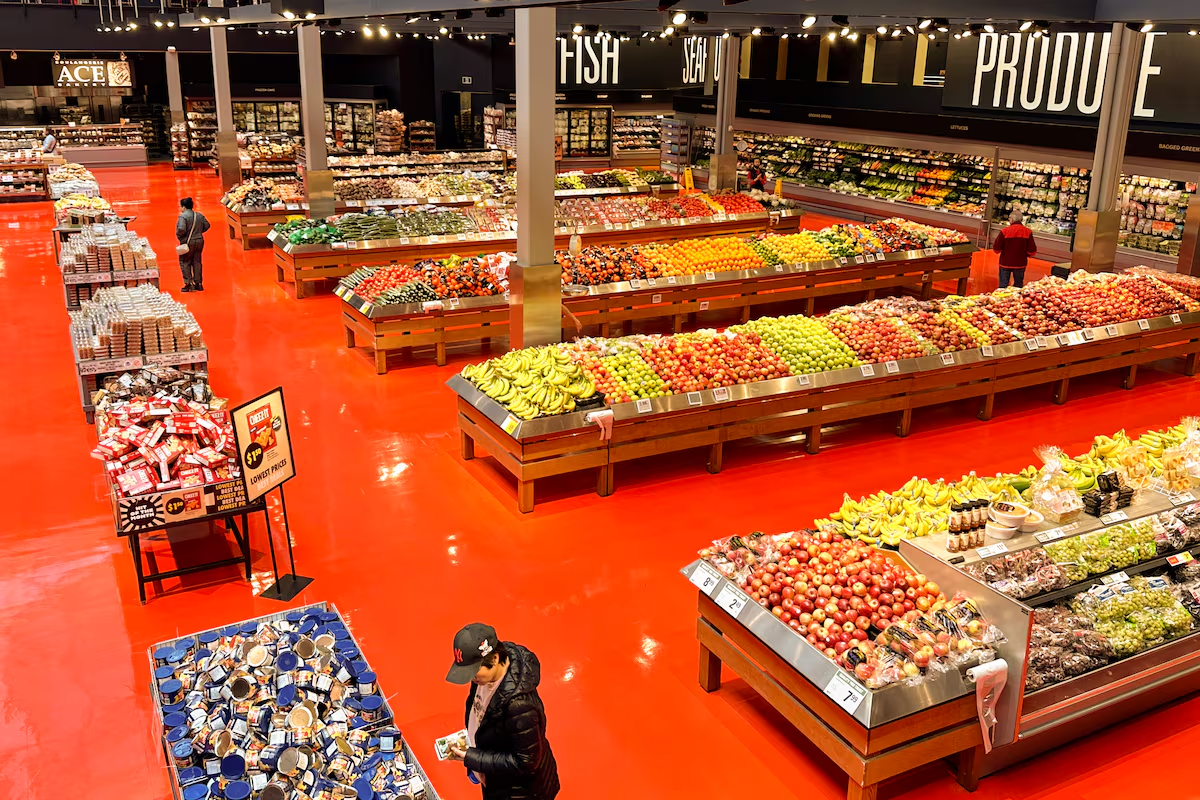
Shoppers browse the produce section of a Toronto Loblaws in May, 2024. Canada’s first grocery code of conduct comes into force in January.Chris Young/The Canadian Press
As the first referee appointed to enforce a new set of rules governing Canada’s grocery industry, Karen Proud knows she has a lot on her plate.
Ms. Proud is president and adjudicator of the office behind the grocery sector code of conduct. The code has been established to curb years of fighting over the fairness of dealings between powerful retailers and their suppliers.
“It is a big job,” said Ms. Proud, who took on the position earlier this year. The work will soon ramp up significantly, as the code is set to take effect Jan. 1.
What is the grocery code of conduct, and how could it impact food prices for Canadians?
The code is meant to set ground rules on issues that have long plagued the industry. Suppliers have complained that major grocers, who have significant market power because of their size, hit them with fees and fines that are sometimes unfair. That fight reignited during the pandemic, when retailers such as Loblaw Cos. Ltd. L-T and Walmart Canada both announced increases in fees charged to their suppliers.
The grocers, for their part, have criticized product vendors for price increases they say are at times unjustified. And smaller retailers say they have been shorted by some suppliers who prioritize filling orders from the biggest retailers first.
“I think it’s fair to say there has been an erosion in the relationships in some sectors, between suppliers and their retailers,” Ms. Proud said.
The outgoing chief executive of Sobeys parent company Empire Co. Ltd. EMP-A-T put it more bluntly in 2020. Michael Medline said at the time that the grocery industry had “the worst relationship I’ve seen in my couple of decades in retail,” and added that some of the practices he had observed were “repugnant.”
Open this photo in gallery:
Michael Medline appears before a committee on Parliament Hill in Ottawa in March, 2023.BLAIR GABLE
But the code has faced numerous delays since then as the industry has negotiated rules that various companies would agree to – and as the government threatened legislation if they did not move forward.
Now, more than 120 companies have signed on, including some of the industry’s most dominant players. Empire was the first major retailer to join the code; Loblaw, Metro Inc. MRU-T and Costco Canada also did so this month. Walmart Canada has yet to sign but is planning to do so by Jan. 1, spokesperson Stephanie Fusco wrote in an e-mail.
Dozens of other companies, including some independent retailers and large and small suppliers, have also signed. Those include Kraft Heinz Canada, PepsiCo Canada and Unilever Canada Inc.
“We will be brutally honest, as an independent office, in saying whether this works or not, and in going back to the government to let them know whether or not we believe that they need to step in and regulate,” Ms. Proud said.
But the new system is not designed to address the most pervasive public complaint about the grocery industry: High food prices. While inflation has slowed, grocery costs are still significantly higher for Canadians than they were before the pandemic.
And food prices are expected to rise another 4 to 6 per cent in 2026, according to a recent report from the agri-food analytics lab at Dalhousie University, in partnership with a number of other universities. For a family of four, that would amount to a nearly $1,000 increase in their annual food bill, the report estimated.
Opinion: The grocery code of conduct has suppliers settling for scraps
But Ms. Proud said she does believe the new code will have benefits for consumers in other ways – namely, in the choices they have when they are shopping. If her office succeeds in changing the way companies deal with each other, she said, smaller suppliers will have more chances to succeed and to get new products on store shelves.
There are also larger economic consequences to creating a more stable, predictable business environment, she said, if it causes larger multinational companies to invest more in operations here.
“I think we’ve come to realize that a lot more in the last few months – it’s always good when you have investment in Canada,” she said. “It’s good for the business, it’s good for the country.”
The code was modeled partly on those of other countries, such as Australia and the United Kingdom, which have also introduced rules to curb abusive industry tactics. But Canada’s code is different because it applies to both sides of the sector while other countries have focused only on regulating retailers’ practices. Christine Tacon, Britain’s first groceries code adjudicator, said that this reciprocal structure will make the Canadian adjudicator’s job more complicated.
Ms. Tacon said she had “a huge barrier” to overcome in the role at first because suppliers were afraid to report bad behaviour – assuming retailers would find out. “If you sit behind a desk and wait for your phone to ring, there’ll be cobwebs growing over it,” she said, adding that it takes work to earn the trust of companies.
Opinion: Food inflation is going up. And there’s nothing anyone can do about it
Ms. Proud stressed that the Canadian office has a mechanism for companies to report issues on an anonymous basis. If the behaviour is covered by the code, she can push for change, she said. While companies have to share their identities in order to make a formal complaint, she is expecting that to be a last resort that is “rarely used.”
While her office does not have the power to fine companies, she believes they will be motivated to work with her. “I can tell you, there’s probably a lot of suppliers and retailers who would prefer to pay a fine than have themselves named in a notice of non-compliance or in a report that names them as not complying with the code,” she said.
The new rules will not be a silver bullet to make it easier to compete in an industry where smaller businesses still have to negotiate with dominant players, Ms. Proud said.
“But there are some behaviours that the code will address that should make it at least more predictable, more transparent, easier and remove some of the more egregious behaviors from the equation.”