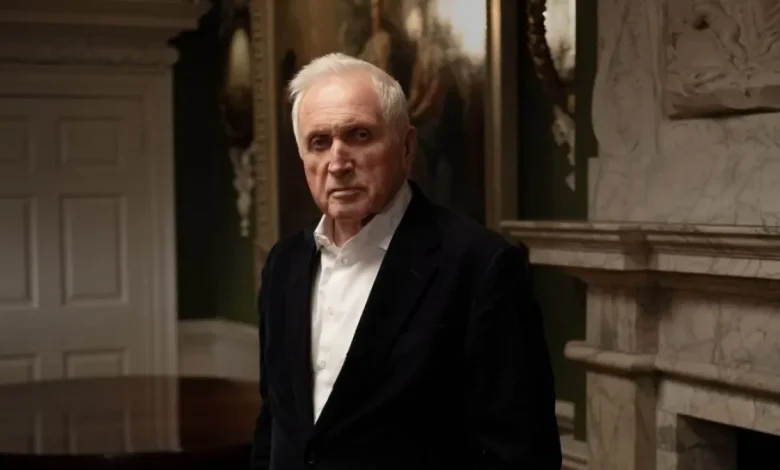
“This may sound odd to you,” says David Dimbleby, “but I’ve always seen myself as an outsider. I know I may be seen as part of the establishment but actually I don’t want to be part of it. I like observing, and commenting on what I see. Does that make sense to you?”
Well, yes and no. As Dimbleby writes in his 2022 memoir Keep Talking, he has been a broadcaster “probably for longer than anyone on Earth”. Born two years after the BBC began regular television broadcasts in 1936, he is almost as old as the medium itself and has been appearing on screen since the 1950s. “I’ve been in all the different bits of [the BBC],” he says. “Except sport. I’ve never done sport.”
By the 1980s, he was the BBC’s safest pair of hands. He helmed its election night coverage from 1979 to 2017 and Question Time from 1994 to 2018. He was there in 1975 when the UK voted to remain in Europe and again in 2016 when it chose to leave. He’s covered the funerals of Princess Diana, Queen Elizabeth and Margaret Thatcher, every state opening of parliament, every remembrance service. He’s interviewed everyone from Harold Wilson to Nelson Mandela. Dimbleby has been an indelible presence in British life: genial, authoritative, steady as a rock.
Talking to him through a laptop screen (he’s at home in East Sussex) is therefore a surreal experience. I’m questioning the questioner: an avuncular 87-year-old man in a blue sweater, smoking a roll-up cigarette and fending off an exuberant dog. He’s very happy about stepping back from the front-line. “I don’t want to do coronations, funerals, state openings any longer,” he says. “I don’t want to do Question Time. Now it’s really interesting to take a deeper look at the bigger issues. I’m just curious.”
Dimbleby’s latest series unpicks the Royal Family’s political influence, finances and image management (Photo: Frank Augstein/AP)
Dimbleby’s latest project, two years in the making, is What’s the Monarchy For? — one national institution examining another. It’s a serious piece of work that looks past the personalities and the pageantry to unpick the Royal Family’s political influence, finances and image management, all of which are shrouded in preposterous layers of secrecy and control freakery.
Among other things, we learn that the King is a billionaire, that royal staff are not protected by legislation like the Race Relations Act and the Equality Act, and that the Queen was perturbed by Boris Johnson’s prorogation of parliament in 2019 but felt unable to block it. It’s fun watching Dimbleby winkle out revelations from his interviewees with mischievous tenacity and the occasional incredulous “Really?”
“For me it was a gentle journey of exploration of power,” he says. “I wasn’t prosecuting attorney.” So far, the response has been gratifying. “Even papers that I thought might be very hostile seem to have understood what I was trying to do. It’s not a demolition job on the monarchy. So I’ve been pleased by the reaction. Surprised by it.”
While Dimbleby’s younger brother and fellow broadcaster Jonathan is famously friendly with Charles, David has met the King just twice, and very briefly. He didn’t request interviews with any of the royals. “What I’m more interested in is how the monarchy needs to adjust itself to the 21st century and keep a new generation who are very sceptical of all the things that in the 50s and 60s people took for granted.”
Dimbleby sits down with David Cameron in ‘What’s the Monarchy For?’ (Photo: BBC/The Garden TV)
For decades, Dimbleby was the model of BBC inscrutability, his personal views a complete mystery. So it was newsworthy when his memoir revealed a profound ambivalence about the monarchy. The Spectator even called him a “closet republican”. “No, I’m not a closet republican,” he protests. “I think it would be almost impossible to have a republic of the United Kingdom because the different countries have such different attitudes. You’d have to have a written constitution, which would take 10 years. I think a monarchy adjusted is as good a way as having a head of state as any. Saves you having more bloody elections.” He chuckles. “Mind you, I like elections.”
Dimbleby has also expressed his support for diversity and sensitivity initiatives, but he’s not one of those BBC veterans who unleashes a barrage of long-suppressed opinions as soon as he gets the chance. “I don’t see any reason why anybody should be interested in my ragbag of thoughts,” he says. “I think that would be arrogant. My views have never influenced my work. I don’t want to use my 60 years or more of broadcasting to suddenly say, ‘And this is what I think.’ I’m more interested in how things work than in what I think.” Also, he says, “I’m not sure I know my politics at the moment.”
Dimbleby is not just hewing to BBC impartiality. He appears to have a remarkable lack of grandiosity. He says he’s no good at socialising and has only ever considered one politician, the Tory MP William Waldegrave, a personal friend. He has surely been offered honours but has accepted none. “Given that any honours come through Number 10, I don’t think people who do political journalism should accept them. But also I’m not interested in it really.”
His discretion extends to Keep Talking. There’s plenty about his career, including numerous anecdotes about what he got wrong, but nothing about his life outside it: his first wife Josceline, his current wife Belinda or his four children (his eldest son Henry co-founded the Leon restaurant chain). Not much, either, about his relationship with his father Richard, the broadcasting titan who died when David was 27.
There’s an awkward moment in What’s the Monarchy For? when the journalist Ash Sarkar accuses Dimbleby of “inheriting” his broadcasting career and he shoots back that the only thing he inherited was talent. “I thought it was funny,” he says. “It was a tease, and my outrageous answer was teasing her back.”
Dimbleby has worked at the BBC since the early Sixties (Photo by Tim Roney/Radio Times/Getty)
From D-Day to the Queen’s coronation to the funeral of Winston Churchill, Richard Dimbleby was the BBC incarnate. So when his Oxford-educated son started working for the corporation, there was some scepticism. One newspaper sniffed, “One Dimbleby is as much as Britain can take.” Another called him a carbon copy. “That hurt me,” Dimbleby says. “If I had been called Smith it wouldn’t have happened. Dimbleby’s such a curious name. I did learn from the way he did commentary on state occasions. The great secret is not to talk too much.”
Perhaps surprisingly, Dimbleby has never held a staff job at the BBC, but he was asked to run for director general in 1987 (“It touched a vein of vanity in me”) and was considered for the role of chair of the board in 2001 and 2004. They seem like thankless jobs. Would he have enjoyed them?
“I would probably have been a dreadful director general,” he says. “I don’t think I knew enough about radio and television. Chairman, I would have been more confident about doing. The license fee is a permanent conundrum and it needs robust defence if it’s to survive. I like to think I would have been quite robust.” He laughs. “I don’t think chairing Question Time and chairing the BBC are the same thing! Although you do need to say to members of the board, ‘We’ve heard your view, now let’s hear another view.’”
I wonder if he’s implicitly referring to Robbie Gibb, the Tory-aligned board member who has been blamed for the recent defenestration of director general Tim Davie. “I see no reason why [Gibb] shouldn’t be on the board,” he says. “If you think he’s improperly interfering, you slap him down. If it’s not properly chaired, people think there are conspiracies going on. Of course the BBC is full of gossip, of course it’s full of opinionated people, of course it’s full of people with axes to grind. But the board and the chair should be able to suck all that up and not get pushed off course.”
‘I’m not a closet republican,’ says Dimbleby (Photo: Jeff Overs/BBC News & Current Affairs)
Dimbleby has seen so many BBC crises come and go that he’s not too agitated about the current drama. “Sanguine, yes. If you claim as the BBC to speak for everybody in the country, you’re bound to have these crises. ITV and Channel 4 never have this. People bother about the BBC because they believe they own the BBC — or they believe they’re being forced to own the BBC. There’s a crisis every year.” He adds, “Every prime minister thinks the BBC’s against them.” He should know because he’s interviewed most of them.
Does he miss hosting election night? “Absolutely! I watch it and think, would I have done it like this? But at the same time I’m aware that I wouldn’t be able to do it. My memory for names was always a bit haphazard.” He gets animated thinking about it, swooping his hands. “It’s like conducting an orchestra: bring in the tuba, time for the flute. It’s terrific fun. You’re right, I do have nostalgia.”
Dimbleby worries that political journalists are so exhilarated by the psychodrama of Westminster that they don’t tell the country enough about policies and institutions. “We don’t know how the civil service works. What spads do. All those issues. The structure of our politics is very opaque. We deal with the front-facing elements of politics, but what actually goes on? We don’t really know where power lies in Britain.” He smiles. “A new series maybe.”
Your next read
Following Invisible Hands, his recent Radio 4 podcast about free market capitalism, he’s currently working on one about US foreign policy. You could make a strong case that Dimbleby represents what the BBC should be: uninterested in his own prestige and influence but dedicated to investigating and explaining how the world operates.
Could he ever scrutinise the BBC the same way he’s scrutinised the monarchy? He inhales sharply. “Well, I mean, I don’t know… If I felt it was right and proper and the BBC wanted to do it, I could certainly do an in-depth look at the way the BBC works. But I think it would be too close to home really. In a way, it would be like examining your own family.”
‘What’s the Monarchy For?’ concludes tonight at 9pm on BBC One