Alex Carey has crammed a lot of career into just four years.
Such a fixture he has become, it may come as a surprise to remember his Test career only began in 2021 when England was last here. In that time he has played the role of quiet new boy, rising star, frustrated struggler, villain to an entire country and now, here in his home town and in his team’s moment of need, a national hero.
The last time such a noise was devoted to Carey was at Lord’s in 2023, when the boos stung the ears following his stumping of Johnny Bairstow.
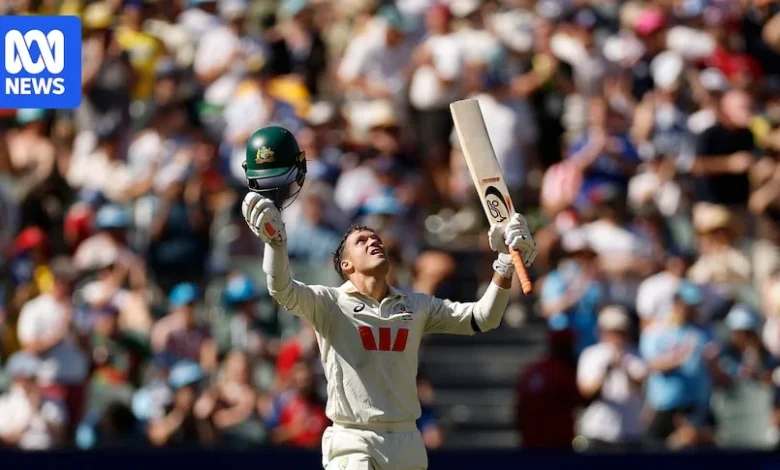
Here at Adelaide Oval, Carey’s name echoed out of the stands, over the hill, past the old scoreboard and through the Moreton Bay Figs, heard by his city and all of Australia, and surely by his father too, who died in September and was at the front of Alex’s mind in his moment of triumph as he gazed skyward.
This, his third Test century and first against England, was the sort of innings Carey would likely not have mustered four years ago when it all began. He is a leader now and a confident one at that, so assured of himself with bat and with the gloves.
Carey arrived at the crease abruptly after lunch after a mini-collapse and with Australia at risk of wasting a cracking day-one pitch. He left it with crisis averted and with his side not out of sight, but more than in the game.
At full flight he is a glorious batter to watch, and in spells he reached that level here. The nerves set in as the century approached, but before that Carey was powerful through the off side and classy through the leg, bold but not reckless with his strokeplay.
Alex Carey batted with freedom for most of his innings. (Getty Images: Robert Cianflone)
Australia needed somebody, anybody, to take his opportunity on day one. Carey eventually obliged, but in the AM hours it seemed like Usman Khawaja, of all people, was going to most strongly stake his claim.
Khawaja was parachuted in after extraordinary morning drama, in which it became increasingly clear Steve Smith would not play due to suffering from the symptoms of vertigo.
Anybody who has not experienced a bout of vertigo should consider themselves fortunate, as it can be a truly disorienting and frustrating experience.
Imagine the sensation of laying in bed after one drink too many, when your head feels like it is attached to the ceiling fan, but without any of the fun that got you there in the first place.
The spins can linger or disappear as quickly as they came, but you’ll never know which and therefore have to go about your business with the nagging concern the world might start revolving at any moment. It’s no way to live, let alone play a Test match.
Smith trudged across the Adelaide Oval outfield, backpack perched over his shoulders like the first day of school, with a look of frustration fixed to his face. But the decision to sit him was the only one Australia could make.
Steve Smith was a very late out in Adelaide. (Getty Images: Gareth Copley)
So there was Khawaja, not 24 hours after his career was delivered the last rites via non-selection, back in the XI and thrust into an unfamiliar spot in the order.
His early strokes were nervous and non-committal. His timing was out, but of more concern was the handbrake effect he was having on the Australian momentum. When he flashed his hands at a wide one on 5 and nicked it, Khawaja had all the appearance of a faded force on the way out.
But Harry Brook reacted poorly, perhaps sprung out of a dozy moment by the oncoming ball, and launched for a catch which did not require launching for.
Khawaja was dropped, a reprieve within a reprieve, and from there the freedom came.
He played elegantly off his pads, cut with flourish and took to Will Jacks with a sprinkling of disdain. If somebody has told Khawaja his Test future is dependent on an increased scoring rate, it is a message he has taken on board.
Before he had even reached 50, the implications of a Khawaja century were being discussed. Though he fell sweeping Jacks on 82, it is a discussion which will continue through this Test and into Melbourne.
Khawaja’s stay at the crease was concrete evidence of this pitch’s suitability for batting, as surviving and scoring looked mighty easy once he was established. With Adelaide on the cusp of a heatwave, and after the coin fell Australia’s way at the toss, this was a day to bat long, to bat sadistically, to bat out of fear of the other mob batting instead.
Australia threatened to follow through on that promise, but tripped every time it had a chance to get out and run.
Marnus Labuschagne threw his wicket away after lunch. (Getty Images: Robert Cianflone)
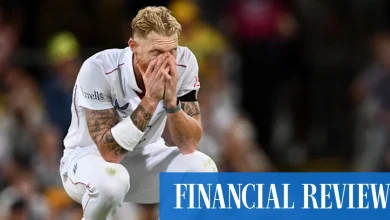
In three dramatic balls immediately after lunch, Australia coughed up two needless wickets and all the ascendancy with moments both Marnus Labuschagne and Cameron Green will work hard to forget.
The impulse after the Green dismissal was to reflect on the overnight headlines out of India, where the all-rounder had sparked a bidding frenzy at the IPL auction and was eventually valued at a record $4.17 million.
Obscene money, unsustainable money considering the uncertain financial future of the global game, and curious money given the appalling nature of the shot which cost Green his wicket after lunch.
In fairness, Green’s shot was only the second-worst of Archer’s post-lunch over. Two balls earlier, when Labuschagne’s brain and body stopped communicating, the most timid prod-pull across the line presented Brydon Carse with the simplest catch of his Test career.
They were gifted wickets for Archer, who deserved them in any case on the overall strength of his performance.
The discourse around Jofra’s performances this summer has been all over the shop, with criticism tossed out haphazardly and often without much reason behind it.
Archer has bowled well on the whole this summer, his only poor showing coming in the second innings in Perth when the entire English attack fell to bits. He was solid in the first innings in Brisbane, electric if a little too lippy in the second, and very good again here on day one in Adelaide.
He inserted himself into the story unnecessarily by baiting Smith under the Gabba floodlights, but to his credit looks to have taken the mild embarrassment of that affair and used it into fuel his fire rather than extinguish it.
Alex Carey rescued Australia on day one in Adelaide. (Getty Images: Gareth Copley)
Archer troubled Carey more than anyone and was unlucky not to take his wicket. But luck, among other things, was smiling on Carey in Adelaide.
Riding high after a stellar wicketkeeping performance in Brisbane, Carey’s career has now after four years reached a new level.
His keeping has long been deserving of comparison to Australia’s greats, but many more innings like this one could quickly prompt reassessment of Carey’s position in the pantheon of Australian wicketkeeper-bats.