Palestine & Middle East
Eamonn McCann, a veteran civil rights campaigner from the north of Ireland, spoke to Socialist Worker about the 1980s hunger strikes and today
By Arthur Townend
Downloading PDF. Please wait…
Tuesday 16 December 2025
Issue 2986
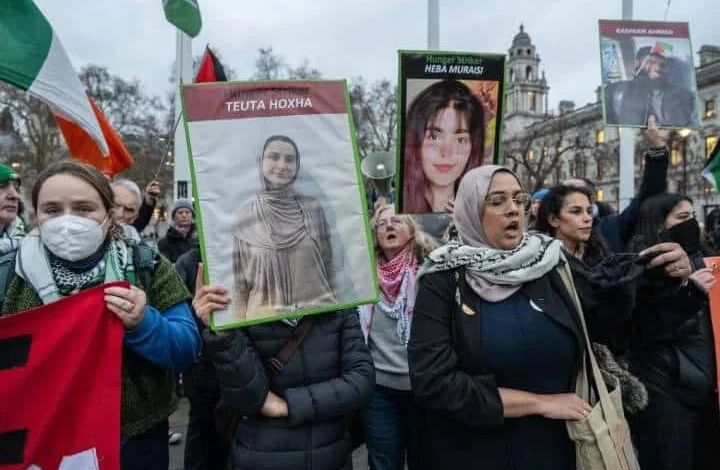
Solidarity with the hunger strikers outside parliament on 15 December (Picture: Guy Smallman)
The British state is willing to let eight political prisoners die. The Palestine hunger strikers stood up to the Labour government’s support for Israel’s genocide and were imprisoned awaiting trial.
They are on remand—some held without trial for over a year—allegedly in connection to action at Elbit Systems and the RAF’s Brize Norton base.
The strike is at a critical point in the third week of December, as two strikers were in their sixth week of refusing food.
The Labour government has branded the eight political prisoners “terrorists” after it banned Palestine Action under the Terrorism Act 2000.
This gave the British state free reign over Qesser Zuhrah, Amu Gib, Heba Muraisi, Jon Cink, Teuta “T” Hoxha, Kamran Ahmed, Muhammad Umer Khalid and Lewie Chiaramello.
They faced a torrent of abuse and arbitrary restrictions, forcing them to go on hunger strike just for basic freedoms.
The state has delayed medical care—leaving one prisoner, Qesser Zuhrah, lying on the floor of her cell for hours pleading for an ambulance. And it has restricted letters, communications and tried to ban them from speaking to the media.
Their crime is standing up to the real terrorists—Israel and its Western backers.
The hunger strike has laid bare the British state’s “vicious, murderous instincts”, says Eamonn McCann. He’s a veteran civil rights campaigner from the north of Ireland who has supported protests against the ban on Palestine Action.
The police sent Eamonn and 12 others “advisory letters” on 8 August, the day before a Lift the Ban protest, in an attempt at intimidation.
“Whose side are you on? The starving people in prison, or the side of the prison wardens and the whole state machinery?” he said.
He told Socialist Worker, “The state is ruthless. They let people die. They have done it for a generation and we are seeing it again now.”
The Palestine prisoners’ hunger strike is the biggest the British state has faced since 1981. Irish Republican prisoners went on hunger strike in the H-Blocks of Long Kesh prison. They had been locked them up for resisting British rule and discrimination against Catholics in the north of Ireland.
There are important differences between the hunger strikes in 1981 and the Palestine hunger strike today.
The British state was waging a war of occupation in the north of Ireland. Its troops murdered people and it trained and armed Loyalist murder gangs, which carried out state-backed assassinations and pogroms.
A Labour government sent troops in 1969 in a colonial military operation to prop up a repressive regime that discriminated against Catholics. They faced a challenge from a powerful civil rights movement on the streets. But vicious repression narrowed the space for mass struggle and saw the rise of the IRA.
In 1981, the British state let ten of the Irish Republicans die on hunger strike to make an example of those who resisted its rule.
“The British state was severely rattled by the Republican hunger strike,” says Eamonn. He added, “The one thing we have to keep in mind is that this is part of a struggle against repression.
“It is true of Irish Republicans and it is true of the Palestine Action prisoners. You only have to shine a light under the surface to see these similarities.”
The British state has faced a crisis of legitimacy over its ongoing support for Israel’s genocide in Gaza.
The ban on Palestine Action, a non-violent direct action group, became a focal point amid a torrent of repression of the entire movement.
The state faced a wave of sharp resistance over the ban, as people refused to be criminalised for resisting genocide.
“The fact that they’re in jail at all for supposedly being in Palestine Action is illustrative of how oppressive the British state has been towards the Palestine movement,” says Bríd Smith.
The former People Before Profit TD in the Irish parliament was active in the campaign around the 1981 strike. “The difference is that Ireland was under occupation—still is technically,” she told Socialist Worker.
“It was a very dangerous and very violent period of fightback against occupation. So that’s not the same—you can’t compare that with what’s going on in Britain.
“But the role of the British state hasn’t changed in that sense. The role of British imperialism, both in the occupation of Ireland and what’s happening now in Palestine, is continuous.
“And its bitterness, its viciousness—that’s what stands out to me, the viciousness. The British state has always been so vicious towards those who resist its rule.
“That was the case in Ireland and they’re now doing the same with people who mobilise to support Palestine.”
The demands of the Palestine hunger strike are clear—stop the censorship of prisoners, immediate bail, a fair trial, end the proscription of Palestine Action and shut down Elbit Systems.
The Palestine and labour movements should raise solidarity for the hunger strikers.
The real criminals on the Labour front bench should be made to pay for supporting a genocide and leaving those who resist it to die.
‘The state classed them as terrorists, now it’s got free rein’
Jayne is a Palestine activist organising around the hunger strikers in the Highlands and Islands of Scotland.
She knows Amu Gib, who’s currently imprisoned and on hunger strike for alleged involvement at the RAF Brize Norton action.
“Amu didn’t take this step lightly,” Jayne told Socialist Worker. “They’re very strong and committed. I spoke to Amu on Wednesday morning—they are tired but sharp and committed.”
Jayne said that the overarching force behind the hunger strike is the “situation in Palestine, and to draw more eyes to that”.
“Specifically regarding Elbit Systems, the demand is to shut it down—it supplies 85 percent of military equipment to Israel,” she said.
Jayne slammed the government’s actions as “beyond the pale”. “At the start, I was sending letters and books to Amu—and these were being specifically withheld,” she said.
“At this point, some of them have been in prison for nearly two years and they haven’t been convicted for anything. Because they have been classed as terrorists, it’s giving the state a free rein to do whatever it sees fit.”
Jayne said that the state’s overwhelming repression stems from the fact that Palestine Action was “so successful”. “Social media was exploding, normal people were getting behind the group,” she said.
“The government has contracts with Elbit, Leonardo and so on, but Palestine Action disrupted that.”
In the Highlands and Islands, Jayne and fellow activists are “constantly bombarding” MPs with letters and “door-stepping them whenever we can”.
“This is about the wider situation in Palestine—they say there’s a ceasefire, but that’s not what I’m seeing,” she said.
Labour has faced a crisis over its role in Israel’s genocide—and letting people starve in prison for opposing Israel’s barbarity is only adding to that.
‘Drop the charges, end complicity in genocide’
Leading figures in the international Palestine solidarity movement are demanding the immediate release of the hunger strikers.
One of them is Richard Boyd Barrett, a People Before Profit TD in the Irish parliament well-known for speaking up for Palestinian liberation.
He told Socialist Worker, “It’s absolutely shocking beyond belief that a so-called Labour government is prosecuting people under terror legislation.
“They were attempting to disrupt those involved in supporting the genocidal crimes being committed by Israel against the Palestinians.
“Keir Starmer should have arrested Israeli president Isaac Herzog—instead of welcoming him to Britain—for his incitement to genocide. Instead, he is persecuting those who wish to stand against Israel’s crimes.
“It’s very alarming that these brave protesters now have their health and lives seriously imperiled because of the moral and political bankruptcy of the British government. They should be immediately released on bail.
“But, beyond that, these outrageous charges should be dropped. These people should be commended for doing what the government is actually obliged to do under the genocide convention.
“But certainly, the charges should be dropped immediately and Britain should end its shameful complicity with the genocidal regime of Israel.”