The generative AI industry has some key supporters in the video game industry in the form of Microsoft, Ubisoft, and EA, but it has made some big enemies too. Chief among them is Bruce Straley, the Last of Us co-director who left Naughty Dog in 2017 and went on to found his own independent studio, Wildflower Interactive. In an interview with Polygon ahead of the 2025 Game Awards, where we saw the first trailer for Wildflower’s debut game Coven of the Chicken Foot, Straley didn’t hold back about the prospect of generative AI aiding in game development.
“It’s a snake eating its own tail,” Straley told Polygon. “It can’t grow and think for itself, it just consumes, and it tries to mimic what it’s consumed. That’s the best it can do right now.”
Image: Everstone Studio/NetEase Games via Polygon
The topic came up as Straley told me about the tech powering Coven of the Chicken Foot. The upcoming adventure game, which stars an elderly witch, features a highly reactive companion character. It’s able to observe what players do, mimic their behaviors, and learn like a toddler would. None of that is being accomplished through generative AI tricks; it’s just good old-fashioned game design that builds upon Straley’s work at Naughty Dog. After he describes it to me, I point out that Wildflower seems to be accomplishing something that generative AI advocates have been pushing for years, which is creating more responsive NPCs. Straley believes that the studio was able to accomplish that thanks to its commitment to human work.
“The charm is that the creature is allowed to be a buffoon,” Straley explained. “If you feed it too many bad apples, it gets indigestion and poops in the woods. These are the things you can discover, but it’s because we can create a world and craft those moments. We’re not trying to create a human. If you’re trying to match human intelligence… Look, we’ve had hundreds of millions of years of evolution to get to this little eight pound supercomputer in our skulls. It’s a miracle what we’re able to do. They can do a fraction of what our brains can do in a football field of computation, and they’re still not able to do it. I don’t know who wants it, I don’t know who’s asking for it, I don’t know who’s pushing for it, but I don’t think it’s the way as a human species we need to be evolving.”
I have zero interest in looking at art that is generated by a computer.
Straley notes that the rise of generative AI has muddied the waters for video game creators like him. Despite the fact that Straley didn’t use generative AI to create Coven of the Chicken Foot and is staunchly against the tech, he has found it hard to discuss what Wildflower is creating without it getting misinterpreted and lumped into the tech craze. That’s because the term has been used in gaming for decades, usually to refer to the human-scripted actions and reactions of enemies and other non-player characters.
“It’s difficult to even pitch the concept of this creature, because in my world, NPCs are AI,” Straley said. “AI programmers are a type of personnel you have on staff in the programming department. Now you can’t say that because if somebody does have an opinion about AI, I can’t now call this creature the most advanced AI companion. People are going to think we did machine learning, and LLMs, and all that. No, we did none of that. This is hard work, and a lot of problem solving, and a lot of creative thinking. Which I think makes it more charming. I like art that has chips and flaws. It’s like pottery. It has imperfections because it didn’t come out of the kiln right. That’s the cool stuff about art.”
Image: Embark Studios
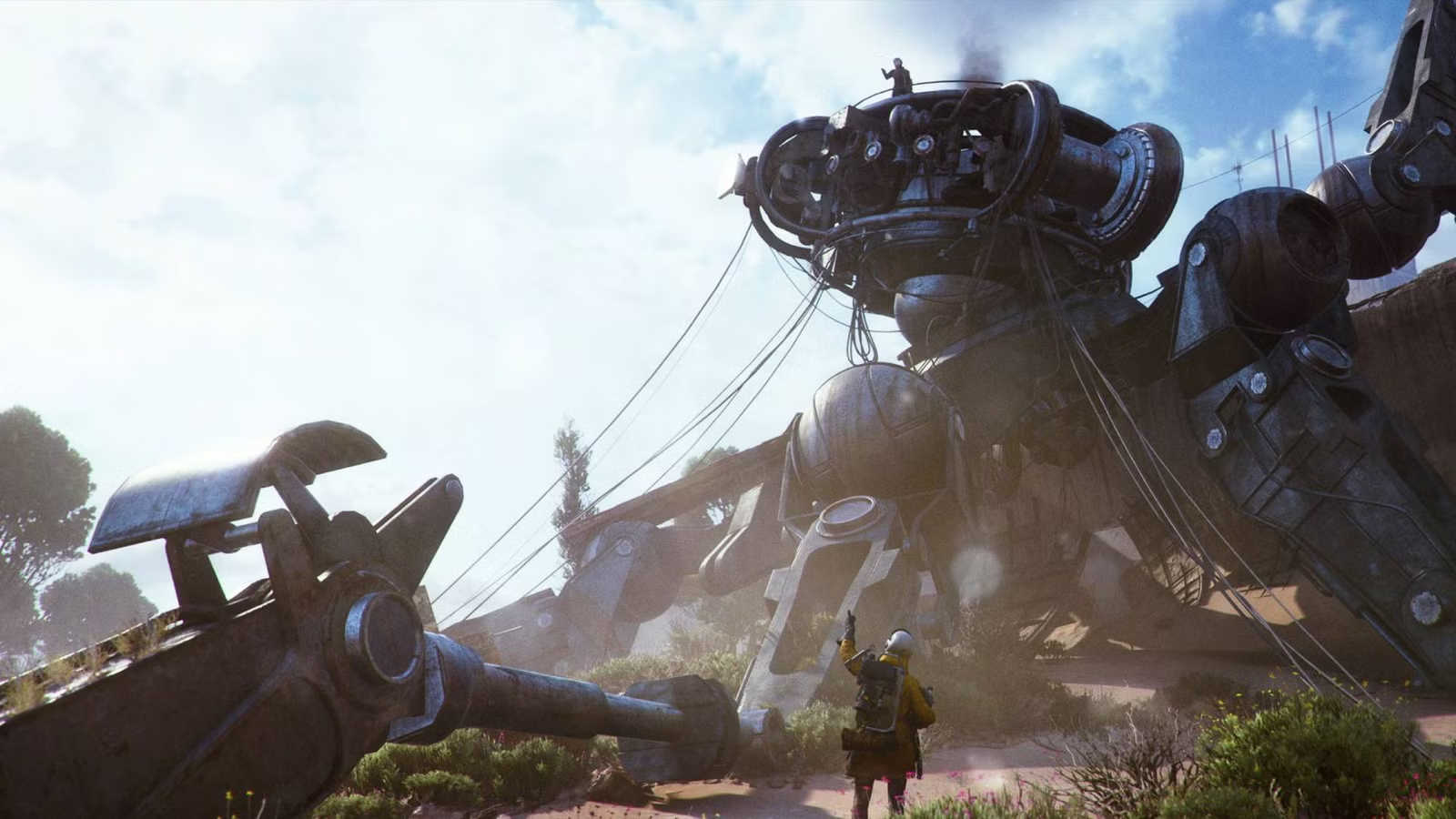
Not all developers agree with Straley’s assessment. Recently, Embark Studios utilized the technology in its multiplayer hit Arc Raiders to create AI-fueled NPCs. NetEase Games’ Where Winds Meet also uses the tech to power some of its NPCs, as players can interact with certain characters that function like AI chatbots. (The feature has allowed players to skip puzzles and earn loot, with the right prompts.) The tech is popping up in more and more mainstream games, making it harder for players to fully avoid it.
It’s not that Straley doesn’t believe that generative AI can be useful in some contexts or that the tech won’t improve. His dissent is more philosophical in nature, as he simply doesn’t believe there’s value in art that wasn’t created by humans.
“Maybe it can work,” Straley admitted. “If your dataset is small enough that you’re only working within the world space, like maybe you get a team of writers in a AAA company to write the lore of a world and feed that in and try to spit out dialogue based on that, you might create something compelling. I’m not interested in the slightest bit in that world. I feel like without a human being the creation, I personally have zero investment in wanting to watch a TV show made by a robot. I have zero interest in looking at art that is generated by a computer. I don’t think prompting is art.”
Somewhere in the middle of his long answer, Straley stops to heave a big sigh before making his position as blunt as possible: “I don’t like AI!”