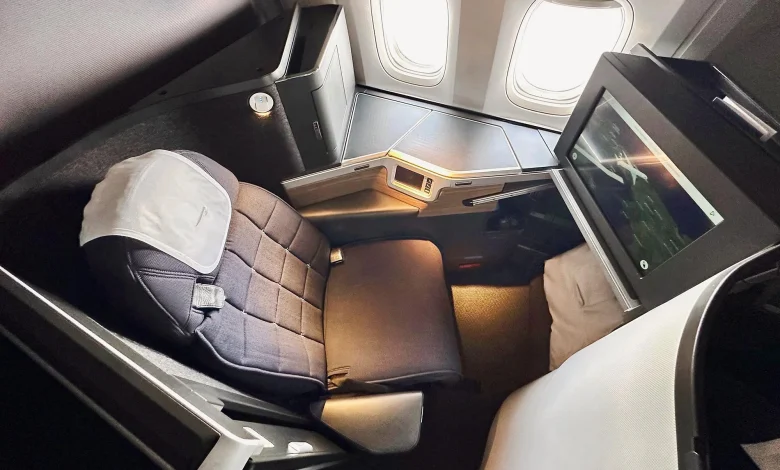
British Airways’ Club Suite saw it leapfrog from early 2000s mediocrity to the latest closed-door mini-suites in Business Class. How does the experience stack up?
Most major airlines refresh their long-haul Business Class products every decade or so, to stay competitive, but British Airways has charted its own course over recent years. The airline launched Club World in 2000 – revolutionary for being the first Business Class seat to offer a truly flat bed, a full six years before Singapore Airlines followed suit.
That early success, however, seemed to breed some complacency.
Despite minor tweaks over the years, BA stubbornly stuck with Club World’s aging design and peculiar yin-yang configuration that often meant staring at a stranger for much of your journey. It wasn’t until 2019 that the airline finally made the leap, arguably skipping an entire Business Class seat generation in between, to introduce the Club Suite – a proper 1-2-1 layout with full aisle access and closing privacy doors.
A few weeks ago I snagged my first experience of this new product on a flight from the USA to London – a good opportunity to see if BA has finally brought its Business Class experience up to par, with a full review.
Flight details
- Flight: BA196 Houston to London Heathrow
- Class: Business
- Seat: 17A
- Aircraft Type: Boeing 777-300ER
- Aircraft Registration: G-STBK
- Aircraft Age: 11.4 years
- Departure / Arrival: 21:00 / 12:20
- Flight Time: 9h 20m
The aircraft was nearly 12 years old, but its Club Suites cabin was installed three years ago in August 2022, from the old yin-yang Club World product. BA also refitted its First Class cabin to include closing doors at the same time.
The Club Suite
British Airways deserves credit for pioneering the world’s first fully flat-bed seats in Business Class back in 2000, but let’s be honest, the airline has been left behind for at least the last decade in a competitive marketplace increasingly dominated by Middle Eastern and Asian carriers.
BA had let the existing Club World seat fall so far behind industry standards, especially over the past ten years, that any minor enhancement was never going to cut it.
Enter the Club Suite.
British Airways’ Club Suite on the Boeing 777-300ER.
(Photo: MainlyMiles)
The seat is a customised version of the Collins Super Diamond product, adapted by BA to include its own features – most notably a closing privacy door. You may recognise the seat (minus the door) as that installed on Qatar Airways’ older Airbus A350-900s, which we reviewed a few years ago.
Seats are arranged in a 1-2-1 reverse herringbone layout, with all seats angled rather than forward-facing. Window seats face away from the aisle towards the window, while the middle pairs face each other.
Key specifications
- Bed length: 79 inches (200 cm)
- Seat width: 21 inches (measured between armrests)
- Screen: 18.5-inch HD touchscreen (fixed position)
- Charging: 2 x USB-A ports, 1 x universal 110v AC
- Door height: 44 inches (112 cm)
Contrary to BA’s older Business Class seats, the new Club Suite comes with that all-important sliding privacy door, now almost ‘de rigueur’ in the latest Business Class seat products.
The Club Suite has a 44-inch privacy door.
(Photo: MainlyMiles)
The seat converts into a fully-flat bed measuring 79 inches (200 cm), ample even for taller passengers, overall a significant upgrade over the previous Club World product in terms of both comfort and privacy.
Booking
This was a work trip and a last minute change of plan to head to the UK saw me rebooked – somewhat against my will – on this British Airways flight from Houston to London at short notice, just two days before departure (instead of an Emirates flight straight home to Singapore, via Dubai).
On the plus side I was pleased to see the flight was operated with a Club Suites-equipped aircraft – a first for me – and of course that I didn’t have to part with any miles (Avios) or cash of my own to finally achieve it!
Nonetheless this really isn’t a good value Avios award route anyway, thanks to BA’s steep carrier surcharges on long-haul awards, whether you use the airline’s own programme or the Qatar Privilege Club to book.
Avios Award Rates
BA Houston – London
Business Class
Off-Peak
Peak
90,000 Avios
+ S$663
100,000 Avios
+ S$663
76,000 Avios
+ S$857
84,000 Avios
+ S$857
62,500 Avios
+ S$1,003
75,000 Avios
+ S$1,003
54,000 Avios
+ S$1,388
58,000 Avios
+ S$1,388
45,000 Avios
+ S$1,731
42,000 Avios
+ S$1,731
31,250 Avios
+ S$1,988
30,000 Avios
+ S$1,988
Asia Miles is a better proposition, with Business Class awards at 63,000 miles + S$510, still a very steep cash outlay but less than BA and Qatar are charging, though you need partner award space to be available in order to book at this rate – BA offers more award seats to Avios members than to Oneworld partners.
Other redemption options, if you have the appropriate miles in the right place and partner awards are being offered, include:
- American Airlines AAdvantage: 57,500 miles + US$947
- Qantas Frequent Flyer: 108,000 points + US$1,362
Seat selection – a dilemma
British Airways’ Boeing 777-300ER features a massive 76 Club Suites following its retrofit – the second-highest Business Class count in the BA fleet after the A380’s 96 seats. To put this in perspective, it’s a significantly different capacity strategy compared to the Boeing 787-10 that operates the earlier daily departure from Houston.
Both aircraft have identical 256-seat total capacity, but the 777-300ER clearly prioritises Business and Premium Economy over Economy, while the 787-10 tilts the balance towards more Economy passengers – an interesting split in BA’s fleet philosophy.
British Airways’ Boeing 777-300ER Club Suite configuration, with 76 seats across three cabins.
(Image: aeroLOPA)
Even BA’s upcoming Boeing 777-9 will feature 15% fewer Business Class seats than this current 777-300ER configuration. Did BA perhaps overdo it slightly in this cabin with the refit?
Anyway here’s the worst part – BA charges for advance seat selection in Business Class, except for its most expensive fully-flexible fare types.
The only ways around this are to either fork out the cash, or hold British Airways Silver or Gold status (or equivalent Oneworld Emerald / Sapphire), which grants free seat selection from the time of booking. Bronze members (or Oneworld Ruby) get free seat selection within seven days of departure, while everyone else can just wait until online check-in opens and take their pick from what’s left at T-24h.
I was booked into a semi-flexible R fare bucket, which didn’t count as one of the eligible categories for complimentary seat selection – those are limited to the fully flexible J, C and D fare classes.
Without any decent Oneworld status to call on, that left me with two options: either fork out US$135+ just to pick my seat (US$135 for a middle seat, US$160 for a window seat), or take my chances at online check-in.
ExpertFlyer seat availability around 48 hours before departure.
(Photo: MainlyMiles)
I decided on the latter approach, having scoped out the seat availability via ExpertFlyer, which showed the cabin was relatively empty towards the back. This suggested I should be able to score a solo window seat without too much trouble, and without the hefty surcharge.
I set an alarm reminder for exactly 24 hours before departure and managed to secure 17A (seat 16A had already been snapped up by that point), but this still put me right at the back of the large 11-row second cabin section, with a bulkhead behind me.
At least I hadn’t had to pay for the privilege!
Check in
British Airways offers dedicated check-in for Club World customers, and those travelling in lower cabin classes with Silver or Bronze status in its frequent flyer programme – or Oneworld Sapphire and Ruby equivalents.
British Airways priority check-in at Houston Airport.
(Photo: MainlyMiles)
Check-in was quick, my bag was tagged and boarding pass issued, then after a short journey up the escalator to the TSA screening point, through security and to the lounge took a grand total of just 8 minutes from taking the above photo (which was taken before I checked in!).
I was quite astounded how quiet the terminal was and how efficient the process was – yes the TSA agents were still rude (par for the course in the USA), but to be processed so fast was surprising.
Lounge
British Airways uses the Executive Club Lounge in Houston, a third-party facility that coincidentally shares its name with the airline’s former loyalty programme (now simply “The British Airways Club”).
Entrance to the lounge.
(Photo: MainlyMiles)
It’s really nothing special, though it was quiet and includes a tended bar plus a decent selection of hot and cold food.
The Executive Club lounge in Houston.
(Photo: MainlyMiles)
Not one to reach the airport early to experience, was my lasting impression.
Boarding
Boarding commenced 30 minutes prior to departure, with Club World passengers invited forward after families with young children, those requiring assistance, and First Class passengers had been called in turn.
This gave me the opportunity to get my first proper glimpse of the product as I made my way through the cabin.
The middle seat pairs are an interesting proposition – they really don’t lend themselves particularly well to travelling with a partner, since you have to lean forward when you want to have a chat, given that the consoles of both seats are positioned in the middle, rather than on the outside.
The middle seat pairs (seats 18E and 18F here) face each other – sort of!
(Photo: MainlyMiles)
A small privacy divider slides closed if you happen to be seated next to a stranger here, and I’d actually be perfectly comfortable with the overall privacy this arrangement provides.
In fact, I’d go so far as to say there are no truly ‘bad seats’ in the Club Suite configuration, some are just better suited to solo travellers than couples, and vice versa.
The Club Suite door features an embossed seat number and BA’s ‘speedwing’ logo.
(Photo: MainlyMiles)
Waiting at my seat 17A was a White Company amenity kit, a bottle of water positioned in the holder at the back of the console, and a White Company bedding pack already laid out.
First impressions? The cabin felt intimate and modern, a significant step up from the old Club World in terms of both aesthetics and that all-important sense of personal space.
Seat 17A on boarding.
(Photo: MainlyMiles)
The suite felt quite private, even with the door still locked open for boarding.
Settling in
Within just three minutes of reaching my seat, the crew were already circulating with welcome drinks – champagne or orange juice were on offer.
I opted for the champagne, naturally, which arrived in proper glassware with a very short stem, to account for in-flight turbulence.
Champagne on boarding.
(Photo: MainlyMiles)
Shortly afterwards, menus were distributed, with both food and wine lists provided in the same tall booklet which extends in concertina style.
Menus are distributed shortly after the welcome drink.
(Photo: MainlyMiles)
What particularly impressed me was the efficiency of the pre-departure service. Before we’d even pushed back from the gate, the crew had already taken full meal orders, including my post-takeoff drink preference and whether I wanted still or sparkling water with my meal!
The seat itself has high-quality upholstery and nice detail on the stitching, while the suite wall has a felt-like lining, which apparently reduces noise.
Detailed stitching on the seat.
(Photo: MainlyMiles)
Seat controls
The seat control is located below the side console, just to the side of the fixed armrest.
The seat control panel is located to the side of the left armrest.
(Photo: MainlyMiles)
You can use one of three buttons to the right of the screen, or you can customise specific functions by tapping the screen itself, which brings up more options.
Seat control panel.
(Photo: MainlyMiles)
Pressing any of the buttons immediately moves the seat, then you simply hold until reaching your desired setting. The seat stops adjusting when you release the button or stop pressing the screen.
Seat control panel.
(Photo: MainlyMiles)
Overall it’s quite intuitive to move the seat to your desired setting, including bed mode.
Table
The bi-fold tray table stows neatly underneath the TV screen at a good height to maximise legroom.
It needs to be pulled out before it can be deployed for use. When fully unfolded, it measures a generous 16 x 18 inches (40 x 46 cm), ample surface area for dining or laptop work.
The table in its furthest position, folded at the upper detent.
(Photo: MainlyMiles)
The table can be positioned at two different heights depending on your needs, either closer to your body for dining, or extended further away when you want a bit more breathing room, easier access to move around or just want to use it as a cocktail table.
The table in its closer position, folded at the lower detent.
(Photo: MainlyMiles)
Table fully extended at the lower position, closer to the seat.
(Photo: MainlyMiles)
Table extended at the upper position, further from the seat.
(Photo: MainlyMiles)
Here it’s also worth mentioning that the armrest between the seat and the aisle is fully retractable. This serves two purposes: it gives the seat a bigger effective surface area in bed mode, but crucially it also allows you to slip in and out during meal service with the table fully extended – no need to pack everything away just for a quick toilet break.
The aisle-side armrest in its raised position.
(Photo: MainlyMiles)
The aisle-side armrest fully retracted, allowing easy exit even with the table deployed.
(Photo: MainlyMiles)
The armrest also locks at intermediate positions according to your preference, so you can find exactly the right height for optimal comfort during the flight.
Storage options
BA’s former Club World seat suffered from a chronic lack of decent storage by modern Business Class standards, so it’s good to report that the Club Suite makes a genuine effort to address this shortcoming – though with mixed results.
The seat features two primary storage compartments on the side console for smaller personal items like glasses, wallet, or your phone. The larger of these holds the inflight entertainment handset, two USB ports, and the power socket, while still leaving enough room for a phone or other small essentials.
The shallower storage compartment on the left.
(Photo: MainlyMiles)
The deeper storage compartment on the right.
(Photo: MainlyMiles)
Next to the seat back is a console with a vanity mirror and additional storage space inside, enough for headphones or the amenity kit, though honestly it’s not especially spacious.
The side storage compartment with vanity mirror.
(Photo: MainlyMiles)
The reading light is fixed to the seat’s wall, positioned such that it can’t really disturb neighbouring passengers.
Reading light.
(Photo: MainlyMiles)
The light comes on automatically when you pop it out, then you can adjust the angle so that it illuminates the table, right round to a more appropriate angle for reading a book, for example.
Reading light in forward position.
(Photo: MainlyMiles)
Reading light at its rear angle limit.
(Photo: MainlyMiles)
At the front of the console near floor level is a deep storage recess where you can stash personal items during the flight, such as the amenity kit or a small bag. However, this space isn’t approved for use during takeoff and landing, so you’ll need to transfer anything stored here to the overhead locker during these periods.
The deep storage recess at floor level near the front of the console.
(Photo: MainlyMiles)
There’s also floor storage available under the footrest, useful for slipping off your shoes and keeping them out of the way during the flight, though it’s a tight squeeze if you’re wearing anything larger than a UK size 10!
Shoe storage space under the footrest.
(Photo: MainlyMiles)
Finally, there’s a coat hook mounted on the back of the seat in front, though I suspect very few passengers actually make use of these, most people seem to prefer the overhead lockers for jackets and coats.
Coat hook on the seatback in front.
(Photo: MainlyMiles)
Hanging a large coat or jacket there would also impede your entry and exit to the seat.
The door
The Club Suite’s signature feature is undoubtedly its sliding privacy door, though it comes with some operational caveats worth understanding before you get too excited.
The door is fixed in the open position during takeoff and landing, a regulatory requirement in case of an evacuation, but once at cruise altitude the flight attendants release the locking mechanism and you’re then free to leave it open or closed according to your preference.
The door also does not fully close, with about a 1 cm gap from the front edge to the back of the suite in front.
The door in its fully closed position.
(Photo: MainlyMiles)
At 44 inches tall, it’s a decent height, but let’s be clear, it’s far from floor-to-ceiling.
For context, Qatar’s Qsuite doors stand at 52 inches, making BA’s offering notably shorter by comparison. This means cabin crew can still easily peer over and check in with you as needed, which is presumably intentional from a safety perspective.
In practice, the door predominantly provides improved privacy in bed mode rather than while seated upright. When you’re sitting normally, the door doesn’t make a huge difference to your sense of seclusion.
The Suite door provides the most privacy while in bed mode.
(Photo: MainlyMiles)
I only bothered closing the door when sleeping, which is probably when most passengers will use it. Once you’re horizontal and tucked under the duvet, having that extra barrier between you and the aisle does create a noticeably more cocoon-like environment.
Is it revolutionary? No, but it’s a meaningful upgrade over the former Club World.
Power and device charging
Charging options in the Club Suite are located in the deeper of the two side storage compartments, alongside the IFE remote control. You’ll find two USB-A ports and a universal 110V AC socket delivering up to 125 Watts, which is enough power to charge even demanding laptops at decent speed.
USB-A charging ports in the side storage compartment.
(Photo: MainlyMiles)
Unfortunately, there are no USB-C outlets or wireless charging on offer, the Club Suite was probably designed just a bit too early to incorporate these latest enhancements that are now becoming standard in newer Business Class products.
What I did appreciate was the depth of the compartment. It’s generous enough to accommodate an Apple charging block without any awkward squeezing or repositioning required. Everything fits comfortably inside, which is more than can be said for some premium seats when you’re trying to use bulky adapters.
The compartment is deep enough to comfortably accommodate an Apple charging block.
(Photo: MainlyMiles)
There’s also a thoughtful design detail worth noting: a small gap in the sill of the compartment once closed, allowing charging cables to thread through even when the lid is shut.
A small gap allows charging cables to pass through even when the compartment is closed.
(Photo: MainlyMiles)
This means you can keep your phone or laptop charging elsewhere in the seat – on the table, on your lap, or tucked away on the side console, without having to leave the storage compartment awkwardly ajar.
It’s these little details that show someone actually thought about real-world usage patterns when designing this seat, even if the charging options aren’t cutting-edge by 2025 standards.
Amenity kit
Business Class passengers on BA’s long-haul routes like this one are provided with an amenity kit by The White Company London.
Amenity kit by The White Company.
(Photo: MainlyMiles)
This certainly doesn’t stand up to the amenity kits provided by Middle East carriers like Emirates and Qatar Airways, which include fragrance, deodorant and shaving kits, but it at least surpasses the lacklustre Singapore Airlines offering in Business Class.
Amenity kit contents.
(Photo: MainlyMiles)
Contents include:
- Earplugs
- Dental kit
- Eye mask
- Flight socks
- The White Company Pulse Point relaxation oil (3 ml)
- The White Company Luxury Lip Balm (3 ml)
- The White Company Restore Moisturiser (5 ml)
The enclosed information card describes the products, along with some advertising blurb for The White Company itself.
Wi-Fi
British Airways’ Boeing 777-300ERs are fitted with Intelsat 2Ku satellite Wi-Fi, but unlike in First Class where unlimited connectivity is free, Business Class passengers have to pay for the service.
Nonetheless, there is the option to enrol for a free ‘Messaging package’ if you’re a BA The Club member, but if you want to do more productive work on board or browse social media, stream music or video during your journey, you’ll need to pay for the ‘Stream package’.
On this Houston to London service the cost was GBP 19.99 (~S$35), which is definitely on the steep side for a nine-hour flight, especially when you consider that most airlines now offer a complimentary unlimited connection for Business Class passengers.
Each connection is tied to a single device with no option to switch between devices, unlike some carriers that allow unlimited device switching within the same session. This inflexibility is frustrating if you have multiple devices and wish to switch between them – impossible on BA, as it was on Finnair during my recent flight.
Since this is a Ku-band connection, it’s slightly slower than the newer Ka-band systems, and of course much slower than the latest Starlink low-earth orbit (LEO) satellite connections.
However, one benefit of the Wi-Fi being expensive is that for those who do pay, the connection is quite fast, since only a limited number of passengers will bother signing up for the full connectivity option due to the high cost, especially on an overnight flight.
I found the connection reliable and quick, with the following speeds recorded at three different parts of the journey:
Test 1
- Down: 30.89 Mbps
- Up: 3.37 Mbps
Test 2
- Down: 63.77 Mbps
- Up: 2.82 Mbps
Test 3
- Down: 60.00 Mbps
- Up: 1.90 Mbps
To get around the ‘once device’ rule, I connected my phone to the complimentary Messaging package as a BA Club member, so at least I could use it for WhatsApp, but I can confirm it won’t do anything else – including sending or receiving messages that include images or attachments.
British Airways has recently announced that it will install Starlink Wi-Fi fleet-wide from 2026, with free connectivity for all passengers that that ‘feels like home’, which will be a very nice improvement over these expensive paid packages – even though I can’t complain about the download speeds themselves on this particular flight.
In flight entertainment
BA’s Club Suite on the Boeing 777-300ER features an 18.5-inch HD display, which is fixed in position and can be controlled either by touchscreen – which I found the easiest method thanks to its relative proximity – or via the IFE controller housed in the side storage compartment.
The 18.5-inch HD screen showing the flight route on the ground in Houston prior to departure.
(Photo: MainlyMiles)
The system runs on the Panasonic eX3 platform, with content available gate-to-gate, a significant improvement over the old Club World, where the 15.4-inch screen had to be stowed for takeoff and landing.
Being able to dive straight into a film during taxi, or keep watching right through descent and landing, is one of those small conveniences that genuinely improves the experience.
The IFE remote control, housed in the side storage compartment.
(Photo: MainlyMiles)
Active noise-cancelling headphones are provided, which were decent quality with good sound isolation, though the headband padding could have been a touch more comfortable for extended wear. They’re unbranded, which is quite common for Business Class, though I understand they are Panasonic RP-HC800s.
They get the job done – quality is solid but they are not industry-leading.
BA’s unbranded active noise-cancelling headphones.
(Photo: MainlyMiles)
The entertainment system itself, called “High Life”, offers an extensive selection of movies and box-set TV episodes to explore. The 3D interactive flight maps are a particular highlight, allowing you to follow the flight route in high-resolution graphics – perfect for AvGeeks who want to track progress throughout the journey.
The High Life entertainment system offers an extensive movie library.
(Photo: MainlyMiles)
I found the system one of the simplest on the market when it comes to ease of navigation and browsing the selection, with a logical and clear user interface that doesn’t require you to hunt through endless menus to find what you’re looking for.
Sometimes the best design is the one you don’t have to think about, and BA’s High Life system definitely falls into that category for me.
Food and drink
The meal service after takeoff started with a drink from the bar, and I had pre-ordered a Hattingley Valley English sparkling wine – which was served in a wine glass rather than a champagne flute, and was a very generous pour!
A generous pour of the Hattingley Valley Blanc de Noirs Brut 2019.
(Photo: MainlyMiles)
This excellent option scores 4.1 out of 5 on Vivino, better than most Business Class champagnes. It was previously exclusive to BA’s First Class (albeit the 2015 or 2018 vintages in that case), but has now been extended to Business Class.
Personally I preferred this over the Nicolas Feuillatte champagne also offered, though that’s not a bad drop either.
Here’s how the food and beverage menu looked for this flight, with supper followed by breakfast.
Menu
Before the meal service, a hot towel was offered.
Hot towel.
(Photo: MainlyMiles)
For the starter I opted for the Smoked Atlantic salmon.
Smoked Atlantic salmon.
(Photo: MainlyMiles)
This dish was fresh and delicate, with the fish maintaining a proper texture that suggested quality sourcing.
The real surprise came from the spicy mango salad positioned in the centre of the plate – unexpectedly vibrant and zingy, it delivered a genuine chilli kick that provided an interesting contrast to the richness of the salmon. It’s a bold choice for British Airways, who in my experience tend to stick to slightly more ‘bland’ options, but this worked really well.
The pickled cucumber, however, lived up to only half its name – it was essentially just cucumber without any discernible pickling, though it served its purpose as a refreshing element on the plate.
For the main course I decided on the lemon herb cod fillet.
Lemon herb cod fillet.
(Photo: MainlyMiles)
This was served with turmeric and herb couscous, sautéed spinach, shallots, and a Mediterranean olive sauce.
The couscous was well executed – fluffy and well-seasoned with a nice golden hue from the turmeric.
The fish itself was serviceable rather than exceptional, suffering from the limitations that often plague protein cooking at altitude, though the robust red Mediterranean sauce did it favours and added much-needed moisture and depth.
The spinach, while nicely flavoured, had that telltale sogginess of having spent a bit too long in the aircraft ovens – another casualty of the constraints of inflight catering. That said, the overall flavour profile of the dish was well-balanced, and the portion size was generous, without being overwhelming just before bedtime.
The real standout was the side salad of black rice and quinoa, which proved to be a surprising winner. It had distinct Middle Eastern notes, likely from what appeared to be parsley or possibly another herb, giving it a fresh, vibrant taste.
The warm bread service featured a fist-sized herb-flecked roll with butter – very nice, but a bit much for me in addition to what was already a substantial meal.
For dessert I want for the warm chocolate raspberry lava cake, served with vanilla crème anglaise.
Warm chocolate raspberry lava cake.
(Photo: MainlyMiles)
I should preface this by admitting that I don’t have much of a sweet tooth – dessert for me is largely a professional obligation for review purposes – but I could appreciate the execution here.
The presentation was appealing, with the molten center revealing itself dramatically when cut, releasing a stream of raspberry into the pool of custard.
Some oozing satisfaction.
(Photo: MainlyMiles)
It was undeniably rich and decidedly sweet, way too much for my personal palate, but I suspect it would be precisely what many passengers are looking for to round off their meal.
The sponge had a notably dense texture, which gave it a substantial, almost fudge-like quality. Whether this is a virtue or a flaw no doubt depends on your preference. Some might find it satisfyingly decadent, while others might expect something lighter.
For those with a genuine sweet tooth, this would undoubtedly hit the spot, but personally I should probably have gone for the cheese!
After a good sleep, breakfast service began with a single option: fried eggs, bacon, and Swiss cheese on a toasted English muffin with smoked tomato chutney.
Fried eggs, bacon, and Swiss cheese on a toasted English muffin.
(Photo: MainlyMiles)
It was a simple, straightforward affair – nothing particularly memorable, but perfectly adequate. The English muffin was properly toasted, the eggs cooked through, and everything came together in a serviceable if unremarkable fashion.
Alongside was a coconut chia pudding, mango compote and a blueberry muffin, none of which I actually tried because I’d just finished dinner six hours earlier!
I requested a cappuccino but was informed that only regular coffee was available – surprising but a fact then confirmed when I checked the menu.
The coffee arrived promptly and tasted fine, though the lack of any espresso-based options does feel somewhat basic for a Business Class service. It’s not a deal-breaker by any means, but other airlines in this cabin typically offer a broader coffee selection, and it’s a small detail that would elevate the breakfast experience.
Wine ratings
One aspect that particularly impressed me was the wine and port selection – seven different options plus champagne, which is genuinely excellent for Business Class.
To put this in perspective, Singapore Airlines typically offers just five wine choices on long-haul flights in the same cabin, with one champagne and one dessert wine or port, making BA’s offering notably generous.
Here’s how the full champagne, wine and dessert wine selection on this flight stacks up on our favourite comparison website Vivino, out of 5.
Bed mode
The Club Suite converts to a fully-flat 79-inch (200 cm) bed, plenty of length even for taller passengers, and a big improvement on the 72-inch Club World beds.
Sadly, BA does not provide pyjamas in Business Class – only in First.
The White Company bedding package, waiting at each seat.
(Photo: MainlyMiles)
Bedding is provided by The White Company and is genuinely soft and comfortable. It includes a mattress pad, duvet and generously-sized pillow. It’s a noticeable step up from the rather thin bedding you’ll find on some carriers, and the mattress pad in particular adds a welcome layer of cushioning to the seat base.
The Club Suite in bed mode, viewed from above.
(Photo: MainlyMiles)
The footwell obviously narrows towards the end, an inevitable consequence of the reverse herringbone layout, but it’s still quite spacious even in this non-bulkhead seat. I’m had no issues with feeling cramped or restricted.
The full length of the bed from head to toe.
(Photo: MainlyMiles)
Plenty of room for feet, even at this non-bulkhead seat.
(Photo: MainlyMiles)
I slept soundly for close to five hours on this flight, waking only once briefly before drifting off again, which for me is about as good as it gets in the air. The combination of the fully-flat surface, good bedding, and that privacy door doing its job meant I actually felt quite rested on arrival in London.
Club Kitchen
BA’s wide-body aircraft feature the “Club Kitchen” somewhere in the Business Class cabin. This is a self-service area where you can help yourself to drinks and snacks between meal services, without having to trouble the crew.
On the Boeing 777-300ER, this is located on the right side of the aircraft between Rows 7 and 8, at the main galley and toilet area separating the two cabin sections.
The Club Kitchen on BA’s Boeing 777-300ER.
(Photo: MainlyMiles)
It’s nothing too special – crisps, nuts and cookies alongside a variety of soft drinks, plus self-pour wine and champagne. The nice thing is that it includes a fridge, so at least the champagne is properly chilled rather than sitting at room temperature.
While you can of course always press the call button and ask the crew for a glass, I found myself pouring a champagne here on my way back from the toilet. There’s something quite liberating about being able to grab a drink on your own schedule, especially on overnight flights when you don’t want to disturb the crew during their quieter periods.
It’s a small touch, but one that adds a bit of flexibility to the overall experience, though I can’t see carriers like Singapore Airlines going down this route!
Service
One aspect of the service that immediately struck me was the sheer speed of execution.
Once the post-takeoff service began, it felt almost like a race against the clock, and at wheels-up plus just two hours, all the cabin lights were dimmed and it was sleep time.
This is clearly a deliberate strategy, and I have to admit, they really do achieve maximum rest time for passengers on overnight transatlantic flights. While I can certainly understand this approach on a shorter JFK-LHR sectors that can sometimes clock in at barely six hours, I’d expected things to be slightly more relaxed on a nine-hour Houston-London routing.
But no, sleep is evidently the priority, and BA ensures everyone gets the message.
The breakfast service was equally brisk. I’d asked to be woken for the meal, and when I stirred naturally at landing minus 1 hour 10 minutes to go, I was genuinely surprised – assuming I must have missed it entirely. It hadn’t even started yet!
The cabin slowly waking for breakfast, just over an hour before landing.
(Photo: MainlyMiles)
Within five minutes the lights came on, breakfast was served alongside coffee, and the whole thing was done and dusted within another 10 minutes.
Efficient? Absolutely. Leisurely? Not remotely.
That said, the crew won’t leave you high and dry outside the scheduled service windows. I stayed awake perhaps an hour longer than most passengers to finish some work, and when I pressed the call button to order a glass of red wine, it was served politely and promptly with no issues whatsoever.
BA’s service was friendly but very fast on this flight!
(Photo: British Airways)
Some crew members were occasionally chatty, but otherwise the service style felt decidedly functional, very much “get the job done” rather than the attentive, anticipatory approach you might expect in premium cabins. Perhaps that’s not entirely surprising when you’re catering to 76 Business Class passengers, one of the most premium-dense configurations in the industry.
Don’t get me wrong though – all interactions with the crew were friendly, and every request was answered promptly and politely. But it’s just not quite the same standard of service you’d experience with Asian and Middle Eastern carriers, where crew seem to have a sixth sense for what you need before you’ve even asked.
Toilets
There are four toilets for the Business Class cabin on BA’s Boeing 777-300ER aircraft, all located behind the galley at the second main set of aircraft doors, separating the first and second sections of Club Suites seats.
One of the Business Class toilets on board.
(Photo: MainlyMiles)
With a full load, that means 76 passengers sharing four toilets, a decent 19:1 ratio which is typical in this cabin class, comparable to the likes of Singapore Airlines and Emirates.
BA never makes a special effort with toilets in our experience – even in First Class – and this refit was no exception.
One of the Business Class toilets on board.
(Photo: MainlyMiles)
Perfectly fine and clean, but no luxury here – even the (wonky) flower holder on the mirror stood sadly bare.
Some additional products from The White Company were provided – Hand Wash and Hand Balm.
The White Company products in the toilet.
(Photo: MainlyMiles)
There is also a large baby changing table, which can always double up as a handy place to keep your clothes off the floor when changing.
Baby changing table.
(Photo: MainlyMiles)
Which BA flights have the Club Suite?
If you’re flying on one of the following aircraft types with British Airways, you’re guaranteed the Club Suite product in Business Class, because they were either delivered with these seats from new, or have all been retrofitted:
- Airbus A350-1000 (18/18)
- Boeing 777-300ER (16/16)
- Boeing 787-10 (12/12)
For some other wide-body aircraft in the fleet, you may or may not get the Club Suite, depending on whether your aircraft has been refitted yet:
- Boeing 777-200ER (31/43 – 72%)
- Boeing 787-8 (7/12 – 58%)
All Boeing 777-200ERs based at London Heathrow have the Club Suite (31 aircraft). The remaining 12 aircraft are based at London Gatwick and have recently had a cabin refresh – but retain the older Club World product – they will not be getting Club Suite.
Boeing 787-8 Club Suite refits are ongoing.
Club Suite Business Class can be found on many British Airways flights.
(Photo: MainlyMiles)
Finally there are two aircraft types that currently do not have the Club Suite at all in Business Class, at the time of writing:
- Airbus A380 (0/12)
- Boeing 787-9 (0/18)
British Airways has started Club Suite refits on its Boeing 787-9 aircraft, but none have rolled out with the new product at the time of writing.
The Airbus A380s will all be getting the Club Suite in Business Class, when those aircraft are refitted from mid-2026 onwards, including a new First Class cabin, as we revealed in late 2024.
Future Boeing 777-9 deliveries, likely from 2027 onwards, will also have the Club Suite.
The British Airways Club Suite is a significant leap forward from the airline’s Club World predecessor, finally bringing the Oneworld carrier’s long-haul Business Class product into the modern era.
The 1-2-1 layout with closing privacy doors, fully-flat 79-inch beds, and direct aisle access for every passenger addresses the most glaring deficiencies of the old yin-yang configuration – though it’s worth noting that Club World is product that should probably have been replaced years earlier.
The hard product itself is solid if not spectacular. The Collins Super Diamond seat offers good comfort and privacy, with thoughtful details like the retractable armrest and sturdy tray table. Storage remains somewhat limited compared to competitors, and the absence of USB-C charging or wireless connectivity feels dated by 2025 standards, but these are minor quibbles in an otherwise well-designed seat.
The focus on maximising sleep time did result in a rushed, almost assembly-line meal service that felt more functional than premium. The food quality varied from very good (that spicy mango salad!) to merely adequate, while the excellent wine selection partially redeemed the overall dining experience.
Overall, BA’s new Club Suite now ticks most of the right boxes and I would happily fly it again – just don’t expect it to match the polish and refinement of the industry’s premium-cabin leaders.
Review Summary
4 / 5
among long-haul Business Class seats
British Airways Club Suite Business Class
British Airways finally joins the 1-2-1 party with a respectable long-haul Business Class product, though functional service mean it’s still not quite matching the premium-cabin big hitters.
Flew: August 2025
(Cover Photo: MainlyMiles)