Trump officials respond to the Susie Wiles Vanity Fair interview
Trump officials, from JD Vance to Karoline Leavitt, responded to Susie Wiles’ Vanity Fair interview.
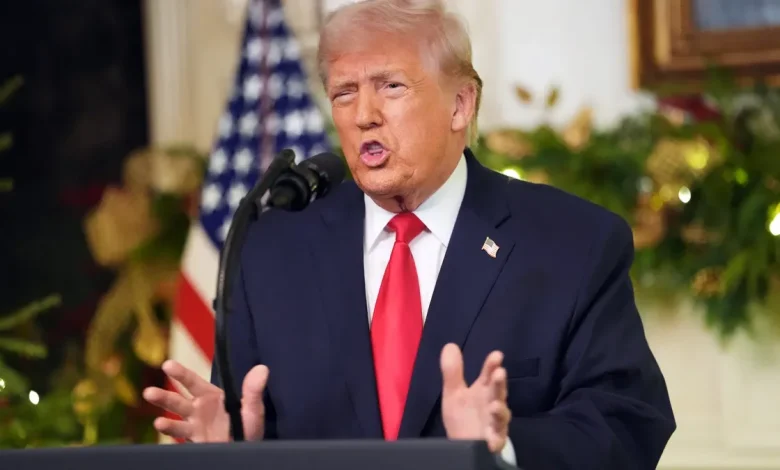
President Donald Trump’s triumphant assessment of his achievements in a year-end Oval Office address to the nation offered nary a nod to the troubles now rising around him.
“Over the past 11 months, we have brought more positive change to Washington than any administration in American history,” he declared in a rapid-fire, 19-minute address touting his record on everything from tariffs to immigration. “There has never been anything like it, and I think most would agree.”
What he didn’t say: The jobless rate is edging up. Republican officeholders are increasingly restive. His approval rating is sinking. The state of his health is attracting scrutiny. Peace deals in Ukraine and Gaza have proven more difficult to deliver than he predicted.
And the midterms next November? Don’t ask.
Happy new year, Mr. President.
There’s no debate that the first year of Trump’s second term has been breathtaking in its scope − to the approval of some Americans, the dismay of others.
He has pared 200,000 people from the federal workforce, imposed the highest tariffs since the 1930s, reordered America’s foreign policy priorities, signed more than 200 executive orders, pardoned the Jan. 6 rioters, and forced elite universities, top law firms and television broadcasters to bend to his will.
He has exercised unprecedented powers, less constrained by convention than during his first term. His stamp on the government and even on the White House complex − from a huge ballroom under construction to gilt everywhere − will not be soon erased.
But not even Donald J. Trump can defy the calendar.
A lame duck and a ticking clock
He is already a lame duck, barred by the Constitution from running for a third term. While his hold on the GOP has been astonishing, the first fissures are beginning to show. Hours before his speech, four Republicans in the House broke ranks with GOP leaders to force a vote on extending expanded premium subsidies for the Affordable Care Act.
Meanwhile, the Republican-controlled Senate had just approved a defense policy bill that reasserted Congress’ role in overseeing U.S. attacks on Venezuelan boats and proposals to withdraw American troops from Europe.
Trump is about to encounter a new phase of his presidency − and a ticking clock.
He won’t be on the ballot again, but other Republicans officeholders will be. In the off-year elections last month, Democrats easily won the governorships in New Jersey and Virginia amid signs that voters who swung to Trump in the 2024 election, among them Hispanics and young people, can’t be relied on to stick with the GOP.
What’s more, the most reliable predictor of which party will prevail in midterm elections is the sitting president’s approval rating. At this point in his first term, Trump’s rating in the Gallup Poll was a dismal 36%; Republicans would lose 40 seats and control of the House.
Gallup now puts Trump’s rating at 36% again.
An NPR/PBS News/Marist poll released Wednesday put Trump’s approval rating on the economy, traditionally a source of strength, falling to a record low of 36%. Nearly half of those surveyed said they were most concerned about prices − the “affordability” crisis that Trump has dismissed as a Democratic hoax.
In his speech, Trump again and again blamed President Joe Biden for the nation’s ills, particularly on the economy. “Eleven months ago, I inherited a mess, and I’m fixing it,” he said as he began. “I am bringing those high prices down and bridging them down very fast.”
In fact, while the costs of some items have fallen, inflation persists at 3%. Many families report that the rising costs of housing, groceries and health care are pinching their budgets. While the GOP-controlled Congress refused to extend premium help on Obamacare, he insisted, “It’s not the Republicans’ fault; it’s the Democrats’ fault.”
The speech had no light touch, no humor, no humanizing anecdotes and no significant news. Trump offered a rush of grievances, a crush of statistics and a defense of his record.
A year of crucial court rulings and historic celebration
Early next year, Trump will deliver the annual State of the Union address to a Joint Session of Congress, outlining his legislative priorities. At some point soon, the Supreme Court is expected to rule on several crucial issues, including the constitutionality of his tariffs and of his efforts to end birthright citizenship.
In a bit of serendipity, he will be the president who presides over the 250th anniversary of the signing of the Declaration of Independence on July 4. Two weeks later, he’ll have the chance to attend the FIFA World Cup final in New Jersey. And he harbors hopes that he’ll hear his name when the Nobel Peace Prize is announced in October.
But by the end of next year, the battle to succeed him in the White House will be in full force − though he doesn’t sound ready to consider relinquishing it, not yet.
“It’s not done, but, boy, are we making progress,” Trump said. “Nobody can believe what’s going on.”