‘Waiting for Godot’ Breakout Michael Patrick Thornton on Keanu Reeves, What Happened to ‘The Savant,’ and Sian Heder’s Next Film

One of the most iconic moments of 20th century theater isn’t two men sitting under a tree, waiting for a God that won’t come, in Samuel Beckett’s “Waiting for Godot“: It’s a long, unpunctuated speech delivered by the character Lucky that makes James Joyce’s “Finnegans Wake” look like Ernest Hemingway.
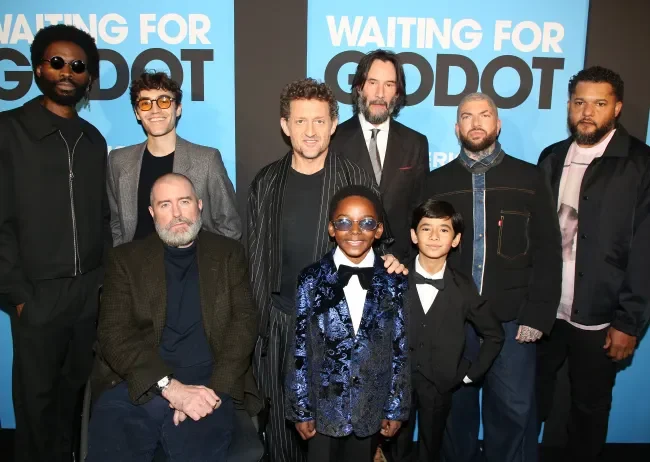
In “Sunset Blvd.,” director Jamie Lloyd’s ongoing Broadway mounting of “Waiting for Godot,” also starring Keanu Reeves and Alex Winter aka Bill and Ted, that speech is delivered by actor Michael Patrick Thornton, who plays Lucky as the mostly silent, muzzled end of a slave-master relationship with Pozzo (Brandon J. Dirden). But the twist here is that, with Thornton being a wheelchair user himself, so is Lucky, which casts the character into a new 21st century perspective.
“That speech is typically looked at as a speed and volume parlor game, like, ‘Holy shit, look at how many words are coming out of this guy’s mouth? Isn’t that amazing?,’” Thornton told IndieWire in a recent interview. “I always find that with text that looks absurdist, the more you treat them as not absurdist and take them at their own terms, they become even more creepy and menacing and truthful and absurdist.”
Told in a lingua franca of philosophy and academic jargon, Lucky’s speech has something to do with the collapse of reason and logic, and the futility of human progress, which is ultimately what tramps Estragon (Reeves) and Vladimir (Winter) are up against, too. Thornton spent three weeks memorizing it.
Thornton, who starred onstage next to Jessica Chastain in Jamie Lloyd’s 2023 Broadway showing of “A Doll’s House,” has been seen on television in series like “Black Rabbit,” “Madam Secretary,” and “Let the Right One in.” “Waiting for Godot” only has a few more weeks before it must close January 4, and Thornton’s portrayal of the speech could make him a Tony contender next year.
“What I was more interested in is can the images that I’m working with, and the emotion that I have around different sections, can that translate in a way that passages of Shakespeare that have ancient fucking agrarian jokes that make no sense to our modern society, can enough be transferred in the hyper-specificity of the images and the emotion, to get the emotional narrative of it, as opposed to the philosophical narrative?,” the actor said.
As Thornton is otherwise largely silent onstage, what’s going on inside the actor’s head while Reeves and Winter share droll, existentialist banter? The play takes place inside a giant drain pipe constructed on the stage, and underneath it all thrums a destabilizing Lynchian sound design of moody ambience.
Michael Patrick Thornton© 2024 Kevin Scanlon
Thornton said he took inspiration from one Charlie Chaplin in channeling a mostly wordless performance outside of that speech.
“There’s this incredible moment in ‘The Gold Rush’ … Chaplin is obviously silent. He’s at the bar, and the girl that he likes is in front of him, and she’s in the foreground, and he’s just maybe a few feet behind her, and all he does is he watches her,” Thornton said. “She is the focus. He doesn’t pull focus; he doesn’t move his body. It’s really just his eyes. It’s a five-second shot, 10-second shot. I saw that years ago, and when I got cast as Lucky, I went back to it. There’s something humane he does in giving her all the power, all the status; you know everything by how he looks at her. He loves her so much but is terrified to talk to her. I was like, if I can get that quality into everything I’m doing in act one before that speech, I will be very happy. If love can shine through my eyes, and yearning, and protectiveness, and yet not pull focus and help the audience out in terms of where’s the ball, who’s got the story, it feels very ‘Gold Rush’ to me. It feels like act one Chaplin, actor two David Lynch.”
That feeling of shining love out from the stage is also, he said, reflected in the unusual beating heart that Reeves and Winter’s friendship helps bring to Beckett’s otherwise emotionally dry text.
“I remember seeing them when I was younger and thinking they were amazing. I remember the scene of Napoleon talking about a waterslide. I think the guys just do one shout-out to their band. By the voluminousness of the laugh each night, you can almost nail down the median age of the audience, of who gets that,” Thornton said. “Whether you are a fan of Bill and Ted or not, what does propel the production, I would bet a lot of chips on, is Alex and Keanu’s friendship. They generally are like brothers. They care for each other and have gone through a lot of shit together, at the ascent of their careers being crazy famous. There are moments where I can hear that friendship come through the lines in a searing way. If you are a fan, you are going to geek out about the wild stallion reference, and if you’re not, there’s a huge beating heart at the center of the production that, not to play favorites, I just don’t think most people associate with Beckett at all.”
Another reason I wanted to talk to Thornton was over his starring role in Apple TV‘s limited series “The Savant,” which was pulled from the calendar in September, seemingly in response to the murder of Charlie Kirk. Led by “A Doll’s House” co-star Chastain (who’s since pulled the series’ title from her social media bios), it’s about online infiltrators of dark-web hate groups whose mission is to prevent possible attacks from happening. (Apple did not reply to IndieWire’s recent request for comment on a series update, but it’s currently undated.)
Jessica Chastain in ‘The Savant’Courtesy of Elizabeth Fisher / Apple TV+
“I hope [it comes out] soon because we need to have a conversation about why our young men are being radicalized online, and why the story of the American Dream has failed the middle class, and why these online communities are providing the comfort and support and sense of identity that obviously the real world and the job market and family and friends are not,” Thornton said. “The show talks about that, and the show talks about the personal cost that these anonymous, white hat, thankless online warriors undergo by sifting through the internet and trying to predict when something bad will happen based on anonymous accounts. There are a lot of good people who get up every morning in this country and log on and protect us from attacks we never knew were imminent.”
He also added bluntly: “It’s a conversation we need to have way sooner than later, and the fact that the first U.S. trillion-dollar company would backpocket a work of art in order to maybe sell more phones is worrisome for any pluralist democracy.”
Of his role in the series, Thornton said, “I play this great character named Gary, who’s former law enforcement, who now runs an organization called the Anti-Hate Alliance. Imagine if you had the ACLU and a bunch of hackers, a love child between them as an organization, and I am Jessica [Chastain]’s boss, and I oversee a team that monitors the dark web very closely and tries to give actionable pieces of information to the FBI in order to keep the country more safe.”
Next up, though, Thornton stars on the big screen in “CODA” Oscar winner Sian Heder’s “Being Heumann,” a portrait of disability rights activist Judith Heumann (Ruth Madeley). The film shot in Toronto in mid-2025 with Mark Ruffalo, Dylan O’Brien, and Rob Delaney also in the cast.
Thornton plays Ed Roberts, a pioneering disability rights activist who was also the first wheelchair user to attend the University of California, Berkeley.
“For 25 years, I’ve always been the only wheelchair user on set. And everything has been a conversation like, ‘Oh, what if we can’t get him into the makeup chair? What if we can’t get an ADA trailer? What can we get for his dressing room?’ There’s been so many fucking annoying things that come with every single job that quite frankly non-disabled people don’t even have to think about,” Thornton said.
“Being Heumann,” though, was “like going to disabled Valhalla. Every trailer was ramped. There was an access coordinator there. The people who were non-disabled were in the minority as opposed to the people who were disabled. You had people who were deaf, blind, power wheelchair users, manual wheelchair uses; it was astounding what they pulled off, and the script is badass about a badass woman and unfortunately still very timely about access needs in Section 504 [which prevents disability discrimination and helps ensure access needs are met] and the largest sit-in protest in the history of the United States, which brought together the butterfly brigade, and the Black Panthers, and brought all these groups that previously were siloed to collaborate and say enough is enough. I can’t wait to see it.”
“Waiting for Godot” is onstage at the Hudson Theatre through January 4.