It wasn’t supposed to look like this. When the Boston Bruins traded Brad Marchand — a move that felt like ripping the ‘B’ directly off the sweater — the writing on the wall seemed legible enough. The pundits called it a tear-down. The fans braced for a lottery year. The organization signaled a youth movement.
But nobody told Marco Sturm.
In his first season behind the bench, Sturm hasn’t just kept the Bruins afloat; he has fundamentally re-engineered the team’s DNA. We are witnessing a squad that is arguably playing above its collective talent level, not because of puck luck or a hot goalie (though that helps), but because they have bought into a distinct, unwavering culture.
The “Bridge Year” narrative is dead. In its place, Sturm has installed a system of accountability and patience that has turned a potential rebuild into a retooling on the fly.
Where Empathy Meets Iron
When Sturm was hired, the immediate question was what kind of voice he would bring to a room that had cycled through the intense structure of Bruce Cassidy and the emotional connectivity of Jim Montgomery. Interestingly, the early returns suggest Sturm isn’t a departure from his predecessors, but a synthesis of them.
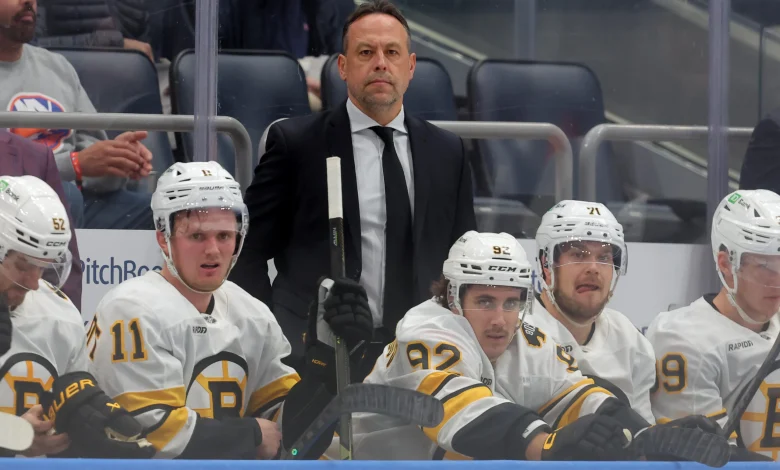
Boston Bruins head coach Marco Sturm (Brad Penner-Imagn Images)
He has managed to thread the needle, combining Montgomery’s emotional outreach with the structural rigidity that Cassidy was known for. It’s a delicate balance. A coach who is too soft loses the room when adversity hits; a coach who is too hard loses the modern athlete. Sturm’s secret weapon appears to be radical honesty.
Related – Bruins Reportedly Interested in Maple Leafs’ Maccelli
In press conferences and, reportedly, behind closed doors, there is a refreshing amount of self-analysis regarding the team’s status. Sturm isn’t selling false hope. He has explicitly stated that the priority is everyday improvement rather than a fixation on the standings. For a roster suddenly infused with youth, this alleviates the paralyzing pressure to win every night, replacing it with the pressure to work every night. It prevents the rigidity that often sinks rebuilding teams, allowing players to breathe while demanding they adhere to the details.
Grind, Wait, Strike
Culture is great, but it doesn’t kill penalties. What’s happening on the ice is a direct reflection of that off-ice discipline.
Casey Mittlestadt, who has quietly become a barometer for this team’s mindset, noted recently that Sturm has been “firm and strong” regarding the team’s identity. But what is that identity?
Casey Mittelstadt, Boston Bruins (Photo by Mike Carlson/Getty Images)
If you ask David Pastrnak, it’s about weaponizing patience. The superstar forward described the new system not as a high-flying circus, but as a war of attrition. The goal is to “wear them down,” stay responsible defensively, and wait for the opposition to crack. It’s a style that requires total buy-in. If four guys are trapping and one is cheating for offense, the whole structure collapses.
Pastrnak warned that when the Bruins are “on the same page,” they are miserable to play against. We saw the proof of concept clearly in the recent win over the Utah Mammoth. For two periods, it wasn’t highlight-reel hockey. It was heavy, grinding, suffocating work. But late in the third, when Utah’s legs grew heavy and their mental focus slipped, Boston struck. They capitalized not because they were faster, but because they had successfully dragged the game into deep water and waited for the Mammoth to drown.
The Eagles Model
Perhaps the most fascinating wrinkle in Sturm’s tenure is where he looked for inspiration. It wasn’t the Tampa Bay Lightning or the Colorado Avalanche he studied; it was the Philadelphia Eagles.
Sturm reportedly treated the NFL franchise as a research project, fascinated by their coaching dynamic, their chemistry, and the “family” atmosphere that permeated their locker room. He wanted to understand how organizations maintain high performance through roster turnover.
Related – Bruins’ Holiday Wish List for 2026
The translation to hockey has been the implementation of a “family first” operating system. In a salary cap era where roster turnover is constant, creating immediate emotional buy-in is a competitive advantage. Sturm wants the Bruins to operate with a connectivity that transcends the x’s and o’s. It sounds like a cliché until you hear the players talk. They aren’t just reciting media training lines; they are echoing their coach’s specific vision of connectivity.
Leadership by Committee
The elephant in the room — or rather, the missing Rat in the room — remains the departure of Marchand. Trading a captain usually leaves a vacuum that sucks the air out of a season. The Bruins made the controversial decision not to stitch the ‘C’ on a new jersey immediately, a move that could have led to a rudderless ship.
Instead, under Sturm’s guidance, it has democratized the locker room.
Goaltender Jeremy Swayman, who has settled into his role as a franchise pillar, recently described the room as “really special.” The absence of a singular, dominant voice has forced a “leadership by committee” approach. Swayman noted that the culture now allows “voices to be heard that necessarily wouldn’t be heard” in previous years.
Jeremy Swayman, Boston Bruins (Eric Canha-Imagn Images)
This is the hidden benefit of Sturm’s approach. By emphasizing that “anyone wearing the jersey has a say,” the Bruins have accelerated the maturation of their younger core. They aren’t deferring to a veteran who isn’t there; they are taking ownership themselves.
The Bruins may not have the deepest roster in the league this season. They are certainly not the most experienced. But for the first time in a while, they know exactly who they are. And as Sturm is proving, a team that knows its identity is a dangerous thing.
AI tools were used to support the creation or distribution of this content, however, it has been carefully edited and fact-checked by a member of The Hockey Writers editorial team. For more information on our use of AI, please visit our Editorial Standards page.