Opinion: With Pablo Rodriguez’s resignation, Quebec Liberals have one last chance to reboot before the next election

Open this photo in gallery:
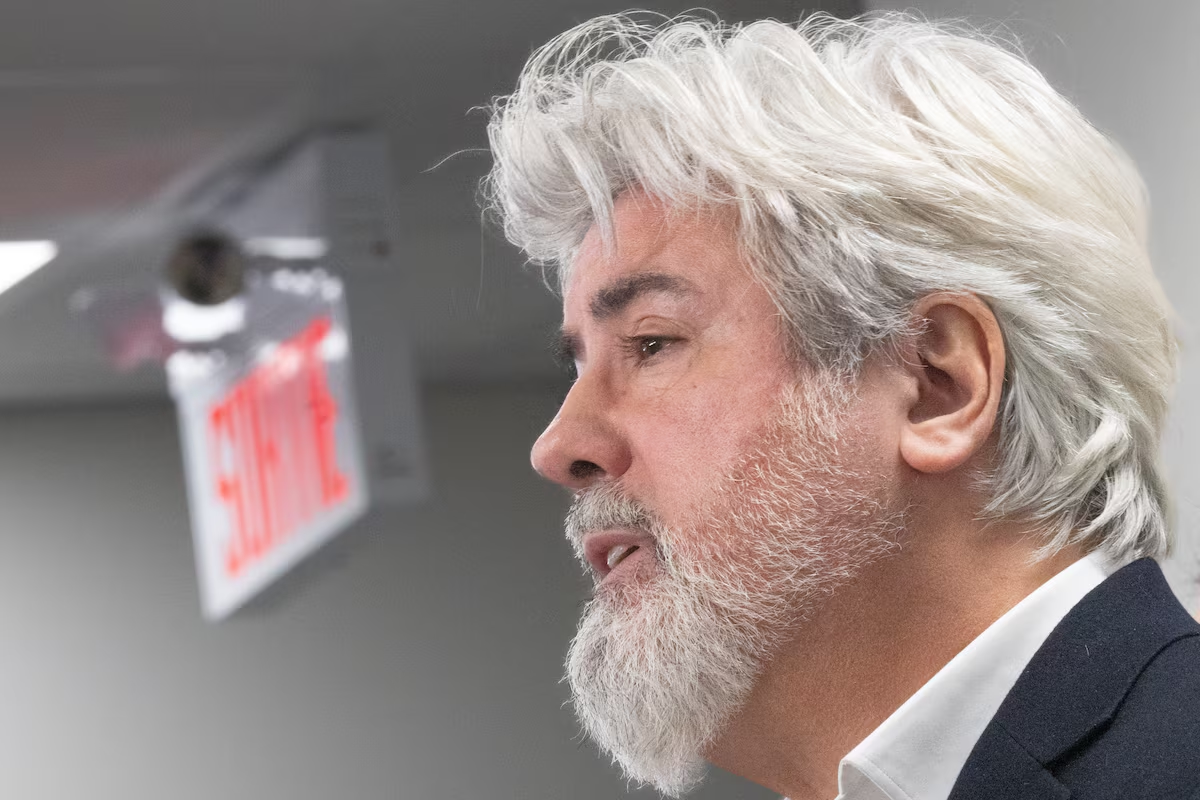
Pablo Rodriguez after his resignation as Quebec Liberal Leader in Montreal on Thursday. He has denied any knowledge of unethical activities by some of his supporters.Christinne Muschi/The Canadian Press
The producer of Radio-Canada’s annual Bye bye comedy retrospective, a New Year’s Eve tradition in Quebec for more than five decades, conceded this week that the show’s writers have been frantically revising their script to keep up with late-breaking political events.
The Thursday resignation of Pablo Rodriguez as leader of the Quebec Liberal Party, six months after being elected to the job and 10 months before the next provincial election, has given Bye bye’s creators yet another last-minute political bombshell to consider.
Mr. Rodriguez’s comedic reign atop the QLP had already provided plenty of fodder for the Bye bye before his departure. The saga has now veered into tragedy, destroying the former federal Liberal cabinet minister’s political career.
Truth be told, the mess in which Quebec’s oldest political party finds itself is no laughing matter. Not for the province, which is facing a period of renewed political turbulence as the sovereigntist Parti Québécois leads the polls. And not for Canada, with the federalist QLP looking demoralized, divided and devoid of anything resembling a credible political platform.
Konrad Yakabuski: Sorry, Marc Miller, Quebec’s language debate will not be ending any time soon
Weeks of daily headlines about questionable financing tactics used by supporters of Mr. Rodriguez during the QLP leadership race have badly damaged the party’s image. Allegations that some party members were paid $100 each to vote for Mr. Rodriguez and that some donors to his campaign were reimbursed to the tune of $500 by a Montreal businessman who held a fundraiser at his home are damaging enough in themselves. Mr. Rodriguez’s woeful mishandling of the crisis has made matters much, much worse.
Mr. Rodriguez denied any knowledge of unethical activities by some of his supporters. But if that were true, it only suggested he had not been in control of his own team. He lashed out at his party’s most high-profile MNA, Marwah Rizqy, expelling her from caucus after she fired her chief-of-staff, a close associate of Mr. Rodriguez, without informing him first.
When the Quebec provincial police anti-corruption unit revealed that it had undertaken a criminal investigation into the allegations of possible illegal financing activities during his leadership campaign, it became clear to almost everyone except Mr. Rodriguez and his most loyal supporters that his days as leader were numbered.
Most Quebeckers had by then already taken the measure of Mr. Rodriguez and written him off as a potential premier material. His erratic crisis management did not reflect well on his leadership abilities. Members of his own caucus could no longer stick up, or make excuses, for him.
His departure now should be seen as a mixed blessing. It at least provides the QLP with a chance to reboot under a new leader before the next election. Mr. Rodriguez’s main rivals during the leadership race – Charles Milliard and Karl Blackburn – are both expected to seek to replace him now. Both have strong business credentials, but neither is well-known to Quebeckers.
Konrad Yakabuski: A Quebec Liberal Party meltdown ups the likelihood of a PQ victory in the next election
Some Quebec Liberals still dream of drafting a big-name politician, such as federal Finance Minister François-Philippe Champagne or federal Industry Minister Mélanie Joly. Neither appears to be interested in the job.
Could that change with some serious arm-twisting?
In 1998, then federal Progressive Conservative leader Jean Charest was drafted by the QLP after emerging as a federalist star during the 1995 Quebec referendum campaign. Mr. Charest, who had eyed the top job in Ottawa, reluctantly agreed to put his federal ambitions on hold to take the QLP helm amid talk of another referendum. Under Mr. Charest, the PLQ lost the 1998 election, though it won the popular vote. The result proved chastening enough for then PQ premier Lucien Bouchard that he shelved any referendum plans.
If Mr. Champagne and Ms. Joly refuse to bite, the QLP might also seek to recruit Guy Cormier, the former head of Quebec’s giant Desjardins Group financial co-operative and a respected household name in the province. Though he took a pass on the last leadership race, he did not then close the door on a political career. His candidacy might be a godsend now.
Quebec politics is in flux. The governing Coalition Avenir Québec increasingly looks like it may not outlast its founder, Premier François Legault, whose popularity has sunk to unprecedented depths. The far-left Québec Solidaire is imploding amid internal squabbling. The provincial Conservative Party is capturing disaffected CAQ voters in the Quebec City region. The PQ under the untested and temperamental Paul St-Pierre Plamondon is mostly leading the polls by default.
The QLP should not be written off – yet – even if it has given this year’s Bye bye scriptwriters plenty of material to work with.