Get the free Morning Headlines email for news from our reporters across the world
Sign up to our free Morning Headlines email
Sign up to our free Morning Headlines email
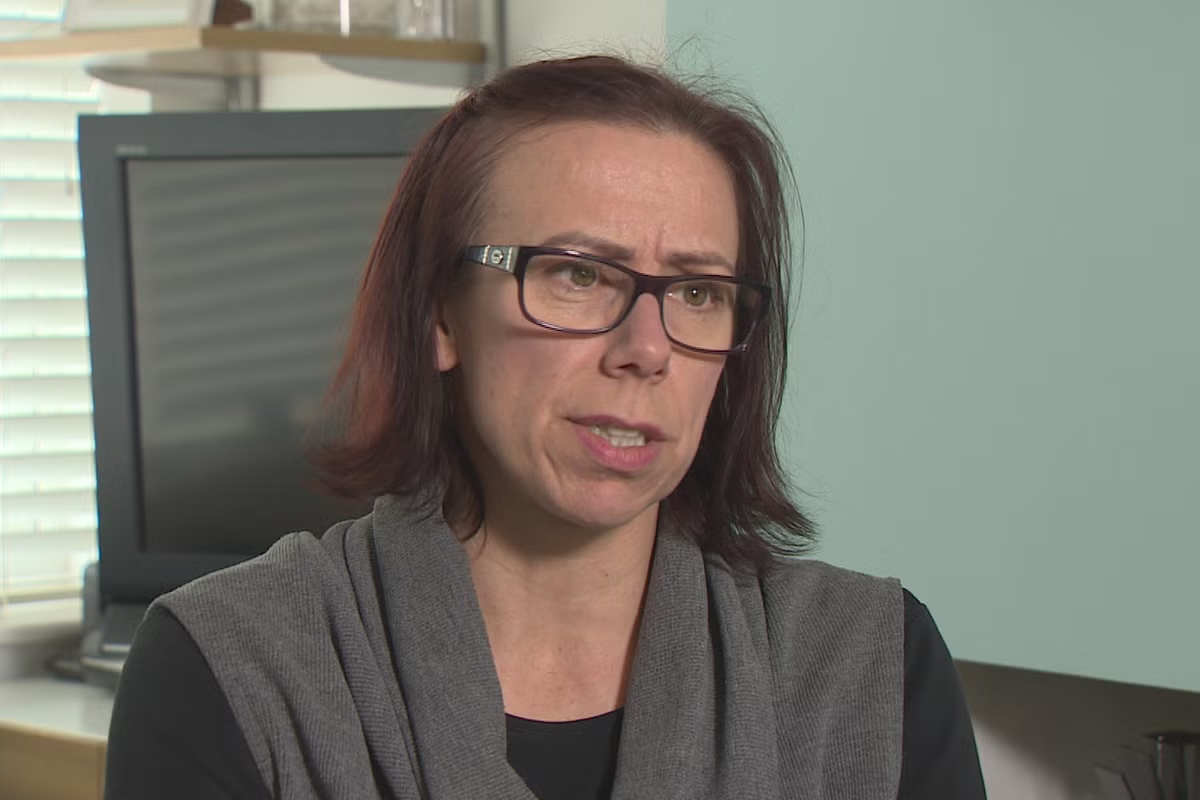
Natasha Walker can be certain that at least twice a year, someone will contact her claiming to be her missing sister, Katrice Lee.
Katrice vanished from a supermarket in Germany in 1981, when she was just two years old. In the decades since, her family has endured relentless abuse.
They are repeatedly targeted by impersonators, trolls and conspiracy theorists who, Natasha claims, “really try and put the knife in”.
When Natasha first began receiving messages from people claiming to be Katrice, she would question whether it might be her sister reaching out. She now just chooses to ignore them.
“If you truly believe that you’re someone who is missing, you go to the police and give them credible information as to why you think you’re that missing person. You don’t contact their sister and expect them to be able to deliver a DNA kit to you,” Natasha said.
While The Independent and the Missing People charity aim to raise £165,000 to launch SafeCall, a service for the 70,000 children who go missing each year in the UK, we spoke to those who have had to suffer the additional torment of online abuse.
Donate here or text SAFE to 70577 to give £10 to Missing People – enough for one child to get help.
open image in gallery
Natasha Walker said her family is repeatedly targeted by impersonators, trolls and conspiracy theorists (ITV)
Since 2014, one woman has been jailed for harassing Katrice’s family, while another received an 18-week prison sentence, suspended for two years, for malicious communications after using social media to impersonate the missing toddler. Natasha said abuse in general has become unrelenting and is now a grim routine in their lives.
This month alone, yet another person has contacted Natasha claiming to be her sister.
Some people genuinely believe they are Katrice, while others act with malicious intent, Natasha said. At one point, she was dealing with two women claiming to be her sister at the same time, despite both having DNA tests that proved otherwise.
“In the end, one was talking to the other. I was like, ‘You two can crack on and argue it out then, because you both can’t be Katrice,’” Natasha added.
In today’s social media age, families of missing childrenmust also contend with online trolls, armchair sleuths, malicious comments, imposter accounts, and even AI deepfakes.
For many with missing loved ones, this digital onslaught has become unavoidable. It can hinder investigations, create false hope, frighten families away from making public appeals, or even stop a missing person from coming home.
open image in gallery
The family of Katrice Lee, who went missing when she was just two, say they have been harassed by many following her disappearance (Family photo c/o MOD)
Amy-Kathleen Walker, the head of digital development at Missing People, has supported countless families exposed to harassment, including Katrice’s.
In her 14 years, she said she has seen all forms of hatred. When the missing person is a child, the judgement can often be harsher, she said.
It has now become standard to warn family members of the harassment they may face. She said: “You’re already in the worst place. You are so worried and so scared for your loved one.
“Can I now also warn you that the world is not necessarily very nice? And people are likely to be horrible to you on social media. What a horrible conversation to have with someone who’s already in the darkest of moments.”
Beyond cruel comments and messages, some families face far worse. Kevin Gosden, whose son, Andrew, went missing when he was 14 years old in 2007, has had to wake up to AI deepfake videos of him and his son.
He described it as “a feeling of absolute powerlessness and helplessness” in what “feels like a hugely dystopian world”.
Many families experience fake social media accounts set up in the names of their missing loved ones, sometimes made to impersonate that person, and other times, made just to be malicious.
Ms Walker said that in many cases, the person behind the account truly believes they are that missing child, especially if it is a child who went missing at a young age. Even when it is proven untrue, they don’t often go quietly, turning to trolling to try to convince the family otherwise.
She added: “I would love a chance to actually talk to someone and ask them, ‘Why did you do this? What were you hoping to achieve? Were you trying to give closure to these people, or did you just want to be horrible?’”
open image in gallery
Jay Slater’s mother is calling for ‘Jay’s Law’ to stop grieving families from being abused (Family Handout/LBT Global)
Other families are up against conspiracies and constant speculation around their loved ones’ disappearance. Sometimes, no harm is meant by it, but it can be really damaging for that missing person or their family, Ms Walker said.
It could also prevent people from coming back. “Imagine if all of that is on the internet, all these conspiracy theories about you, and it never goes away,” she added.
The mother of Jay Slater, who died after going missing in Tenerife last year, is calling for ‘Jay’s Law’ to prevent people from facing the same abuse that she did.
Mr Slater’s disappearance attracted a host of conspiracy theories, and Debbie Duncan, his mother, was accused of various things, including covering up a murder and setting up a fake GoFundMe page.
“One content creator even said: ‘How do you know it’s Jay that was in the coffin? He needs digging up’,” Ms Duncan told The Mirror. “It hurts. They don’t know our family or anything about us, but they’re allowed to say what they want.”
Ms Walker said: “Please remember before you hit send, before you upload that thing, that is someone’s someone… harm is not just bruises, harm is also words and intentions, so just be kind.”
Please donate now to The Independent and Missing People’s SafeCall campaign, which aims to raise £165,000 to create a free, nationwide service helping vulnerable children find safety and support.
For advice, support and options if you or someone you love goes missing, text or call the charity Missing People on 116 000. It’s free, confidential and non-judgemental. Or visit www.missingpeople.org.uk/get-help