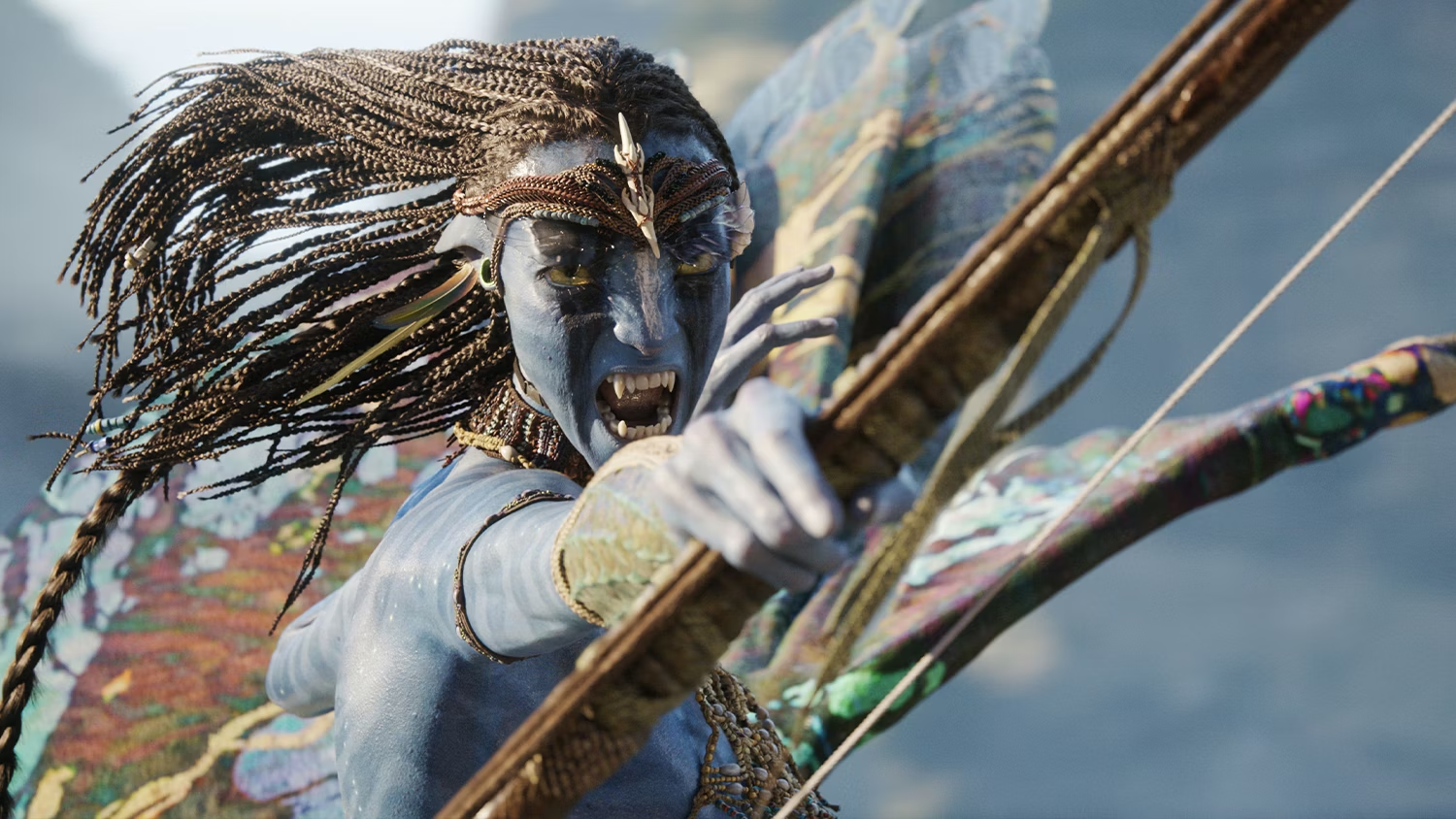
On Pandora, the Sully family are still grieving. When Quaritch (Stephen Lang) and the colonising RDA team up with Na’vi nihilist Varang (Oona Chaplin), a new battle looms.
James Cameron has always excelled at part twos. Aliens and Terminator 2: Judgment Day remain among the greatest sequels of all time. And 2022’s Avatar: The Way Of Water proved that the 2009 original was no fluke; he expanded the world of Pandora, the sprawling story of the big blue aliens, with seeming ease, unfurling new cultures, new conflicts, new complications. But we’ve never seen a James Cameron part three. Until now.
Or is it? Technically, yes, Fire And Ash is the third Avatar film in Cameron’s planned five-movie saga; except, it plays really as a part two to his part two — a direct continuation of The Way Of Water, taking all the familial threads, the vast worldbuilding, the interpersonal beefs, and doubling down on them. Neteyam, the eldest son of the Sully family, is dead. Neytiri (Zoe Saldaña, powerful as ever) is buried deep in her grief. Jake (Sam Worthington) is ignoring his, hardening as he focuses on practical matters. The kids — Lo’ak (Britain Dalton), tiny Tuk (Trinity Jo-Li Bliss), miracle-child Kiri (Sigourney Weaver), and abandoned human Spider (Jack Champion) — reel from the loss; particularly Lo’ak, who blames himself for Neteyam’s demise. The family focus is clearly where Cameron’s heart lies, yanking at these tangled threads. The emotion here is deceptively complex, the film daring to go deeper, frequently to shocking places.
The final battle, sprawling across sea and sky, is the biggest brawl Pandora has ever seen.
This isn’t Na’vi Noah Baumbach, though. The wounded family drama goes hand in four-fingered hand with colossal Cameron action. Gigantic sea ships are smashed together with wild abandon; hordes of marauding squids hurtle themselves onto unsuspecting victims, tentacles flailing; banshees fly at each other full-force, as arrows and gunfire pepper the skies. It’s mind-melting stuff, using all that character development as a springboard to deliver huge adrenaline jolts. A first-act attack on the air-jellyfish-riding Wind Traders – a brief but joyous inclusion of a new clan – is thunderously exciting, while the final battle, sprawling across sea and sky, is perhaps the biggest brawl Pandora has ever seen.
Much of that escalation of the action is courtesy of Fire And Ash’s most significant new element: Varang (Oona Chaplin) and her Mangkwan Clan, the first all-out Na’vi villains in Cameron’s world. They are a brutal, formidable new presence, rejecting hippy-dippy niceties (“Your goddess has no dominion here,” purrs Varang of deity Eywa) as they mutilate their fellow people, blazing trails of hatred wherever they go. Varang herself is particularly mesmeric, sultry and commanding as she and ‘Recom’ hybrid Quaritch (Stephen Lang) become a sort of nightmare power couple. “I will eat your heart,” she tells him after blasting him with psychedelic drugs, by way of fucked-up flirting. They’re a match made in hell.
In many ways, then, Cameron is escalating things once again, pushing further outwards into Pandoran lore, and deeper inward to his characters. But compared to the relative clarity of The Way Of Water, the middle act of Fire And Ash feels knotty. A game-changing development with human Spider sparks a chase across Pandora that sees Cameron — with writers Rick Jaffa and Amanda Silver — moving too many players across the board in myriad directions. There are moments of real déjà vu as entire plot beats are repeated from The Way Of Water. The film is over three hours, and often feels it; streamlining that storytelling would allow the majority of masterful stuff here to shine even brighter. As a result, those not in thrall to Eywa might have their patience tested.
With so many pieces in play, it’s inevitable that some suffer for screentime. Lo’ak, this film’s narrator, feels oddly sidelined, while Tuk still exists mainly to be menaced. Most disappointingly, Varang disappears in the final act, while anyone hoping for a seismic shift in the overall saga should recalibrate their expectations.
Still, this is about the most spectacular spectacle you could ever ask for — utterly transportive, technically masterful. It’s near-unfathomable that barely anything on screen actually exists; so photo-real, you never even think about it. And it’s all in service to mythmaking at the highest level, Cameron and crew weaving entire new tapestries with unparalleled imagination. Who else out there is giving us space-whale politics, mystical mycelial networks, and children questing to witness the face of God? Flaws and all, it’s a privilege to witness. Bring on Avatar 4 and 5, as Cameron’s overall sequel plan enters part two. He’s pretty good at those.
In a bigger, busier and burlier Avatar, James Cameron once again displays his blockbuster mastery. Despite some repetitive moments, this is truly epic cinema, more than worth plugging into for three hours.