For over a decade, a Roman-era skeleton uncovered in southern England has been the subject of debate surrounding migration, identity, and the limits of archaeological science. However, a recent study suggests that the so-called Beachy Head Woman was not an immigrant from afar, but rather a local woman from Roman Britain.
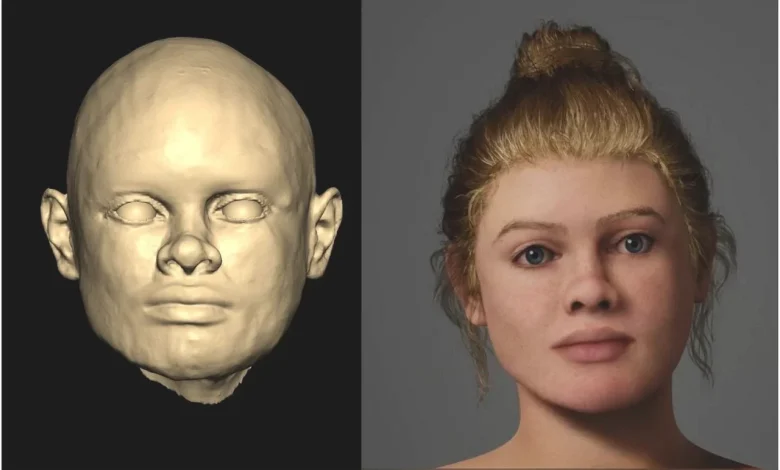
Second iteration facial reconstruction of BHW. (a) 3D scan of the iteration #1 facial reconstruction – physical model (b) Iteration #2 of the facial depiction of Beachy Head Woman. MetaHuman version with hair, skin and eye textures as suggested by the DNA analysis. Credit: Face Lab at Liverpool John Moores University, in A. Walton et al., Journal of Archaeological Science (2025)
The remains, which date back around 2,000 years, were rediscovered in a box located at the Eastbourne Town Hall in 2012. A handwritten label indicated that the skeleton had been recovered near the cliffs of Beachy Head in the 1950s, although there is no excavation record for this event. Radiocarbon dating later showed that the woman died between CE 129 and 311, during Roman rule in Britain.
Initial scientific analyses focused on skeletal measurements, suggesting a possible sub-Saharan African origin. This hypothesis gained considerable public attention, to the point that it was incorporated into museum displays, featuring this woman as one of the earliest known Africans found in Britain. Follow-up unpublished DNA work suggests a possible Mediterranean origin, including a connection to Cyprus, but the genetic data available at the time were fragmentary and inconclusive.
The new study, led by researchers at London’s Natural History Museum, working in collaboration with University College London, used advanced ancient DNA sequencing that was not available a decade ago. By extracting a much larger quantity of high-quality DNA, they were able to place her ancestry within a broader Roman-era genetic framework.
The results show that her DNA is most similar to that of individuals from rural southern Britain during the Roman period and to modern populations from England. There are no traces of recent sub-Saharan African or Mediterranean ancestry. Isotope analysis of her teeth and bones indicates that her early years were spent on the south coast of Britain, and her mobility patterns were similar to those of other local individuals from the same period.
There is also other bioanthropological evidence that helps in learning more about her life. She was 18–25 years of age at the time of death and was just over 1.5 meters tall. She had a healed injury on one of her legs, which shows that she survived a serious wound earlier in life. Her diet, which was identified through chemical traces preserved in her bones, was rich in seafood, suggesting that she lived in a coastal area.
With the help of modern forensic methods, the team has also made some new predictions about her facial features, including the possibility that she had blue eyes, light hair, and intermediate skin pigmentation. Such results have led to the updating of her digital facial reconstruction.
But it’s more than a historical mystery that has been solved; it also highlights how scientific interpretation can change as methods improve. The Beachy Head Woman’s history has been transformed from a distant migration story to a much more local narrative, providing a more accurate vision of life in Roman Britain.
Publication: Walton, A., Marsh, W., Strang, A., Seaman, J., Van Doorn, K., Eckardt, H., … Brace, S. (2025). Beachy Head Woman: clarifying her origins using a multiproxy anthropological and biomolecular approach. Journal of Archaeological Science, (106445). doi:10.1016/j.jas.2025.106445