Open this photo in gallery:
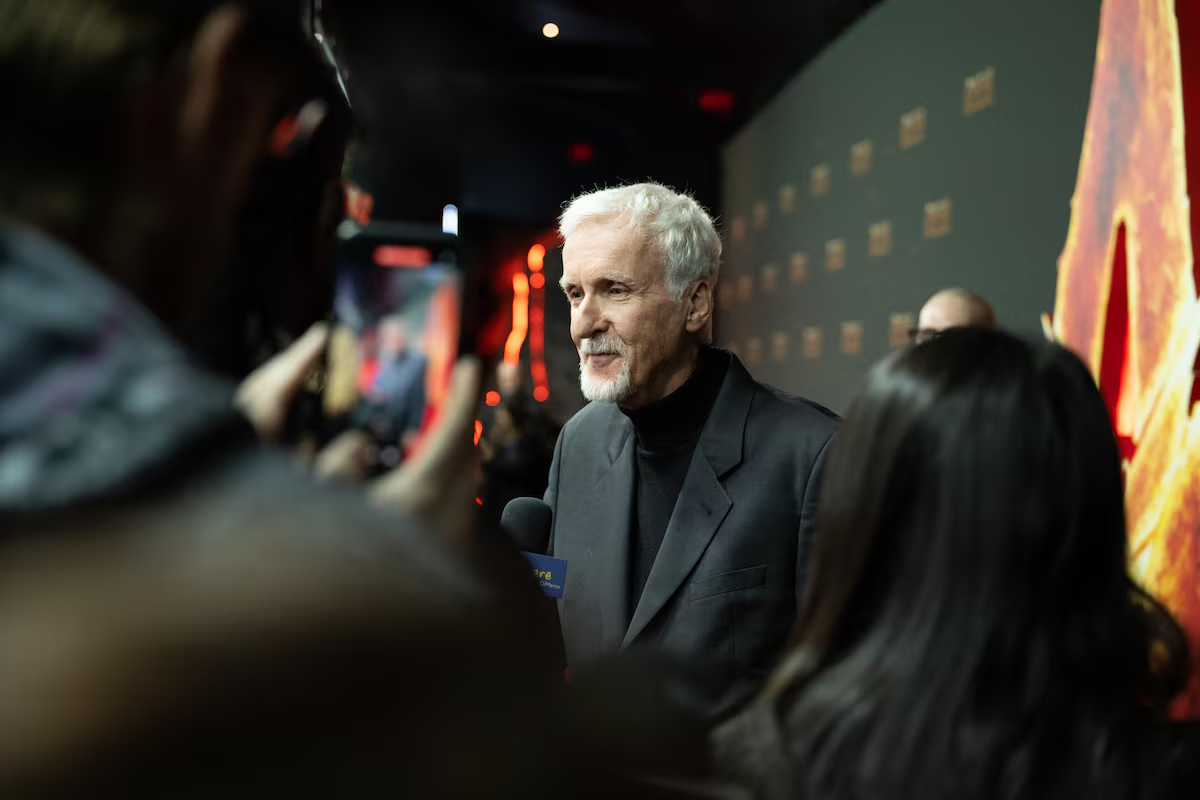
James Cameron attends the Avatar: Fire and Ash Canadian premiere at Scotiabank Theatre in Toronto on Dec. 17.George Pimentel/The Canadian Press
In James Cameron’s new Avatar sequel, Fire and Ash, the indigenous Na’vi tribes of Pandora face their greatest threat yet from the Earthlings who have come to the lush alien world to strip-mine its natural resources.
The “sky people,” as the Na’vi refer to them as, are after everything from the superconductor mineral nestled deep inside the planet’s core to the anti-aging serum found in the brains of its ocean’s massive Tulkun marine creatures (you know, the alien whales). It is a crisis for the blue-skinned Na’vi so environmentally and existentially massive that it feels as if the very ground of Pandora is shifting beneath their feet in real time.
Which is just about the same sensation that Hollywood seems to be experiencing as Fire and Ash opens in theatres this weekend. While the third Avatar film is an adventure explicitly designed to be seen in a cinema – ideally in a premium format such as IMAX 3-D, ScreenX, 4DX or some other wild combination of letters – the past few days’ worth of industry headlines have portended troubling blows to the very concept of moviegoing. Just as everyone was trying to wrap their heads around Netflix likely emerging as the new owner of the century-old Warner Bros. studio, the Academy of Motion Picture Arts and Sciences announced that, starting in 2029, the Oscars would air not on broadcast television, but YouTube, which feels like a devaluation at best.
But Cameron isn’t pushing the panic button. Not in terms of the Oscars, at least.
“I haven’t really thought about the impact of the Academy Awards – but I also don’t think about the Academy Awards that much, intentionally,” says the Kapuskasing, Ont.-born director, who was in Toronto this week for the Canadian premiere of Fire and Ash.
“I don’t try to make a movie to appeal to that sensibility. They don’t tend to honour films like Avatar or films that are science fiction. Denis Villeneuve, another Canadian filmmaker, made these two magnificent Dune films, and apparently these films make themselves, because he wasn’t considered for Best Director. It’s like, okay, you can play the awards game or you can play the game that I like to play, which is to make movies that people actually go to.”
Open this photo in gallery:
In Avatar: Fire and Ash, the Na’vi people are under greater threat than ever before.20th Century Studios/The Associated Press
Cameron has history on his side there. Fire and Ash follows 2022’s Avatar: The Way of Water, which is the third highest-grossing film of all time, having earned US$2.34-billion at the global box office. What is at No. 1? That would be the original Avatar from 2009. (No. 4, by the way, is Titanic, also directed by you know who.)
But with the bruised and battered film industry desperate to prove its worth – ticket sales for 2025 are 22.7 per cent behind the pre-pandemic year of 2019 – all eyes are on Cameron to break another record. Does the one-time “king of the world” – who, for all his talk about not needing the Oscars, did walk away with three of them for his work as director, producer and editor on Titanic – feel the weight of the industry pressure?
“I’d love to be able to see that emerge from this. That the exhibitors are happy that they’ve got something that they can sell, that they can inject some vigour into the theatrical experience,” Cameron says.
“But ultimately it’s all market-driven. People make choices, and if they like the convenience, especially in the dead of winter, watching a movie day and date with its release at home, this will shake itself out. It’s above my pay grade. What I try to do, and what I’ve always tried to do for my entire filmmaking career, is to create the most riveting and engaging experience in a movie theatre that I can conceivably, humanly do.”
That unrelenting desire to push the boundaries – of storytelling, of technology and of sheer audience endurance (Fire and Ash is the director’s longest film yet, at 195 minutes) – is what has kept Cameron as something of a hidden-in-plain-sight secret weapon. Every time the industry underestimates his drive and commitment, as if he should be punished for not playing by the rules, the director doesn’t just prove his doubters wrong, he humiliates them.
In that sense, Fire and Ash feels like the film the director has been working his entire career toward, with themes smuggled in from his entire canon (there’s more than a layer of Terminator’s John Connor inside of Avatar’s boy hero Spider, and a whole lot of Alien’s Ellen Ripley in the teenage Na’vi heroine played by Sigourney Weaver) and cutting-edge technology developed in tandem with shooting. (Only seven of the film’s 3,389 shots, totalling a mere 11 seconds, do not contain visual effects.)
“I’ve always tried to figure out new ways to do that, I’ve always tried to stay humble before the craft by looking for ways to grow, new ways to express these things. And it’s not just about improving the technology, it’s also about improving your command of narrative art,” Cameron says.
“It’s about working with the actors, making it compelling in a way for the audience. And it’s even more important when you’re doing something on another planet where it’s very phantasmagorical and dismissible, in a way, to have it be very grounded in the human experience and human emotion. I’m so proud of how the technical artistry kept those performances front and centre and undiluted in any way.”
That’s a sentiment that veteran character actor Stephen Lang, who returns in Fire and Ash as the villainous Colonel Quaritch, echoes in his approach to the production, which was shot simultaneously with The Way of Water over 18 months. To play the once-human Quaritch, who has been resurrected into his own Na’vi body, Lang wore high-tech suits with reflective markers and helmet-mounted cameras to capture body movements and facial expressions, performances that were later digitally rendered into the Na’vi character we see on screen.
Open this photo in gallery:
Cameron, right, works with Stephen Lang on the set of Avatar: Fire and Ash.Mark Fellman/Disney
“Performance-capture is the defining process of Avatar, and we do that in a space called ‘the Volume,’ which resembles nothing so much as a bare-bones rehearsal room. Performance-capture itself has a number of rigours and restrictions, you know, wear this, wear that. But once you get into the Volume, it’s just as deep as one wants to go,” Lang says in a separate interview, the actor just about ready to wind down his whirlwind promotional duties.
“And Jim is there, both as a guide and a supporter – he’s got your back, he’s got your six all the time – even as he leads the way.”
While Cameron has a plan to finish out the Avatar saga with two more films, he is aware that such ambitions will depend just as much on the performance of Fire and Ash as his own desire to spend that many more years building and perfecting Pandora.
“I want to focus any future technical development not on doing it better on the screen, because we don’t need to, we’re there – whatever we imagine, we can do it right now: water, fire, critters, it’s all doable. Question is how do we do it with the same level of quality in half the time, and therefore half the money. Because I don’t want to be making Avatar movies for the next 15, 20 years. I don’t know if I have five years. Nobody does. But you certainly reach an age where the actuarial reality starts to guide your decision-making,” Cameron says. “I think we can figure out how to make an Avatar movie in half the time.”
And the method to do so? Cameron sees a responsible path in artificial intelligence, not the kind of AI apocalypse that so many inside Hollywood fear.
“If that involves generative AI embedded in the tools of the workflow, that’s fine. I don’t have a problem with that. As long as we don’t replace writing, acting and the inception of the artistic process, because I work with some of the best artists in the world,” he says.
“But if we can use that to speed up the VFX workflow, great. I’m not even going to put one artist out of work, because we’ll just start the next day on the next film, and this could go on ad infinitum.”
To Pandora and beyond, then.