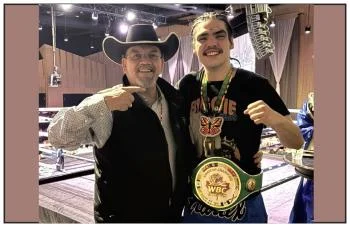
Photo: Chief Irvin Wai, left, joins Cameron Billy, right, in Kananaskis, Alta. following Billy’s WBC amateur cruiserweight title win at Muay Thai World Cup 13 / Photo by Sheila Billy
By Aaron Walker
Local Journalism Initiative Reporter
Windspeaker.com
When Cameron Billy stepped into the ring at Muay Thai World Cup 13 in Kananaskis, Alta. he carried the weight and pride of his Secwépemc community and his new Saskatchewan home into the biggest fight of his career.
By the end of the night Nov. 29, Billy emerged as the new World Boxing Council (WBC) amateur cruiserweight champion, becoming one of the first Indigenous fighters—and the first from Saskatchewan—to earn that distinction.
“Oh my gosh,” he said his first reaction was. “No words can explain it. Three years ago, I walked into that gym knowing nothing … I told myself that I wanted to be a champion, and I just showed up every single day. Just to feel it and finally have it, it’s insane.”
Although now residing in Moose Jaw, Sask., Billy is a member of the Neskonlith Indian Band in Secwépemc territory, B.C., and his achievement did not go unnoticed at home. Chief Irvin Wai travelled to the event, joining family at Stoney Nakoda Resort & Casino.
“My chief even came out, which was pretty cool,” Billy said. “He was like, ‘Young warrior, you are making your community proud’.”
Billy may have discovered Muay Thai only three years ago, but the values that powered his rise — discipline, humility, focus, and carrying his community — are anything but new to him.
“My parents gave me my work ethic and just kept me away from trouble,” he said.
Muay Thai originated in Thailand centuries ago and is often described as the “art of eight limbs,” referring to punches, kicks, elbows, and knee strikes. It differs from western kickboxing through its clinch-fighting techniques, permitted moves, and its ceremonial traditions.
While the sport continues to grow across Canada, full Muay Thai training and competition remains off-limits in Saskatchewan. For Billy, that means many central techniques — including elbows, knees, and clinch manoeuvres — can’t be practiced at his local gym. To train in full, he must travel out of the province.
The restriction makes his work more difficult but hasn’t stopped him. At home Billy relies on strength work, conditioning, and one-on-one sessions with his coach to stay sharp.
“(A couple of weeks ago) … we were doing hill sprints. He has a nice trail on his acreage, so that’s up and down the hill 15 times. I did that jogging and sprinting, then I’d go stretch out a bit. Then I do some shadow boxing and we do five-threes,” Billy explained. “We just do old school, hard training. You can’t beat that.”
In the championship fight, Billy faced Calgary’s Sean Newberry in what he described as one of the toughest contests of his career.
“It was super close, man. It was a tight match,” Billy said. “I was timing my kicks well. He was playing his length really well … (and) he was keeping me at the end of his jab. This was the first time I was cut in a match, and that obviously didn’t stop me at all.”
Billy’s coach, Alex Dally of Control Jiu Jitsu in Moose Jaw, guided him throughout the match.
“From the start, it was like he’s got the controller, and I just executed,” Billy said.
Billy entered the sport almost by accident. A friend persuaded him to try a class and within three years he was competing internationally for Canada, earning a silver medal at the World Muay Thai Festival in Italy June 25 to June 29.
His father, Riley Billy, spoke with emotion after the event.
“My chest is swollen with pride; the tears are proud,” he said when Billy returned from Italy. “I was screaming and yelling at the TV … ‘you can’t hear me, but I’m there with you’.”
The butterfly medallion Billy wears speaks to that journey and was gifted on his return along with a star blanket. His father said the medallion symbolizes his transition into manhood and noted that it was originally meant to be a war club. A relative kept seeing visions of butterflies — a sign of transformation — and felt compelled to change the design. Sewn by hand, the beadwork reflects the patience, focus, and long hours of training behind Billy’s success.
His work ethic, shaped at home and maintained through full-time work at C&E Mechanical, now defines his training, Billy said.
“Imagine you wake up at 8 a.m., go to work, work hard all day, and then it’s about 4:30 p.m. I’d get home, shower quickly, get on my gear, and then I wouldn’t be able to make supper, because if I ate before (training), I’d puke,” he said with a smile.
Despite national success, Billy cannot compete on home soil. Muay Thai remains illegal in Saskatchewan due to restrictions under the Saskatchewan Martial Arts Association.
“I wish that I could have come home and competed in front of my people, the people who got me here. That would be the dream … but it’s not really an opportunity I have because we can only do light kickboxing here.”
Billy plans to travel to Thailand for a six-week training camp, returning to defend his title on March 14, 2026. After that, he intends to turn professional, which involves fighters removing their protective gear and shifting to full-rules competition.
“I want to be part of a ONE Championship one day, and I will be,” he said. ONE Championship is a Singapore-based global combat sports organization that features some of the world’s top Muay Thai athletes.
Billy hopes the moment encourages Indigenous youth to pursue their own ambitions.
“My people, we’re good at everything we do. As long as you try, and everything you do is 1,000 per cent, then you can get things like a championship belt,” he said.
Above all, Billy remains grounded in gratitude for the community that lifted him to this point.
“Thank you. Really, just, thank you,” he said, acknowledging the support of his family, friends, coach, his First Nations community, and the fans who continue to stand behind him. “Without you guys, I’m nothing.”
For more information, visit MuayThai.Sport or follow Billy on his social media channels.