Sign up for the Slatest to get the most insightful analysis, criticism, and advice out there, delivered to your inbox daily.
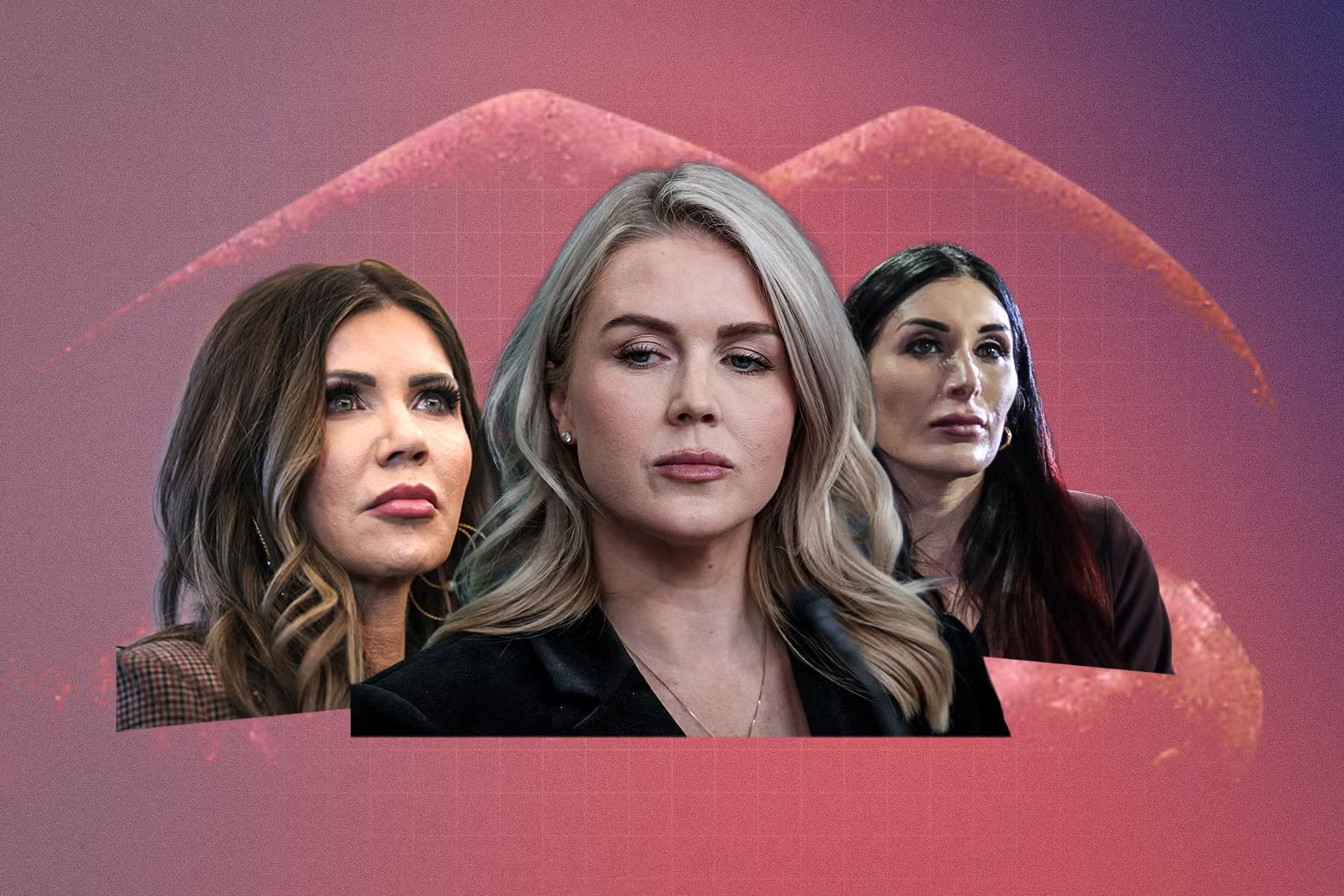
By now you’ve seen them: Karoline Leavitt’s lips flecked with injection punctures and slathered in gloss too thin for the job, in one of Christopher Anderson’s fascinatingly unflattering viral images captured for Vanity Fair’s story on Trump 2.0. While the consensus on TikTok seems to be that the White House press secretary’s injector hates her, the photograph is just the latest, most confronting example of MAGA world’s increasingly compulsory, almost uncanny cosmetic interventions for women, the more obvious the better. It’s what Occidental College political scientist Caroline Heldman characterizes as an aesthetics of capitulation, in which, for women like Leavitt, Kristi Noem, and Laura Loomer, “it becomes like a badge of honor.”
Showing the work is the point. Aesthetics for women in politics have always been fraught, but once upon a time, conservative women commentators could get away with a commitment to a brassy Fox & Friends blond dye job and a crucifix. These days, going full MAGA seems to mean getting a new face too. It means injections. It means work, in every sense of the word.
But first: What, exactly, is going on with 28-year-old Leavitt’s lips? It’s baffling even to experts like Kristy Hamilton, a board-certified plastic surgeon and social media chair of the American Society of Plastic Surgeons. The puncture marks, she said, suggest that the photo was taken “almost immediately post-injection.”
But new filler usually causes more swelling, making the image “a little bit of a mystery,” said Hamilton, who noted that even the use of more-opaque lipstick would have helped conceal the punctures. Leavitt’s visible vertical lip lines, she added, also don’t align with the typical appearance of fresh filler. “That does not look like someone who had lip filler the day prior, other than that it appears to be injection marks,” she said. Hamilton floated a theory that perhaps Leavitt had had “a very, very conservative touch-up” immediately before the shoot, but she noted that this would have been “extremely ill advised.” (Two dermatologists and a plastic surgeon told a beauty writer at the Cut that they also thought the injections had likely been done very recently, possibly even the day before the photo shoot.)
Hamilton’s response when I asked how a similar last-minute request would be received at her practice? “We’re not doing it.” Normally, she said, lip filler needs four weeks to settle in advance of a special event like a wedding—or a Vanity Fair shoot. The goal is for patients to feel beautiful.
But according to Heldman, the extreme cosmetic surgery currently animating the right wing’s aesthetic plays a different role: “You are communicating to the world that you are not just capitulating but embracing these ideas of femininity that have very conservative roots in the sense that they’re about controlling women’s bodies and putting a lot of pressure on women to perform femininity in a very specific, narrow, traditionally gendered way,” she said.
The strange case of Leavitt’s filler is an extreme, and perhaps unintentional, example of the sinister parallel between the political party currently limiting the bodily autonomy of women, trans people, and nonbinary people, and the self-regulation of the women tasked with selling that toxic agenda.
It’s the Marjorie Taylor Greene problem: If your political party’s MO is to constrain women and gender-nonconforming people across the country, you shouldn’t be surprised when you, too, end up on the wrong side of that dynamic. To avoid this fate, it appears that women like Leavitt are wearing their compliance on their faces and bodies. If there’s a brutality to this, it’s because it’s a reflection of an administration whose calling card is harm, greed, and rising fascism—delivered, as the Vanity Fair shoot reveals, without an ounce of style or self-awareness.
Although the GOP’s cluster of obvious cosmetic interventions might be the most prominent example, Hamilton said, any kind of cosmetic surgery preference can be influenced by group dynamics. “You can end up in a little bit of an echo chamber in terms of a certain aesthetic,” she said. For some, cosmetic procedures have also become an indicator of financial status. “We see people discussing these things as a luxury item,” Hamilton said. In the case of women like Noem and Leavitt, it seems a combination of these factors is to blame—along with the pressure to conform to a conservative gender norm.
They’re far from alone in succumbing to this pressure: There’s a long history of heightened, compulsory beauty work on the American religious right, and among conservative communities more broadly, which could be why Salt Lake City has the second-highest number of plastic surgeons per capita among American cities—after only Miami, naturally. According to the Utah Women and Leadership Project at Utah State University, the Mormon church’s emphasis on marriage and motherhood could be a contributing factor to this outsized demand for cosmetic procedures, since these norms give women the impression that physical beauty is the key to social success.
The Secret Lives of Mormon Wives, with its constant references to Botox and body enhancements, is a compelling reflection of this dynamic, although, in the case of MomTok, attaining ever-greater physical beauty is rolled into professional success more than the pursuit of marriage; many of the women on the show are divorced or in tense romantic partnerships, but all have lucrative careers as influencers. It’s telling that Jessi Draper, the only MomTokker with a job outside social media, owns a salon.
Though it’s more extreme in these spaces, the rise of cosmetic procedures isn’t just a right-wing phenomenon: Getting work done has become normalized in the years since early COVID, and more and more people are talking openly about it. With the advent of Zoom, we all know too much about our own faces. And with every swipe across another short-form video featuring a filtered and fillered TikTokker, it’s easy to understand the allure of purchasing beauty.
Heather Schwedel
Kimberly Guilfoyle’s Uniquely MAGA Humiliation Is Complete
Read More
But the right’s fascination with body modification belies something more insidious than the mere desire for beauty, which is ordinary and human and, as long as it doesn’t tip into addiction or reinforce body dysmorphia, can be a healthy form of self-expression. To the contrary, “I think this performative plastic surgery is a way to signal your conformity to the traditional gender binary during a time when it is perceived to be under threat,” said Heldman. We’re in a moment of cultural backlash, and some of us are wearing it on our faces.
-
The Dangerous Message Hiding in Karoline Leavitt’s Face
-
The Party of “Parental Rights” Just Took a Terrifying Step Toward Stripping Mine and Putting My Child’s Life in Danger
The emphasis on beauty work for women like Leavitt, then, reflects a deep discomfort with an ongoing fracture of gender norms. The right’s radical, surgical insistence on the gender binary is a transparent effort to cling to a crumbling foundation, though it’s no less damaging for being one. This, after all, is the same set of principles propelling attempts to erase through policy and language the existence of people outside the gender binary, to set the conditions to gut access to abortion nationwide, and to peddle a policy agenda that demonizes birth control and fabricates a crisis of childlessness while ignoring truly dire public health concerns, all in the name of an idea of gender that’s increasingly out of step with mainstream values and scientific reality.
If gender were so simple and clearly defined, said Heldman, “then you wouldn’t need to police it, and you wouldn’t need to get plastic surgery or work out at the gym to conform to it.”
So, in the end, it’s not really about Karoline Leavitt’s filler at all, if that’s what caused the punctures in her lips. It’s about the worldview her aesthetic choices reflect and the harm that worldview is actively causing to marginalized people across the nation, making our country a little bit worse and a little bit more cruel and a little bit more unserious with every passing day.
That’s the real power of the photographs Anderson took. For once, Leavitt and her cronies were caught in the act of their greed-based political project, complete with unflattering makeup, rumpled clothing, exposed outlets, deflated posture, and a crumpled American-flag blanket—a banal, slapdash Death of Stalin–style portrait that would be almost funny if it weren’t so deeply tragic. It looks ugly because it is.