Trump’s social media post says airspace around the South American country should be considered closed. Venezuela condemned the comments as a “colonialist threat” incompatible with international law.
Trump suggests Venezuela’s airspace is ‘closed’ as strikes ramp up
President Trump issued a warning to avoid Venezuelan airspace as his administration is ramping up strikes against drug trafficking organizations.
The United States appears to be inching closer to directly attacking Venezuela.
President Donald Trump on Nov. 29 issued a warning to avoid airspace around the South American country. Trump has already signaled imminent land attacks in Venezuela, a country larger than the size of Texas and a population of over 31 million people.
The Trump administration has escalated its threats against Venezuela and its leader, Nicolás Maduro, accusing his government of drug trafficking and terrorism. American military have launched several strikes on vessels near Venezuela that officials accused of smuggling drugs, often without evidence, killing dozens of people.
Now, after months of provocation, the administration may be readying to topple Maduro’s government.
Trump warns of closing airspace around Venezuela
In a brief social media post, Trump warned that the airspace of Venezuela should be considered closed. The president of the United States has no authority over Venezuelan airspace, however several major international airlines suspended flights following an earlier warning due to “heightened military activity in or around” the country from the Federal Aviation Administration.
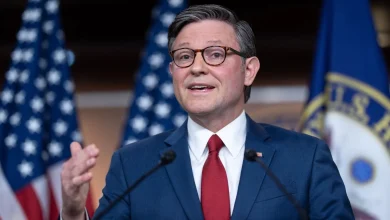
“To all Airlines, Pilots, Drug Dealers, and Human Traffickers, please consider THE AIRSPACE ABOVE AND SURROUNDING VENEZUELA TO BE CLOSED IN ITS ENTIRETY,” Trump said on his app, Truth Social, and his more rarely used X account. “Thank you for your attention to this matter!”
In a statement Saturday afternoon, Venezuela’s government condemned Trump’s comments, describing them as a “colonialist threat” against the South American country’s sovereignty and incompatible with international law.
Trump’s post “represents a hostile, unilateral and arbitrary act, incompatible with the principles of international law,” the statement said.
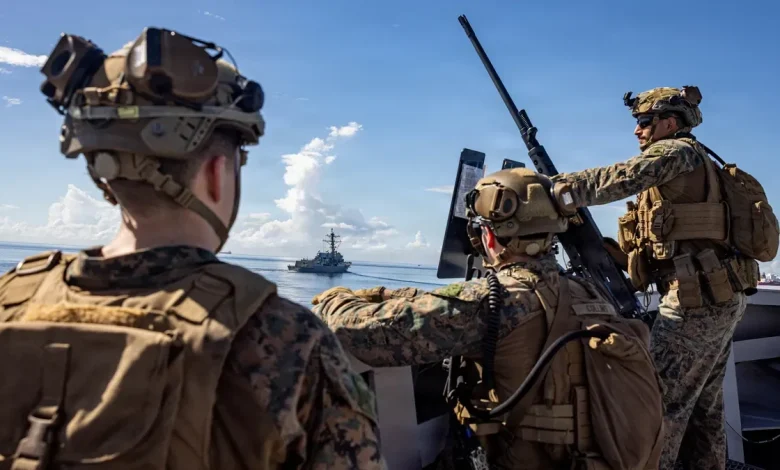
The United States has already positioned its largest aircraft carrier, two guided missile destroyers, and a special operations ship near Venezuela. Around 12,000 troops are stationed in the area.
Trump told military service members earlier this week that the U.S. would “very soon” begin land operations to stop suspected Venezuelan drug traffickers.
Venezuela’s capital and largest city is Caracas, which has a population of around 2 million people and is one of South America’s largest cities.
Administration accuses Maduro of drug trafficking, terrorism
Trump has accused Maduro of being a drug trafficker sending fentanyl that’s contributed to the American opioid crisis.
On Nov. 24, the State Department designated Maduro and other high-ranking government officials as part of a foreign terrorist organization. American officials labeled Cartel de los Soles, “cartel of the suns” in English, as the government-run terrorist group. Experts have told USA TODAY the name, considered a slang term, stems from Venezuelan military commanders’ epaulettes and leaders alleged ties to drug trafficking.
The actual group does not exist in the same way as established drug trafficking networks, though experts have said the Venezuelan military does have drug corruption.
While some other drugs such as cocaine have been tied to Venezuela, fentanyl, a highly potent synthetic opioid, is not a source or stopping point for the drug’s route to the United States. The precursors for fentanyl come mainly from China, and the drug is produced in Mexico before being sent across the border, mostly through legal ports of entry.
US military launches strikes on boats
In the lead up to Trump’s announcement, the military has attacked several boats off South America in international waters. Officials have accused the boats of smuggling drugs to the United States without evidence presented to the public or to Congress.
So far, 83 people, including many Venezuelans but also other South Americans and Caribbeans, have been known to have died on around 21 boats.
The United Nations High Commissioner for Human Rights has said the strikes violate international human rights law. Former military and law enforcement officials, as well as legal analysts, say the strikes are illegal and amount to extrajudicial killings.
Millions fled South American country, oppressive government
Nearly 8 million people have fled Venezuela since around the mid 2010s, according to the UN Refugee Agency. The number of people who left the South American country account for about a fifth of Venezuela’s population, the New York Times has reported.
An oil-rich country, the country’s economy has collapsed, marked by widespread poverty and violence, including allegations of corruption and oppressive crackdowns by Maduro’s ruling government that is widely considered a left-wing dictatorship. Under Maduro’s United Socialist Party, Venezuela has held elections that are seen as undemocratic, with 2024 elections that international observers and Venezuelan opposition leaders say Maduro lost. He has remained in power.
While the United States saw a wave of migrants from Venezuela seeking asylum, most have gone to nearby countries, mostly to bordering Colombia but also Peru and Brazil. The Trump administration has also labeled many Venezuelan migrants as members of a criminal gang, Tren de Aragua, with little or no evidence.
Under Trump, increasing US presence in Latin America
Along with moving strategic military assets into the Western Hemisphere, Trump has frequently weighed in on Latin American affairs.
On Nov. 28, Trump encouraged Hondurans to vote for a conservative candidate for president in the upcoming election, while he said he would pardon a former president convicted in the United States of drug trafficking. At the same time, he told Maduro to stay out of Honduras.
The United States has a long history of regime change across Latin America. The 19th and 20th centuries saw several American-backed coups and direct interventions toppling mostly left-wing governments.
Contributing: Phillip Bailey, Josh Meyer, Zac Anderson, Cybele Mayes-Osterman, Reuters