Getty Images
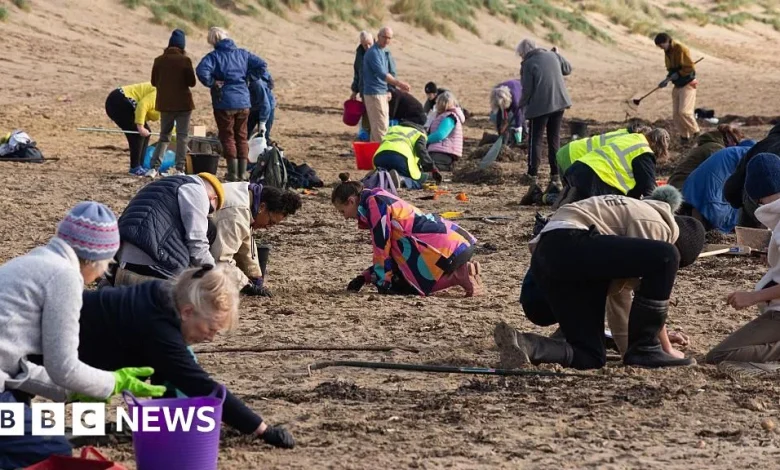
Volunteers have helped to remove the plastic beads from the beach at Camber Sands after a microplastic spill
Southern Water said the clean-up following a leak at a wastewater plant in Eastbourne which resulted in tonnes of pellets washing up on the beach has cost the company £2m so far.
Last month, up to 10 tonnes of plastic pellets entered the sea at Eastbourne through a 3.4km (2.1 mile) pipe after a fault in the treatment tank at the wastewater plant.
The biobeads were washed up on Camber Sands in East Sussex and prompted a major clean-up operation.
Alex Saunders, the company’s waste water manager, said the clean-up was “projected to cost a lot more”.
Southern Water said the 40-mile (65km) stretch of coastline between Eastbourne and St Mary’s Bay in Kent was “believed to be the primary risk area for beads to be washed up”.
A company spokesperson said it would be working on the clean up “for as long as it takes” to get the beach back to the state it was previously.
BBC / Fiona Irving
Alex Saunders, waste water manager of Southern Water, says the company is exploring ways to remove the biobeads from beaches faster
The company said it was introducing 12 battery-operated sieves “to speed up bead sorting”.
It explained the sieves could catch any microplastics that were 2.6mm (0.1in) or larger.
“We are also covering the cost of three new Nurdle machines, which are high-powered vacuum and sorting equipment, for longer-term beach cleaning,” a spokesperson said.
Mr Saunders said the company and its partners are “continuing to innovate, and looking at other ways to collect more beads faster”.
He added they are working with engineers to prevent the beads from leaking from treatment tanks.
Getty Images
The government said it was ‘appalled’ by the pollution incident
The company added it was continuing to repair the mechanical failure that caused the leak.
The pellets were released into the sea during heavy rainfall after the failure of a screening filter.
A defective tank was spotted on 28 October, the company said, but it was not known at the time whether any pellets had escaped.
Southern Water said about 80% of beads washed up on the beach had now been removed.
It urged residents to wear gloves before removing them and dog walkers should ensure their pets do not consume the beads.
A spokesperson for the Environment Agency said: “We acknowledge that Southern Water has admitted responsibility for the pollution incident in a statement.
“This is an active investigation, and we will not hesitate to take robust enforcement action where appropriate.
“We continue to work closely with Rother District Council and other responders on the clean-up operation of plastic pellets on Camber Sands.”
Getty Images
Not-for-profit organisation Nurdle used a vacuum machine to pick up the biobeads during the clean-up at Camber Sands on 9 November
Rother District Council said more work would be done to ensure new beads that may wash up on the beach were cleaned up.
“In between spring tides, the council, Southern Water, Strandliners and other volunteers are continuing to clear as many pellets as possible using more manual methods to protect the fragile strandline,” a spokesperson said.