Listen to this article
Estimated 4 minutes
The audio version of this article is generated by text-to-speech, a technology based on artificial intelligence.
Prime Minister Mark Carney said Tuesday he should not have been dismissive of reporters’ questions about speaking to U.S. President Donald Trump, conceding he used “a poor choice of words.”
Carney dodged questions about the last time he spoke to his U.S. counterpart Sunday, saying ‘who cares?’ when pressed in Johannesburg, South Africa, after the G20 summit.
“We’ve had discussions. I’ve been busy,” Carney said when asked about connecting with Trump. “He’s got other things to do and we’ll re-engage when it’s appropriate.”
Asked again to detail when he last spoke to Trump, Carney said: “Who cares? I mean, it’s a detail. I spoke to him. I’ll speak to him again when it matters.”
WATCH | Carney admits ‘poor choice of words’:
Carney admits ‘poor choice of words’ when saying ‘who cares’ about Trump meeting
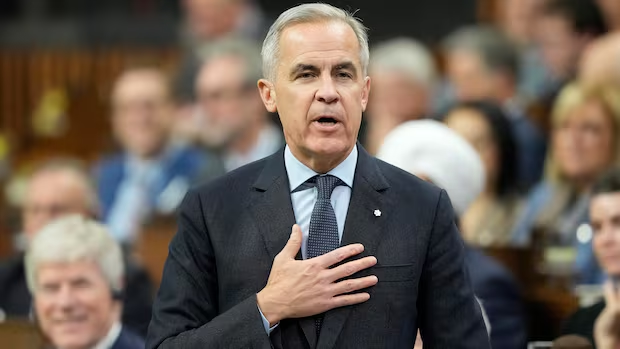
Following a question from Conservative Leader Pierre Poilievre on Tuesday, Prime Minister Mark Carney told the House of Commons that ‘when I make a mistake, I’ll admit it.’ Carney was referring to saying ‘who cares’ when asked about his stalled conversations with U.S. President Donald Trump.
Carney offered a mea culpa after facing an onslaught of criticism from the Opposition Conservatives.
“When I had the great honour from my constituents of being elected to be a deputy in this House, unlike some others in the chamber today, I made a promise to Canadians that when I make a mistake, I’ll admit it,” Carney said, making a dig at Conservative Leader Pierre Poilievre who lost his Ottawa-area seat on election night.
“That was a poor choice of words about a serious issue. And the serious issue is what progress are we making structurally,” Carney said, before going on to tout the relatively low U.S. tariff burden on most Canadian goods.
Canada-U.S. trade talks broke down abruptly last month after Trump lashed out at Canada for Ontario Premier Doug Ford’s anti-tariff ad campaign that invoked Ronald Reagan.
A spokesperson for Carney told CBC News on Monday he is considering a trip to Washington next week to attend the draw for the FIFA World Cup, which Canada, the U.S. and Mexico are jointly hosting in 2026.
That draw, set to take place at the Kennedy Centre, the performing arts centre Trump now personally controls, will determine the group-stage matches for that major soccer tournament.
Poilievre, meanwhile, said Carney’s dismissive answer is a sign that he is not taking the tariff fight seriously and has dropped his “elbows up” approach to the U.S.
“Workers on the line care, Canadians care. Why doesn’t the prime minister care?” Poilievre asked in question period.
Poilievre said Carney’s trips abroad haven’t produced meaningful results to this point — tariff rates with the U.S. are actually higher now than they were when he was first elected.
Carney said Poilievre is wrong and he needs to “check his numbers,” adding Indonesia, the world’s fourth-most populous country, has agreed to drop 95 per cent of its tariffs on Canadian goods after cutting a free trade deal.
After visiting the United Arab Emirates last week to sign a foreign investment agreement, Carney said investors in that oil-rich gulf country are poised to pour some $70 billion into the Canadian economy.
Foreign Affairs Minister Anita Anand called that commitment the “largest foreign investment in Canadian history.”
Plus, while U.S. tariffs are up on some Canadian exports like steel and autos, Carney said Canada still enjoys the lowest tariff burden in the world thanks to Canada-U.S.-Mexico Agreement (CUSMA) carve-outs.
As for helping workers in tariff-hit industries, Natural Resources Minister Tim Hodgson said more relief is coming later this week for some sectors that have been upended by Trump’s protectionist policies.
The forestry sector in particular has been hard hit by a toxic combination of American tariffs and countervailing duties, which add up to more than 40 per cent, a burden that has already forced some mills to close.