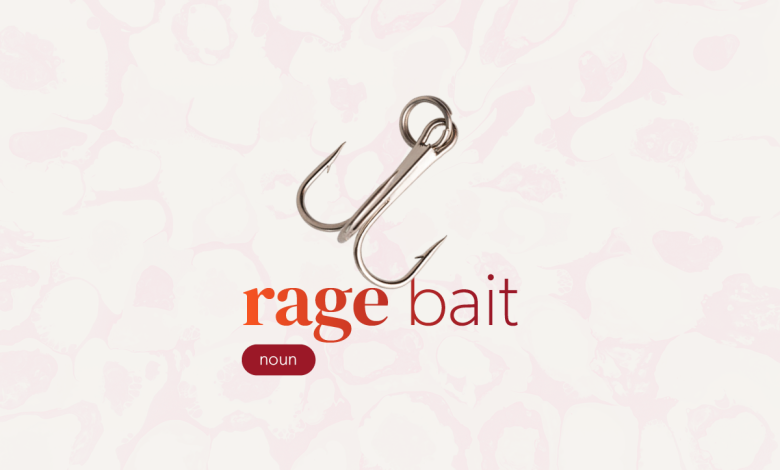
The wait is over—the official Oxford Word of the Year 2025 is rage bait.
Our language experts shortlisted three contenders—rage bait, aura farming, and biohack—that reflect our conversations and preoccupations over the past year. After three days of voting in which more than 30,000 people had their say, our experts chose rage bait after considering votes, the sentiment of public commentary, and their analysis of our lexical data.
Why rage bait?
Rage bait is defined as “online content deliberately designed to elicit anger or outrage by being frustrating, provocative, or offensive, typically posted in order to increase traffic to or engagement with a particular web page or social media content”.
With 2025’s news cycle dominated by social unrest, debates about the regulation of online content, and concerns over digital wellbeing, our experts noticed that the use of rage bait this year has evolved to signal a deeper shift in how we talk about attention—both how it is given and how it is sought after—engagement, and ethics online. The word has tripled in usage in the last 12 months.
Rage bait was first used online in a posting on Usenet in 2002 as a way to designate a particular type of driver reaction to being flashed at by another driver requesting to pass them, introducing the idea of deliberate agitation. The word then evolved into internet slang used to describe viral tweets, often to critique entire networks of content that determine what is posted online, like platforms, creators, and trends.
Since then, it has become shorthand for content designed to elicit anger by being frustrating, offensive, or deliberately divisive in nature, and a mainstream term referenced in newsrooms across the world and discourse amongst content creators. It’s also a proven tactic to drive engagement, commonly seen in performative politics. As social media algorithms began to reward more provocative content, this has developed into practices such as rage-farming, which is a more consistently applied attempt to manipulate reactions and to build anger and engagement over time by seeding content with rage bait, particularly in the form of deliberate misinformation of conspiracy theory-based material.
Isn’t rage bait two words?
The Oxford Word of the Year can be a singular word or expression, which our lexicographers think of as a single unit of meaning.
Rage bait is a compound of the words rage, meaning ‘a violent outburst of anger’, and bait, ‘an attractive morsel of food’. Both terms are well-established in English and date back to Middle English times. Although a close parallel to the etymologically related clickbait—which has a shared objective of encouraging online engagement and the potential to elicit annoyance—rage bait has a more specific focus on evoking anger, discord and polarization.
The emergence of rage bait as a standalone term highlights both the flexibility of the English language, where two established words can be combined to give a more specific meaning in a particular context (in this case, online), and come together to create a term that resonates with the world we live in today.
Speaking about this year’s winner, Casper Grathwohl, President of Oxford Languages, said:
“As technology and artificial intelligence become ever more embedded into our daily lives—from deepfake celebrities and AI-generated influencers to virtual companions and dating platforms—there’s no denying that 2025 has been a year defined by questions around who we truly are; both online and offline.
“The fact that the word rage bait exists and has seen such a dramatic surge in usage means we’re increasingly aware of the manipulation tactics we can be drawn into online. Before, the internet was focused on grabbing our attention by sparking curiosity in exchange for clicks, but now we’ve seen a dramatic shift to it hijacking and influencing our emotions, and how we respond. It feels like the natural progression in an ongoing conversation about what it means to be human in a tech-driven world—and the extremes of online culture.
“Where last year’s choice, brain rot, captured the mental drain of endless scrolling, rage bait shines a light on the content purposefully engineered to spark outrage and drive clicks. And together, they form a powerful cycle where outrage sparks engagement, algorithms amplify it, and constant exposure leaves us mentally exhausted. These words don’t just define trends; they reveal how digital platforms are reshaping our thinking and behaviour.
“Year after year, it’s incredible to see the campaign spark curiosity, conversation, and—most importantly—participation. The Oxford Word of the Year invites us to pause and reflect on the forces shaping our collective language. I can’t wait to see what the next year brings.
Find out more about Oxford Word of the Year, including our 2025 shortlist and approach, here.