About 10,000 Jordan cases thrown out annually as Ottawa, provinces call on Supreme Court for change

Open this photo in gallery:
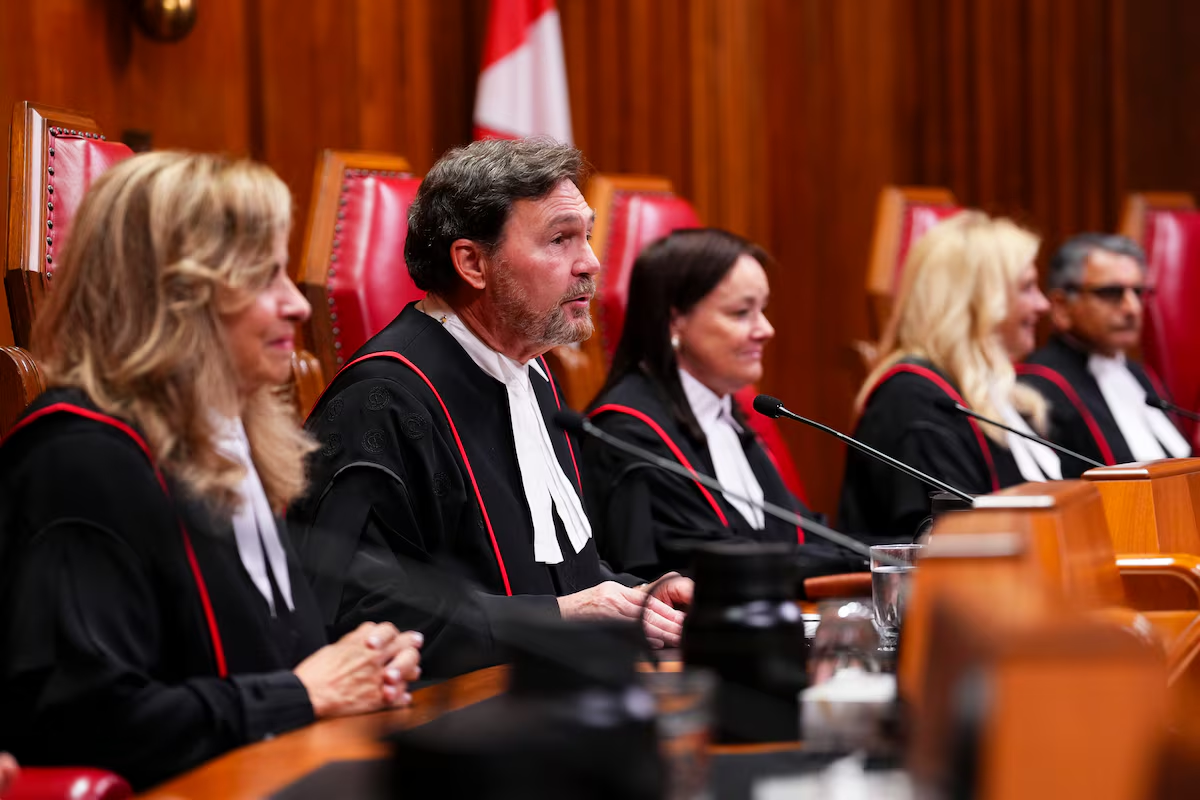
Chief Justice Wagner speaks alongside fellow Supreme Court of Canada Justices during the Ceremonial Opening of the Judicial Year at the Supreme Court of Canada in Ottawa on Oct. 6.Sean Kilpatrick/The Canadian Press
Strict criminal trial deadlines imposed by the Supreme Court of Canada are derailing about 10,000 cases a year, a list that includes several alleged murders and hundreds of alleged sexual assaults, according to the latest Statistics Canada data.
The dire situation has led the federal government and the three biggest provinces to call on the Supreme Court to provide some leeway on the time limits, called Jordan deadlines, in a drug-trafficking case to be heard at the top court in Ottawa on Thursday.
The federal government is also planning to table legislative changes by mid-December to help address the problem of so many serious cases being tossed because of delays.
For decades, such delays have plagued Canada’s justice system. In a landmark decision in a 2016 case called Jordan, the Supreme Court tried to do something about them, citing a pervasive culture of complacency around the issue.
The top court created make-or-break deadlines. Unless there are exceptional circumstances, criminal trials must be completed in provincial courts within 18 months from the day a person is charged, and within 30 months in superior courts.
Hundreds of sex-assault cases are being halted because of trial delays, watchdog warns
But a mechanism that was introduced to improve the justice system has garnered increasingly strident criticism for potentially denying justice to victims, especially in serious cases, such as sexual assault.
In 2023-24, according to Statscan data released in October that show how Jordan has disrupted the justice system, there were 9,560 cases that exceeded Jordan limits and were stayed or withdrawn. The number accounts for 4.2 per cent of all federal statute cases in adult criminal courts across the country.
Among the total are hundreds of sexual assaults and eight homicide cases.
The total of 9,560 is down from a peak in 2022-23 of 11,132 criminal cases derailed by Jordan. But it remains much higher than the level of roughly 5,000 cases a year that had exceeded Jordan limits and were stayed or withdrawn in the first several years after the Supreme Court issued its judgment in mid-2016.
The Charter of Rights and Freedoms states that any person charged with an offence has the right to be tried within a reasonable time. But stays or withdrawn charges in cases can cause anguish for victims. It is for many the absence of justice – a system that has failed.
January: Supreme Court set to hone details on strict Jordan time limits on criminal trials
In 2023-24, there were 525 cases of sexual assault that exceeded Jordan limits and were stayed or withdrawn. That’s 13 per cent of all sexual-assault cases, more than one in eight. It is the highest annual total since the Jordan ruling, and more than double the number of three years earlier.
In September, 22 plaintiffs with cases of alleged sexual violence that were affected by Jordan filed a lawsuit in Federal Court against the federal government. They are seeking $22-million in damages.
Their court filings detail gutting personal stories. In one, Melanie Hatton was allegedly nearly killed by her ex-husband four years ago in an attack in their home in front of their children. The trial was set to start about 21 months later. The charges were stayed. “She has since been in constant fear for her life,” the lawsuit states.
At the Supreme Court on Thursday, the federal government, Ontario, Quebec and British Columbia are asking the top court to reconsider Jordan. Legal arguments for greater flexibility were made in filings ahead of the hearing, which concerns the prosecution of Robert Vrbanic, who was accused of trafficking drugs.
Governments are arguing the Jordan deadlines, which define the boundaries of what is reasonable, are themselves unreasonable.
Opinion: Ottawa’s latest bail reforms continue to ignore the actual problem
Criminal defence lawyers, meanwhile, say governments have for years failed to bolster the justice system with sufficient resources to meet deadlines.
The Vrbanic prosecution had run four days past the Jordan clock. Charges were laid in 2021, and in 2023 the Ontario Court of Justice stayed the case, a decision upheld by the Ontario Court of Appeal early this year. A judicial stay is a legal term for an order to set aside a case.
The Vrbanic appeal centres on the question of complex cases. The federal Public Prosecution Service described Project Skyfall, a joint-forces investigation by the Hamilton Police and RCMP. It required 150 judicial authorizations, and wiretaps produced more than 10,000 audio intercepts. Mr. Vrbanic and Sarah Josipovic were arrested in August, 2021; among the drugs found were two kilograms of cocaine and three kilograms of methamphetamine.
In Ottawa’s appeal to the Supreme Court to overturn the Vrbanic stay and return the case to trial, lawyers for the Prosecution Service said the stay “undermines public confidence in the administration of justice.”
“Justice is not always mathematically quantifiable,” the federal government said in its written arguments. It called Vrbanic one example of a “myriad of cases that demonstrate that clarification from this Court is needed.”
Canadians say too many people are getting out on bail. The data paint a complex picture
British Columbia, in its filing as an intervener, asked for more judicial discretion in cases that are close to the line. Lawyers for the province said an automatic stay is a “devastating consequence for the truth-seeking function of a trial.”
In an interview, B.C. Attorney-General and Deputy Premier Niki Sharma said there’s a need to take another look at Jordan.
“We’re not saying that timelines aren’t important, but should it just be that you fall off a cliff after a certain time?” Ms. Sharma said.
Frank Addario, a Toronto lawyer, has heard it all before. Instead of governments improving the justice system, he said, they’re seeking reprieve at the Supreme Court from their constitutional obligations to the accused.
In a legal filing at the top court on behalf of the Criminal Lawyers’ Association, an intervener in Vrbanic, Mr. Addario argued there was no compelling evidence to justify departing from Jordan.
In an interview, he said the Charter right to a trial within a reasonable time frame may not be popular when cases are stayed, but it’s a crucial part of the legal system. Blame should be cast on governments, not the accused, he said.
“You want to water down a constitutional right because you’re not complying with it?” Mr. Addario said of the governments’ arguments in Vrbanic.
2024: Canada’s civil courts are a mess. What will it take to ensure justice is done faster?
The Jordan decision in 2016 aimed to rectify problems that persisted for decades after two Supreme Court decisions on delays: Askov in 1990 and Morin in 1991. Unreasonable delays were decided on a case-by-case basis on specific factors.
Frustrations with a Byzantine justice system never abated. Former Supreme Court justice Michael Moldaver, an expert in criminal law, was the lead author of the 5-4 Jordan decision, which called the previous system unpredictable, confusing and complex.
The Jordan dissent included former chief justice Beverley McLachlin and then-justice Richard Wagner, now the top court’s Chief Justice. The dissenters stated that unreasonable delays “cannot and should not be defined by numerical ceilings.”
The majority in Jordan did make room for what it called exceptional circumstances. But despite precise deadlines, legal wrangling over details of delays continued. The Supreme Court has weighed a series of Jordan-related cases since 2016. In November, it heard a case called Jacques-Taylor. At issue in that case was calculating Jordan deadlines when there are co-accused.
At the same time the federal government is arguing about Jordan at the Supreme Court, Justice Minister Sean Fraser is working on criminal justice legislation that includes a focus on the issues of delays and Jordan.
The new bill “will include a significant component that addresses specifically the Jordan decision and delays that we see in our court systems,” Mr. Fraser said in late October when Ottawa tabled changes to bail and sentencing laws.
2024 Opinion: What kind of functional country lets alleged criminals, by the hundreds, walk free? Canada, apparently
Mr. Fraser said the planned remedies will help alleviate delays. The number of federally appointed judges is being considered. There are about 10 per cent fewer today, relative to the population, than there were two decades ago.
Ottawa is also looking at the long process to introduce evidence in sexual-assault trials and the challenge police have when it comes to collecting evidence ahead of laying charges.
Even as governments are asking the Supreme Court for leeway on Jordan, the eventual ruling could focus solely on the Vrbanic case rather than adjudicating more broadly. This happened in a 2022 case, when Ontario argued it was “time to revisit the law.” The Supreme Court instead delivered a narrow ruling on the case at hand.
Chief Justice Wagner, although he was in the minority in Jordan, has repeatedly defended the decision – “Jordan is the law,” he said last year – and has called on Ottawa to make sure there are enough judges, and on provinces to properly fund the courts. He has said long delays are unfair for everyone: the accused, victims, witnesses and society.
The message from the Supreme Court has been consistent since Jordan. Yet the chorus of calls for change from governments and others in the justice system has become more urgent as the number of criminal cases derailed remains stubbornly high. The annual average is about 10,500 in the most recent three years of data – 4.7 per cent of the total, almost one out of every 20 cases.
A line in a Vrbanic legal filing, from the Canadian Association of Chiefs of Police, encapsulates the frustration – and underlines the stakes at the hearing on Thursday: “Strict adherence to rigid timeframes risks undermining, rather than advancing, public confidence in a fair and effective criminal justice system.”