Tears streamed down the girl’s face, dampening the collar of her Minnie Mouse sweatshirt.
It was just before noon at Hugh Mercer Elementary School, and while most of her classmates were immersed in a phonics program on their tablets, the girl’s headphones sat unplugged on her desk.
Kindergarten is hard: new faces, spaces and expectations.
It’s even harder when you’re attending school for the first time in a new country, tasked with learning a new language and cultural norms along with letter sounds and numbers.
Luckily for the hundreds of Fredericksburg City Public Schools students whose families come from Afghanistan, there’s someone who understands. Actually — there are three someones.
Last spring, FCPS hired three native Afghans through a federal grant administered by the Virginia Department of Social Services’ Office of New Americans (ONA). Since March, Turyalai Rahmani, Morsal Azizi and Raz Ebrat have worked as family liaisons and student advisors with the school division’s Connection Resources Center (CRC).
Rahmani oversees the program at the division level, while Azizi rotates among the city’s three elementary schools and Ebrat splits his time between Walker-Grant Middle School and James Monroe High School.
The team focuses its efforts on approximately 180 Afghan students and 225 parents who meet the qualifications of the grant, which is based on when they arrived as refugees in the United States.
“But we have an agreement within our team,” added FCPS Director of Student Programs Matt Terry, “that if a family comes to us and they’re an Afghan family, and they need some help, we help them.”
School divisions across the Commonwealth were awarded the same grant, with many putting the funds toward translation devices or online programs. FCPS, which received $469,852, took a different approach.
“We were able to really do whatever we wanted with the money,” Terry said. “But our division philosophy was people over programs.”
Flagging issues, building trust
The assignment seemed simple enough: draw a flag depicting where you’re from.
But while Celia Poudrier recognized most of her students’ banners — including those crafted by her Afghan students — one project stumped her.
“It didn’t look like an [Afghan] flag, because I know what that looks like,” recalled Poudrier, a veteran English Language Learners (ELL) teacher at Walker-Grant Middle School. “I had questions.”
And she knew who could answer them. She called Rahmani and Ebrat, who came to her class the very next day.
As it turned out, the flag in question, which featured green, white and black horizontal stripes, resembled that of the Northern Alliance, a coalition of militia groups that combatted the Taliban in the 1990s and early 2000s. After the Taliban retook the country, it resurfaced as a symbol of resistance.
“I don’t understand the whole politics behind it,” Poudrier said.
It’s unlikely that the eighth-grader who’d drawn the flag did, either. Ebrat spoke to the student privately, explaining that the choice to display various flags had stoked political and sectarian division in Afghan diaspora communities in Europe and elsewhere, sometimes leading to violence.
Then, together, they resolved the issue.
“It was very serious,” Poudrier recalled. “They took the flag, hung it over the trash can, and then — almost like a ceremony — he ripped it and threw it in the trash.”
Not every interaction is so politically fraught.
When a Free Press reporter visited Walker-Grant Middle in October, Ebrat opened his laptop to reveal a list of halal-friendly snacks he was in the process of compiling, with plans to distribute them to the division’s school nurses. Muslim students can’t eat anything containing gelatin, which is found in most gummy snacks, marshmallows and even some ice creams.
As the CRC’s division-wide coordinator, Rahmani works out of the 1935 building, right across the street from the Walker-Grant Center, which houses FCPS’s administrative offices. That building is also home to the youngest FCPS students, those enrolled in preschool programs.
He often walks past preschool classes lined up with their teachers, making a point to stop and greet the children.
CRC division coordinator Turyalai Rahmani (right) leads the team’s translation and communications efforts. (Photo by Jeff Kearney)
“When I see some familiar face, like they might be from South Asia, I’m saying salaam (سلام; hello),” Rahmani said. “And they’re coming to me and saying, ‘Salaam!’ They’re so excited… They are coming and leaving the line. The teacher is saying, ‘Hey, you left the line!’”
Similar scenes unfold daily at FCPS’s five schools. Between periods at Walker-Grant, Ebrat walked the halls outside of his office in the guidance department, offering a greeting of “سلام، چطور استی؟ (Hello, how are you?)” to each passing Afghan student.
As if magnetized by a cultural bond, they approached and shook both of his hands before heading to their next class.
“Whether they are 3 years old or 33 years old, the same reaction happens,” Terry said. “And they make that happen.”
Lost in translation no longer
November parent-teacher conferences were less than a week away, which meant Azizi had plenty of calls to make.
A form asking parents to select a time slot with their child’s teacher(s) had been sent home with all elementary students a few days earlier, but Azizi knew that many Afghan families — her families — didn’t have anyone in the household who could read it.
After consulting with Maricruz Baker, an elementary-level ELL teacher whose caseload includes Afghan students, she dialed the first number on her list of families who hadn’t yet selected a slot.
“Salam alaikum (السلام عليكم; peace be upon you),” greeted Azizi when someone picked up.
What followed was an awkward pause, followed by a woman’s voice in halting English: “Sorry, I don’t speak Arabic.”
“Well, what language do you speak?” Azizi asked.
Azizi herself speaks five languages, but Urdu might be fifth among them. Still, she managed to convey the key details about a parent-teacher conference and confirmed a time slot before hanging up.
While the CRC liaisons are sometimes tapped to resolve cultural issues, language remains the biggest barrier for FCPS’s Afghan families.
According to self-reported data collected by the school system, 240 students consider Pashto their first language, followed by Dari (184) and Farsi at 42 and Persian at 14. For context, FCPS has about 600 Spanish-speaking students.
The latter three South Asian languages, Rahmani explained, are actually the same, just referred to differently depending on the speaker’s country. Dari and Pashto are commonly spoken in Afghanistan.
FCPS uses two primary apps to communicate with parents and families: ParentSquare, which communicates important dates and events, and PowerSchool, which contains information about a student’s grades and attendance.
“One of the challenges I saw when I started working,” said Ebrat, “was that a lot of families, parents don’t have access to some of the technology the schools are using.”
So, the fledgling team turned to an app their families already knew: WhatsApp. In Afghanistan, mobile data is scarce and expensive, but the Internet is more stable. Additionally, most migrant families already use the encrypted app to communicate with loved ones back home.
“They’re familiar with it,” Azizi said. “And the other reason is that, regardless if they are educated or not, it’s easy to use. And women, even if they have limited English knowledge, they can use it.”
The three liaisons maintain a group chat with upwards of 90 families, using the thread to share essential dates and information in three languages — English, Pashto and Dari/Persian — but also responding to questions and concerns on an a la carte basis.
“For every one call, we are receiving 99 [messages] in WhatsApp,” Rahmani said.
FCPS has long utilized resources to assist non-English speakers, including LanguageLine, a phone-based interpreting service. More recently, parents and teachers have also utilized ChatGPT and other online-based translators.
But even if dialect and context line up — and they rarely do, Rahmani noted — the output lacks one critical component: trust. Chatbots don’t care about your family or which state you come from back home.
“We might have the technology and a machine,” he said, “but we know the culture.”
‘Where I had to be’
Ebrat still remembers the simple kindness of a high school principal.
He was 16, a sophomore with passable English but no fluency in the unwritten rules of Michigan’s Ypsilanti Community High School.
Back in 2006, Ebrat came to the United States for the first time after winning a coveted scholarship through the Kennedy-Lugar Youth Exchange & Study (YES) program, which allows students from predominantly Muslim countries to spend one academic year living with a host family and attending high school.
Academics weren’t an issue. He took six classes, three of which were math courses.
“The reason for that is that back home in Afghanistan, math books are in black and white, there are no graphs or pictures,” he said.
He got straight As, including in AP Trigonometry, a course typically reserved for juniors or seniors. Making the grade when it came to American culture didn’t come quite so easily.
At Ypsilanti, or Ypsi High, as the locals called it, Ebrat found himself sharing a classroom with girls for the first time. It was a scenario he’d been specifically prepped for during a six-week cultural seminar prior to coming to the U.S.
“When a girl approaches you or talks to you, don’t take it personal or like it’s intimate,” he said of the training. “If it wasn’t taught, because I was coming from Afghanistan, I would be thinking otherwise.”
In the winter months, the days got shorter quickly, leaving Ebrat with a limited window for the Dhuhr, or afternoon prayer — it would be too late by the time he got home from school.
He consulted with the school’s principal, who agreed to let him use his office for prayer during the lunch break. Each morning, he would drop off his prayer mat, returning at the start of the lunch period to perform the prayer, which is mandatory in Islam.
Raz Ebrat, a CRC family liaison with Fredericksburg City Schools, poses after taking the oath of allegiance to become a U.S. citizen in October. (Photo courtesy of Raz Ebrat)
“And most of the time he knew the time I was coming,” Ebrat said. “So he would go out of the office so that I had that comfort of being alone.”
Now 34 and a newly sworn-in U.S. citizen as of October, Ebrat has realized something since coming to Fredericksburg: He’s more than just a translator or intermediary between families and school administrators.
His job is to ensure that every student he encounters in the hallways at either Walker-Grant or James Monroe has someone like that principal, but with the added benefit of speaking the language and understanding the culture.
As if to underscore that point, shortly into his tenure, two female James Monroe students approached Ebrat with a familiar concern: They needed a prayer space.
“When I started this role, it took me back to where I was a student,” he said. “I was in school. I was sitting in the same chair. This is the place where I had to be.”
‘We are in America’
Azizi, too, sees herself in her students — especially the girls.
Growing up in Ghazni, a city of about 200,000 people to the southeast of Kabul, she watched as her parents lavished her brothers with every possible educational opportunity.
Meanwhile, she had to pave her own way academically, earning a coveted scholarship to attend college in India.
“It was all what I did,” Azizi says, describing a phase of her life that she calls “the dream of India.”
The first surreal moment came when she boarded the plane. The second came on the streets of Bangalore, where she marveled not so much at the darting scooters and motorbikes — but the fact that women were driving some of them!
“I went from a community [where] I had to cover my whole face because I was a woman, and nobody was supposed to see me except my family members,” she said. “India changed my life.”
After earning her bachelor’s degree in three years, she returned to Afghanistan to teach women through a project sponsored by the U.S. embassy. Though Azizi was determined to pay it forward, she struggled to reconcile her newly acquired knowledge with the old ways in Afghanistan.
“Once you’re going from a freedom country, and you’re going back to the same place that you were, it was not easy,” said Azizi, now 27. “I was in a depressive mood for a year,” she said. “I was not able to get up, because I was thinking, if I stayed there, it was not an enjoyable life. It was a miserable life.”
Her choice was made for her in 2021, when the Taliban returned to power for a second time. Along with her co-workers, she fled the country, originally settling in Minnesota before coming to Virginia, which has resettled more Afghan refugees per capita than any other state.
Azizi had learned — albeit begrudgingly — to accept the gender disparity in education back home. But when she detects the vestige of those same ideas among Afghan families in the city’s school system, she refuses to stay silent.
“Here, we are in America. We are not living back in Ghazni in that old district,” she said. “Why [do] people have this mentality here?”
Morsal Azizi serves as the elementary-level liaison for the FCPS Connections Resources Center team.
In school, if Azizi sees a female Afghan student who appears reticent to respond to a male teacher or administrator, she knows that it’s likely more attributable to culture than defiance.
With older girls who are pondering a future beyond high school graduation, Azizi counsels them to focus on their studies and to feel free in doing so.
She urges them to make their parents proud, and — sometimes — to prove them wrong.
“Don’t be like your mom,” she says. “Your mom had no choice, but here, it’s different.”
Married Afghan women rarely work outside the home, so they spend their days together, sharing tea and chitchat. Azizi often finds herself invited to gatherings in the Fredericksburg area.
“And when I go there, I talk to them,” she said.
She tells them that, in her experience at least, America doesn’t see your gender, accent or appearance.
She tells them that, here, “It is equal if you do your best.”
And, if rhetoric fails to sway her audience, she tells her own story. Azizi’s parents may not have invested in her education — but she’s providing returns, nonetheless.
“I’m supporting my whole family,” she said. “None of my brothers who were getting a lot of money from my family — because they were boys — they can’t support them now. I, as a woman, I can support them.”
Making connections — and sustaining them
FCPS sends quarterly reports to the Virginia Department of Social Services, which tracks how they’re spending grant funds.
But perhaps the best indicator of the inroads the three hires have made in the past six months was a candid exchange that took place at the Hazel Hill Community Center earlier this month.
Hazel Hill, which was built in the 1970s as a Housing and Urban Development-assisted apartment complex, is now home to a significant portion of Fredericksburg’s Afghan population. The 15 adult residents who trickled in for the CRC’s first Parent-School Reflection & Engagement Meeting were all women, and all but one spoke Dari.
Rahmani and Azizi mingled among them and their small children, handing out forms, making small talk and explaining, with some difficulty, that a male reporter and male photographer were there to do a story but would respect their privacy. (The Free Press agreed to photograph the women only from behind, not showing their faces.)
Over the next hour, the two CRC liaisons offered updates on the school year and shared information about the relevant apps: ParentSquare, PowerSchool and WhatsApp. Terry, who relied on them as translators, implored the women to take an active role in their children’s education.
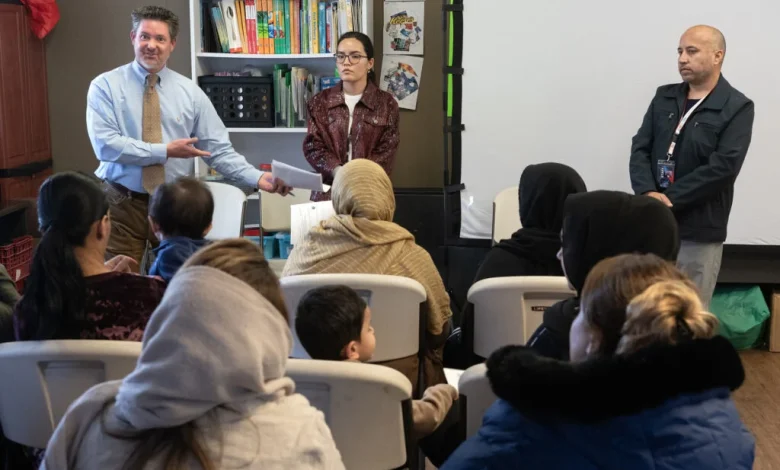
CRC leader Turyalai Rahmani (right) addresses a group of Afghan parents during a “Parent-School Engagement Meeting” as Matt Terry looks on at the Hazel Hill Community Center in November. (Photo by Jeff Kearney)
Terry pointed out that while school officials often have their husband’s contact information on file, fathers are likely away working — sometimes out of state — at the very moment when a parent needs to be notified.
“We want you involved,” he said. “We want you to ask questions, and today, we want to hear a little from you, too.”
One woman explained that when she used LanguageLine to speak with a teacher, she had an Iranian (Persian) interpreter, whose dialect she struggled to understand.
Another shared that a bus driver had been rude to her and had dropped her elementary-aged child off near a major intersection instead of entering the apartment complex.
Just as the meeting was wrapping up, three men walked into the room.
One was Faiz, a father of eight children who attend three different city schools. The family came to the United States three years ago from Nangarhar, a province in eastern Afghanistan.
With Azizi serving as translator, he explained that, prior to the arrival of the CRC liaisons, Afghan families were forced to find an English-speaking friend to handle something as simple as a call home from school.
“Now it’s much easier,” he said, turning to Azizi, “because you are here. Thank you so much.”
Cultural issues weren’t addressed with the same sensitivity in the past, either, Faiz said. He recalled receiving a call from school that his son had gotten into trouble and would receive discipline. That wasn’t an issue, he said. But the specific punishment — his son not being allotted time for prayer — was.
Without an in-house advocate, he struggled to push back.
“That was the biggest issue,” he said, this time in English.
FCPS Deputy Superintendent Matt Eberhardt, who sat in on the meeting, urged the CRC team to establish resident spokespeople in Hazel Hill and other Afghan communities moving forward.
Still, he added, “This is a great first step in communication.”
But that progress shouldn’t be taken for granted, Terry said. The ONA funding is set to expire in October 2026, but he has already included the two school-wide CRC positions in his division requests for the upcoming budget season.
He said he sometimes talks to longtime community members who are shocked to learn about the school division’s significant Afghan population.
“We need to remind people that there’s a need that isn’t obvious,” Terry said. “This isn’t like it used to be when we had white and Black. It’s a different Fredericksburg.”
* * *
Back in the classroom at Hugh Mercer, Azizi asked the crying kindergartener’s teacher, Dawn Anderson, if she could pull her aside for a moment.
She learned from Anderson that the girl was struggling with being separated from her mother — sometimes literally — as they reached the school entrance each morning. Anderson also related that the girl’s English was excellent.
But even if there wasn’t a language barrier in the conventional sense, Azizi knew she was more likely to break through in her native Dari. She crouched down to bring herself to eye level and whispered words of encouragement into her ear.
Azizi likes when students refer to her as “خاله (Khaala) Morsal,” which means “auntie,” a common way to address women in Afghanistan. Together, they decided to take a selfie to send to the girl’s mother, who was likely just as worried.
“خنده کو (smile),” she said, raising her cellphone and striking a thumbs-up pose.
And, for what seemed like the first time that morning, the girl did.