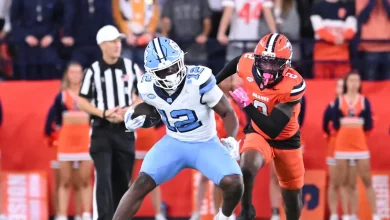
There is a moment of eerie quiet before the snap, a collective intake of breath in Beaver Stadium. Then, the chaos erupts. But amidst the controlled anarchy of a college football play, there is one constant, one vector of pure, unadulterated disruption: Number 11, flowing to the ball like a guided missile.
Abdul Carter isn’t just a linebacker. He is a phenomenon. A force-of-nature clad in Nittany Lion blue and white. Watching him is not like watching other players. It’s like watching a physics equation solved in real-time—mass, acceleration, and violent intent.
He doesn’t just tackle. He consumes ball carriers. He arrives not with a thud, but with a punctuation mark—an exclamation point of pads and resolve that stops momentum dead and often sends it backwards. Running backs who have met him in the hole develop a tell, a slight hesitation before they hit the line, a subconscious calculation of the pain-to-gain ratio.
His pass rush is a thing of terrifying beauty. He doesn’t just use speed or power; he uses a frightening combination of both, a rare synthesis that leaves offensive tackles in a perpetual state of panic. He can bend the edge with the grace of a premier edge rusher, then, on the very next play, crash down inside with the raw power of a defensive tackle. Offensive coordinators don’t scheme for him; they scheme around him, a concession that is the ultimate sign of respect. His presence alone warps the geometry of the field.
But what separates Carter from other athletic freaks is his football IQ. His instincts are preternatural. He diagnoses plays with the cold clarity of a chess master, often seeming to know where the ball is going before the quarterback does. It’s this cerebral element, layered over his generational physical tools, that makes him not just a player, but a predator in the backfield.
For Penn State, he is the beating heart of the defense. He is the energy source. When he makes a play—a tackle for loss, a strip-sack, a momentum-shifting hit—the entire team, the entire stadium, feeds off it. He transforms a defensive stand from a necessity into an event.
Yet, for all the highlight-reel violence, there is a quiet focus to him. He is not a chest-thumping showman. After a sack, he’s more likely to get up, flip the ball to the referee, and jog back to the huddle. The work speaks for itself. This business-like demeanor hints at a understanding of his own potential, a recognition that the noise is just noise. The real statement is made between the whistles.
The ceiling for Abdul Carter isn’t just the first round of the NFL Draft. It’s the Pro Bowl. It’s All-Pro accolades. He possesses the rare archetype that scouts dream of: a modern-day linebacker who can do it all—cover, blitz, stop the run, and change the game on any given snap.
Right now, in Happy Valley, he is writing a legacy. Every Saturday, he adds another chapter of controlled fury. He is the reason an offense’s best-laid plans disintegrate. He is the shadow in the backfield, the reason quarterbacks check the jersey number after the play.
To watch Abdul Carter play is to witness the future of the linebacker position, and it is a future that is fast, powerful, and utterly relentless.
Right now, in Happy Valley, he is writing a legacy. Every Saturday, he adds another chapter of controlled fury. He is the reason an offense’s best-laid plans disintegrate. He is the shadow in the backfield, the reason quarterbacks check the jersey number after the play.
To watch Abdul Carter play is to witness the future of the linebacker position, and it is a future that is fast, powerful, and utterly relentless.