Open this photo in gallery:
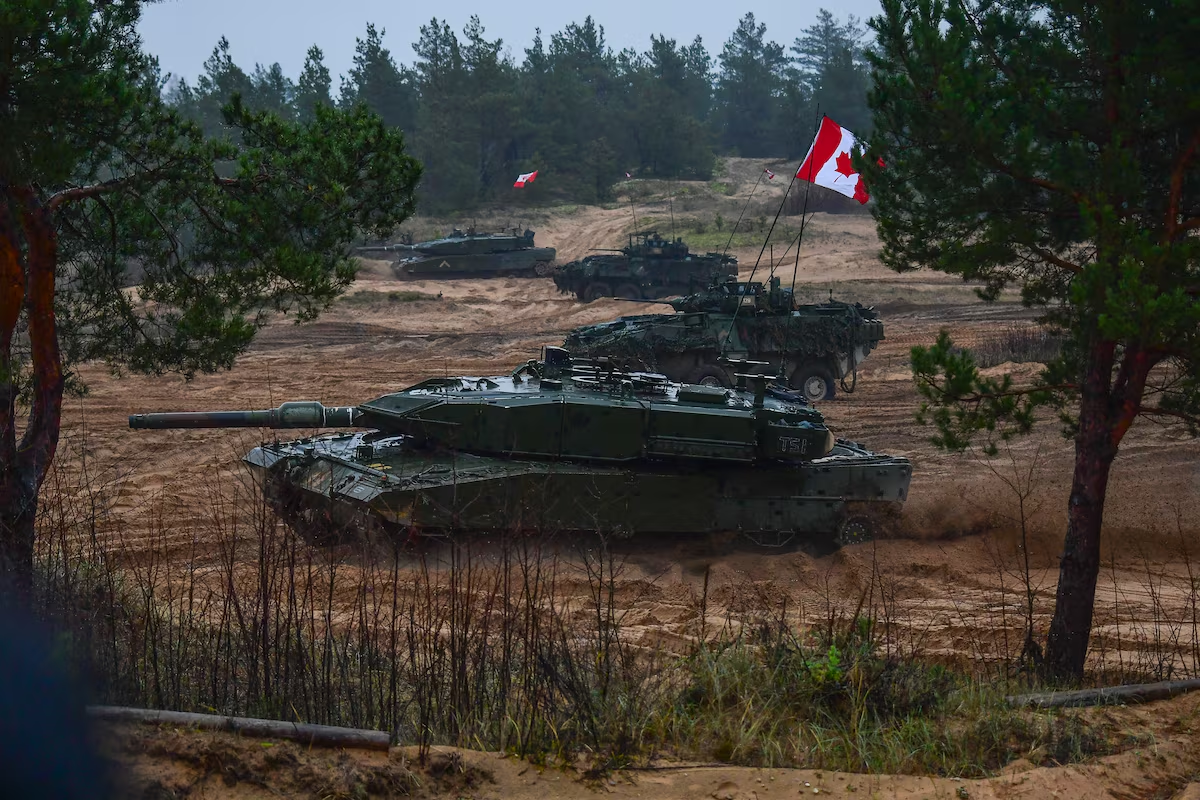
A Canadian fighting vehicle takes part in the exercise Resolute Warrior of the NATO Multinational Brigade in the Adazi Military Base in Adazi, Latvia, in 2024.GINTS IVUSKANS/AFP/Getty Images
Canada has concluded negotiations to join the European Union’s military purchasing fund as the 27-member economic bloc ramps up defence spending, Ottawa says.
Prime Minister Mark Carney’s government however declined Monday to reveal the entrance fee it will have to pay for its membership in the Security Action for Europe (SAFE) program.
As part of SAFE, Canada will be able to make joint weapons purchases with EU countries to achieve savings through large-scale buying, and Canadian companies will be eligible to bid for contracts financed by the €150-billion fund.
Joining the Europeans is part of Mr. Carney’s plan to reduce Canada’s reliance on the increasingly unpredictable United States.
Saab CEO confirms talks with Ottawa, Bombardier for Gripen fighter jet production
Defence Minister David McGuinty wouldn’t disclose how much Canada will pay to join SAFE because there are still “fine print” negotiations to complete.
“We’ve been allowed to step inside a tent, the European Union tent,” he told reporters Monday. “We have negotiated our way into the tent to build this relationship and participate in very large opportunities for procurement. The details in terms of costs, percentages are being ironed out.”
Open this photo in gallery:
Defence Minister David McGuinty says Canada has secured access to SAFE, but there are still ‘fine print’ negotiations to complete.Adrian Wyld/The Canadian Press
Canada is the first non-EU country to gain access.
Britain has also been negotiating to join the fund but talks stalled last month over the entrance fee, which media reports in Britain and Europe have pegged at between £2-billion and £6.5-billion.
A Canadian government source said the entrance fee for Canada would be in the millions of dollars, not billions. The Globe and Mail is not identifying the source because they were not authorized to discuss the matter publicly.
The Security and Defence Partnership, signed by Mr. Carney ahead of a NATO summit in June, was pitched as an effort to reduce Canada’s reliance on U.S military contractors and generate new business for Canada’s defence industry. It points the way for Canada to join a European Union push to re-arm itself in the face of an expansionist Russia under President Vladimir Putin.
Canada and the 23 EU member countries that belong to the NATO military alliance have all committed to raising defence spending to a new target of 5 per cent of gross domestic product by 2035. For Canada, this marks the largest increase in military spending in more than 70 years.
The EU defence pact marks a turning point in Canada’s approach to national security and economic growth given Canada has for many decades relied heavily on the United States for defence needs and roughly 75 per cent of its military equipment purchases.
“In these geopolitically turbulent times, it is a means to increase cooperation, meet defence targets and spend better, as we address short-term urgency and long-term needs,” Mr. Carney and Ursula von der Leyen, President of the European Commission, said in a joint statement Monday.
Ottawa says joining SAFE will unlock “billions of dollars in potential defence opportunities for Canadian businesses.”
SAFE provides up to $244-billion in loans to EU member states to support large-scale defence projects, including acquiring critical capabilities such as ammunition, missiles, drones, artillery systems and infantry weapons. Canada as a non-EU state is not eligible for this financing.
Fen Hampson, a senior Carleton University professor of international affairs, said Canada is going to have to award a significant military purchase contract to Europeans if it expects governments in the EU to reciprocate with business for Canadian companies. One of the biggest decisions before Ottawa right now is whether to substitute Saab’s Swedish Gripen fighter aircraft for U.S. arms maker Lockheed Martin’s F-35s.
“I think we’re going to have to give them a big enchilada,” Prof. Hampson said of the Europeans.
He said restrictions on the transfer of U.S. military technology could also constrain Canadian companies that build their products with American components from selling them to EU suppliers. The U.S. International Traffic in Arms Regulations’ Canadian exemption permits limited technology transfers to Canada but explicitly blocks re-exports to third countries like EU members, Prof. Hampson noted.
Another restriction on Canada doing business in the EU is the fact that 10 countries in the bloc, including France and Italy, have so far not ratified a free-trade deal with Canada. This means the non-discrimination, transparency and dispute settlement provisions in the Comprehensive Economic and Trade Agreement (CETA), which entered into force in 2017, will not apply uniformly across the 27-member union, he said.
“We should be under no illusions that European competitors in those countries will see us in anything but zero-sum terms,” Prof. Hampson said.