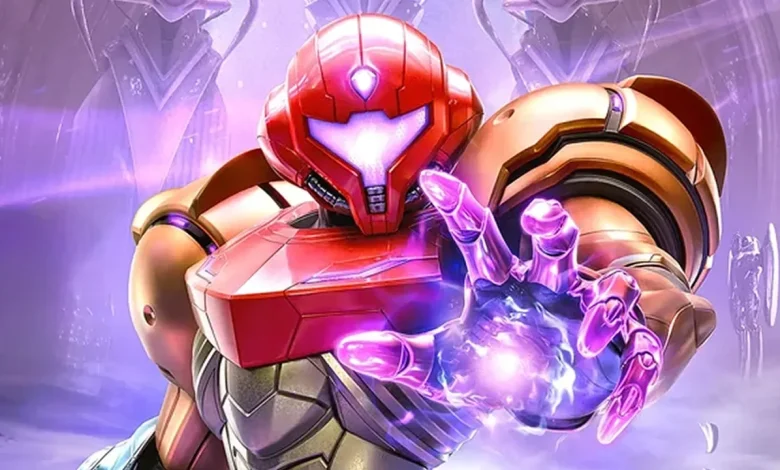
Metroid Prime 4: Beyond tries to be so many different things. There were moments where I thought it might be the strongest Prime since the very first, and others where it felt like the weakest. An outdated open-world hub connects breathtaking areas that brilliantly revisit the classic first-person exploration and lock-on shooting the series is known for. Talkative companions drop a few too many hints and one-liners, but they’re redeemed by some memorable story moments and mostly charming personalities that even a crotchety Metroid fan like me warmed up to in the end. And, thankfully, Retro Studios still mostly understands it’s important to give Samus her alone time, with a relieving amount of exploration in total isolation. While some of what it attempts just doesn’t work, far more of it does, resulting in an uneven but overall impressive revival that reaches incredible heights in its best moments.
The story begins with Samus mysteriously teleporting to the planet Viewros, where she works to find a way home while also uncovering the history of the ancient Lamorn race. The hook this time around is Samus’ new psychic abilities bestowed upon her by the Lamorn. These purple-hued powers allow you to telekinetically manipulate certain objects, while also adding a new wrinkle to Samus’ standard arsenal that includes her Charge Beam, Morph Ball, bombs, and more. They lead to all sorts of different challenges that involve shifting platforms around, directing charged shots to hit multiple targets, cool momentum-based Morph Ball platforming, or searching for enough psychic energy sources to power a nearby device.
Metroid Prime 4 Beyond Switch 2 Edition Screenshots
The puzzles and suit upgrades are great overall, if a little familiar. I really enjoyed using the psychic abilities to find every last hidden item, even though they’re mostly slight remixes of returning powers rather than something truly original. I can only recall a few times where a solution felt particularly novel – but that does include one awesome cinematic moment that really stands out. And when we’re talking about the long-awaited continuation of one of the most acclaimed video game trilogies of all time, it’s not a major complaint to say it’s sticking relatively close to the script.
Combat also feels exactly like you’d expect from a modern return to Metroid Prime. You lock onto enemies and fire shots or missiles while strafing around aggressive monsters and machines. It’s not just a straight retread though; Samus feels amazing to control, with a swift forward and backward dodge, improved maneuverability when popping out of the Morph Ball, and snappier access to your visor, which is more useful than ever thanks to its psychic properties. You’ll also gain flashy elemental beams that are helpful in both combat and exploration (and also change the look of Samus’ arm cannon when they’re equipped, which is a nice returning detail).
The puzzles and suit upgrades are great overall, if a little familiar.
Choosing your weapon and fine-tuning your aim is still fun all these years later despite its relative simplicity. Prime’s combat has always fared best when sparse encounters are supplemental to exploration, which is the format Prime 4 follows most of the time. It introduces new foes that require different tools to beat, like a swarm of hovering robots protecting three weak spots you need to fire a slow-motion charged shot at to destroy. The combat’s low points are when it does its best impression of a mid-2000s corridor shooter, occasionally focusing a bit too much on repetitive waves of enemies. At least those sections always end with something exciting, as the great lineup of boss battles is a nice mix of towering monsters and one-on-one shootouts. An early highlight is a giant plant protected by petals that thrashes its vines at you.
I played almost entirely with dual-stick controls on the Switch 2 Pro Controller, which also has optional motion aiming for fine tuning when locked on to an enemy, like Splatoon. This is my favorite setup, but I dabbled with the Wii-inspired separated Joy-Con control scheme, which is also a totally viable option. The Switch 2-exclusive mouse controls are functional, and it’s neat that you can swap to them on the fly just by placing your controller on a flat surface. But I don’t see many people using them given how physically awkward the Joy-Con 2 is to use as a mouse for any extended period of time, especially when the more traditional control schemes already work so effortlessly well.
Samus’ new motorcycle also controls well, and the way it’s woven into the plot feels surprisingly natural, but what you’ll actually use it for is one of Prime 4’s biggest fumbles. You’ll mainly ride the bike in Sol Valley, a desert hub that serves as the middleground between each major location on its edges, sort of like what Hyrule Field was for Ocarina of Time. It’s mostly empty and devoid of many interesting activities, as the same few enemy types pop up when you’re riding and all you do is fire a basic projectile or charge into them to destroy them. The desert isn’t that big, so it at least doesn’t take too long to get from point A to point B. The problem is that it’s designed as if that N64 Hyrule Field saw the Great Plateau from Breath of the Wild and said, “I can do that, too!”
Almost like it’s trying to justify the motorbike’s inclusion, Prime 4 goes to great lengths to ensure you spend multiple hours riding across this drab desert just to reach the credits. It sprinkles an extremely small number of Breath of the Wild-like shrines on the map that house optional upgrades. The bite-sized puzzles inside those shrines are fine, but there’s absolutely no joy in discovering them when they’re just haphazardly strewn across the visually unimpressive sand, and it feels like a surface-level attempt to recapture Zelda’s open-world magic that doesn’t really work.
A runtime-padding main objective is tied to the repetitive desert.
This wouldn’t be a huge deal, but Prime 4 ties a main objective to its repetitive desert. Samus has to collect enough green energy to preserve the history of the Lamorn civilization before it’s lost to time, which is a very cool setup. But in practice, all that entails is mindlessly driving around the desert and crashing into any green crystals you see. It’s the type of runtime-padding filler that had already outworn its welcome the last time a Metroid Prime game came out, and Prime 4 would be so much tighter without this quest, or even without its half-baked desert at all. It’s far from a dealbreaker since this mission is given to you very early on, meaning you can chip away at it while you’re riding to your next destination, but it’s certainly not fun regardless.
In Prime Form
The good news is that the places you’re riding toward are full of the strong Metroid Prime atmosphere and gameplay you came for. And Prime 4 is at its greatest when playing into the same strengths that have defined this subseries since the GameCube: lonely, haunting exploration through gorgeous, fully-realized areas that each have their own detailed backstory to uncover. Structurally, the individual maps take after Prime 2 and Prime 3’s more self-contained approach rather than Prime 1’s interconnected spiderweb that required revisiting areas several times over with multiple entrances and exits to each.
There is some backtracking involved, of course, but each region has just one entrance from the desert, and you’ll finish most of its main objectives on your first visit. I was delighted to find that this format fills the traditional 3D Zelda-shaped hole in my heart, as each zone essentially acts like a huge dungeon: explore, find a key upgrade, kill the boss with it, and leave. That’s not to say it doesn’t feel like Metroid – there are a few main quests and plenty of optional items I needed to come back for later. It’s just that these two series have always shared a lot of the same DNA, and Prime 4 lands closer to the Zelda style.
Every location stands on its own, which allows Retro to give each a unique tone: sometimes Samus is completely alone and it leans hard into the tense sci-fi horror isolation of Alien, and sometimes she’s accompanied by Galactic Federation companions through more scripted scenes that call upon the action tropes of its sequel, Aliens. This constant genre-shifting across levels keeps things fresh for most of its roughly 15-hour runtime, at least until it’s time to finish collecting all those green energy shards.
In these dedicated areas, Prime 4 makes a case for itself as the best-looking game Nintendo has ever published. Its fantastical art direction is jaw-droppingly gorgeous at times, with incredible lighting, beautiful backgrounds, ornate architecture, and nicely detailed environments. It sounds great, too, with dramatic choral melodies fused with electronic sounds that fit Prime’s atmosphere extremely well. Samus’ iconic visor effects return, like the way it fogs up in extreme temperatures, or how rain droplets patter against it in a storm. Its art direction goes hand-in-hand with its world design, as the way rooms are intentionally framed upon blasting open their doors is often spectacular. To be clear, Prime 4 doesn’t reach the visual heights of the best-looking games on PC or other consoles, but a game this stunning running at a flawless 4K 60 fps on Switch 2 – with a smooth 120 fps option that lowers the resolution – is a huge step forward for Nintendo.
But how does it run on Nintendo Switch 1?
While I almost entirely played on Switch 2, I did test out the last-gen Switch 1 version as well. The resolution downgrade is obviously noticeable in comparison to the fancy Nintendo Switch 2 Edition, as things look much fuzzier than they do in crisp 4K. But it still holds its own and runs at an impressive 60 fps on the old hardware. The initial loading screen upon choosing your save file felt much longer, and there was some slight pop-in I noticed when driving around the desert. None of the drawbacks I encountered were remotely close to game-breaking (I will point out I only played on Switch 1 for roughly 90 minutes in total), and this felt like a totally practical way to play Prime 4 if you haven’t upgraded yet. While I’d clearly recommend the souped-up version to anyone who can get their hands on it, Retro Studios did a very nice job creating two versions of Prime 4, and you shouldn’t feel like you have to miss out if you’re still playing on the original Switch. This is the console Prime 4 was originally announced for way back in 2017, after all.
Some locations stand alongside my favorites in the series, and when you’re methodically tiptoeing your way through each one, Prime 4 more than lives up to the trilogy’s legacy. Without giving too much away, an early highlight is Volt Forge, a gothic, futuristic factory set to a powerful rock soundtrack. It’s impressive how its rich history is intertwined with its level design: you can just work your way through each room and enjoy the intricate layouts at face value, or you can scan every machine and learn why they exist and what they were used for, which provides fascinating context that makes complete sense when you see it all in motion. These places feel big, important, and carefully plotted out. That worldbuilding remains an incredibly special piece of Metroid Prime.
Each region is fairly linear, with usually just one correct way to go, even if multiple choices are presented. When you stumble into a room with three doors, for example, it’s most likely that one is a save room, one is blocked until you get a new upgrade, and one is the way forward. I actually think this choice suits the Prime series very well, allowing it to focus more on mood, handcrafted tension, and distinct sequences, but it’s a very different flavor than the nonlinear design the Metroid series helped pioneer more than 30 years ago. I never felt truly lost, even when poking around its most freeform parts.
Prime 4 makes a case for itself as the best-looking game Nintendo has ever published.
A positive outcome of this decision is that Prime 4 feels like the best entry point into this series for new folks, easing them in to better prepare them for something like Prime Remastered’s more complex labyrinth. It also smartly follows in Metroid Dread’s footsteps by letting you mark your map to remember which rooms have powerups you can’t get yet, streamlining the endgame collectible cleanup.
You’ve Got a Friend
Most regions contain one of several Galactic Federation companions who temporarily travel with Samus before heading back to base camp. Each has their own personality and light backstory, ranging from a nerdy engineer who can barely handle a gun, to a sniper with a broken leg who is questioning his decision to join the military. Thankfully, these characters are far less intrusive than I initially feared after a particularly obnoxious tutorial section I saw in my preview demo. Their limited presence means they don’t have amazing character arcs – a more than acceptable side effect – but they do have mostly likeable personalities and provide a few highlights that give Prime 4 its own identity. I have to admit I smiled when a Samus superfan geeked out after seeing her idol transform into the Morph Ball, and it helps that the great voice acting and facial animations are another step forward for Nintendo.
They could still use some work in the writing department, however, as they often fall back on well-worn clichés or commentary that feels out of place in Metroid, like, “There’s too many of ‘em!” during an action scene, or cracks like, “Piece of cake! Red velvet cake,” upon solving a puzzle. I’m grateful that they generally don’t outright spoil specific puzzle solutions, but they do chime in a little more often than I’d like about where to go or what to do next. Specialist Myles MacKenzie is never as overbearing as in his initial introduction, but he does frequently contact Samus on the radio to tell you the general area you need to search for your next upgrade. Prime 4 lets you toggle on-screen tips that nudge you in the right direction, so I really wish I could turn companion hints off, too. When you’re with someone on a mission – which is a major part of the campaign – certain aspects can feel outdated as well, like waiting for someone to help you open a door, hearing repetitive combat dialogue lines, or reviving them whenever they go down.
Logan Ranks the Metroid Series
I reviewed Metroid Prime 4: Beyond, and it’s great! Here are my favorite 2D and 3D Metroid games, ranked.
Prime 4 keeps these portions in check by smartly knowing when to leave you alone entirely, with multiple lengthy segments where Samus loses radio signal and no one can bother her. You spend over half of the runtime on your own, so if you’re a longtime Metroid fan who craves ambience and isolation, there’s plenty of that here, too. Overall, the companions are tolerable: while there are still several moments that probably would’ve been more epic if Samus was alone, their inclusion does lead to some fun cinematic events that wouldn’t be possible otherwise.
One character who I actually wish was included more is Sylux, Prime 4’s big bad that doesn’t play nearly as big a role in the story as I expected based on Nintendo’s marketing. It’s another underdeveloped part of Prime 4 – Sylux’s amiibo figure has more detail than his personality – and it feels like he’s only here out of reluctant obligation to Prime 3’s post-credits tease from 2007. Instead, this story focuses far more on Lamorn history, which is very fascinating on its own, but doesn’t entirely make up for the disappointing feeling that something’s missing.