Inheritance tax, property and public money: Our first billionaire king has some tough questions to answer

In the wake of the Andrew Mountbatten-Windsor furore, the timing feels prescient: a three-part documentary series on royalty, What’s the Monarchy For? These days, about half of Britain’s population is wondering the same thing. Cue a landmark audit of royalty presented by octogenarian David Dimbleby, whose own hereditary broadcasting privilege is flaunted throughout.
Whether it is the magical conjuring tricks achieved by his father Richard during the late Queen’s coronation, his brother Jonathan’s nip-and-tuck of Charles’s image in the then Prince of Wales’s face-saving 1990s documentary or David’s own inimitable delivery of countless royal occasions, the BBC’s Dimbleby dynasty in the 20th century were to royalty what Netflix has been to the Beckhams in the 21st.
But with this latest series, the BBC – royalty’s “ringmaster”, according to Dimbleby – is clearly trying to do something a bit different. The former director general Greg Dyke naively suggests that the corporation should reflect public opinion on the royal family, and with their popularity hovering around the 50 per cent mark, that perhaps explains why this series is lukewarm about many of our most venerable institution’s attributes – particularly when it comes to royal wealth.
open image in gallery
David Dimbleby solicits the help of the investigative journalist David Pegg, who exposed King Charles as the richest monarch in Britain’s modern history (BBC/The Garden TV)
However, the BBC’s ability to shine desperately needed light into the thicket of secrets that govern the royal family’s finances is hamstrung early on by an editorial decision to make one episode about power and a separate one about money. The first ends up revisiting many of the less edifying political moments in Britain’s last 10 years, particularly Boris Johnson’s proroguing of parliament in 2019. Jacob Rees-Mogg, part of the delegation dispatched to Balmoral to solicit the permission of the monarch, delights in recounting how smoothly everything runs within the royal household. (The viewer is left in no doubt that royal operations are infinitely better resourced and managed than those in the rest of the country). Meanwhile, Dimbleby huffs over the point of monarchy if, constitutionally, they can’t exercise their power independently of government when the chips are down.
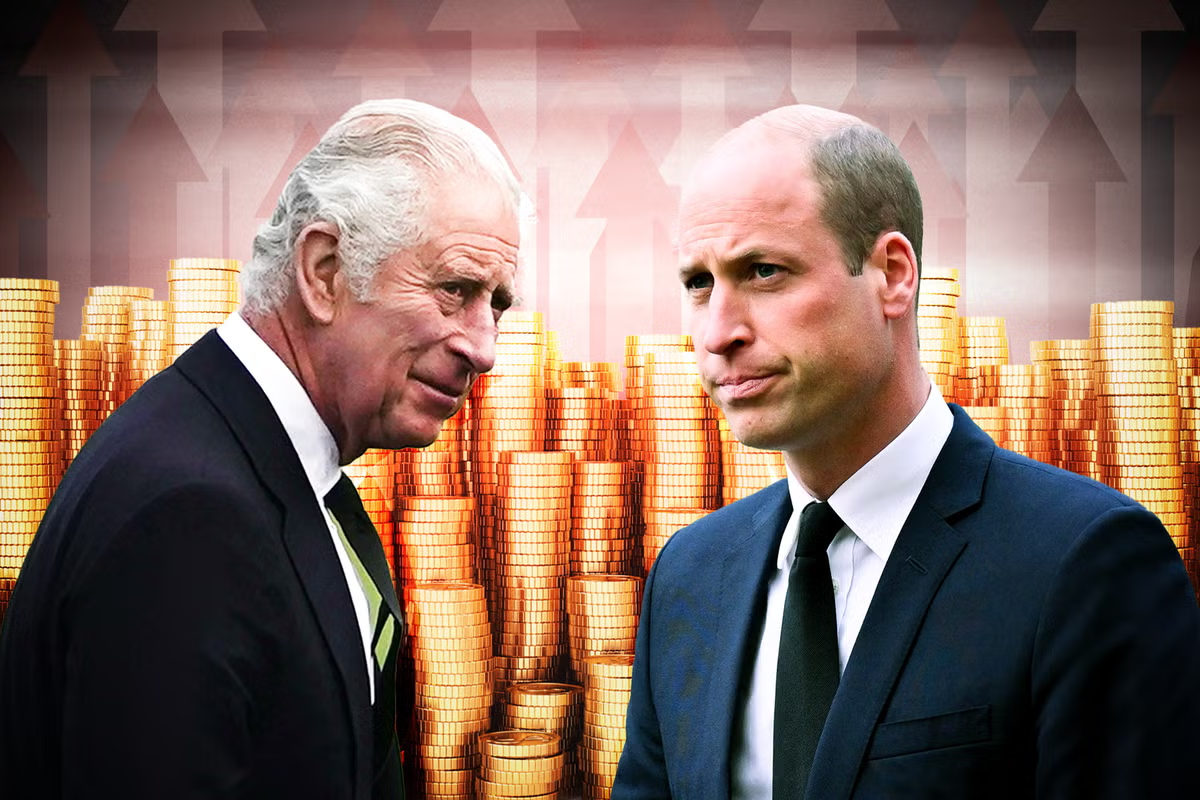
It rather misses the point of where royal power increasingly lies, a reveal which comes in the episode about money. Dimbleby solicits the help of the investigative journalist David Pegg, who helped expose King Charles as the richest in Britain’s modern history, and the first to ascend the throne as a billionaire. The episode retraces well-trodden ground: reminding us that the monarchy pays no inheritance tax, their income tax is a voluntary gesture reintroduced in the 1990s, and that the Duchies of Lancaster and Cornwall evade corporation and capital gains tax.
The latter are massive wealth portfolios, in the possession of the monarch and the Prince of Wales, respectively, which date back to medieval times. Father and son are the recipients of the ballooning profits (between £20m and £25m annually) that these diverse estates generate, with assets including vast tracts of land in the north and south of England and Wales, industrial estates, grouse moors, villages, farms and service stations. The eye-popping list of Duchy candy even includes the Oval cricket ground in Kennington and properties on the Isles of Scilly. These same Duchies were recently exposed, in an investigation by Channel 4 and The Times, for charging commercial rates from beloved public sector institutions like the NHS and reaping the rewards. The BBC series reminds us that a parliamentary committee which looked into the financial anomalies that govern these Duchies in 2005 failed to land a glove on the institution. Dimbleby quietly concludes that our royal family are as rich as plutocrats.
open image in gallery
The man who will be king: Prince William says he wants to do things differently, but has not said how (Getty)
But the BBC resists going in for the killer blow. For all the many political figures Dimbleby has twinkly chats with, the programme fails to get to the bottom of why they never successfully held the monarchy to financial account. Worse, it doesn’t push David Cameron on why his administration heightened royal secrecy, removing the right to table freedom of Information (FOI) enquiries about royal matters. Dimbleby spends a long time recounting the indirect power the then Prince Charles may have asserted through his campaigning letters that landed at the top of government ministers’ in-trays, but he fails to mention that today we don’t have access to equivalent royal correspondence.
Nor does it tackle the issue of royal wills. Unlike us mere mortals, whose wills become public documents once probate is granted, the monarch’s will is protected by an act of parliament. But since 1910 the privilege of privacy has been extended to members of the wider family, presumably to avoid sensitive financial arrangements and information falling into the public domain. In 2021, despite The Guardian’s best efforts, the High Court ruled that Prince Philip’s will should stay sealed for at least 90 years, and even at that point, another judge will decide whether the contents should be released.
open image in gallery
Public displays of wealth: Queen Elizabeth and Prince Philip during the Queen’s golden jubilee celebrations in June 2002 (Getty)
In short, we are more in the dark than we were 15 years ago, a problem compounded by the different legal and institutional structures that bind the royals to their property and possessions, making it incredibly difficult to estimate the value of the monarch’s estate. Nonetheless, extensive research by The Guardian found that in the wake of his mother’s death, the King’s wealth had been propelled to nearly £2bn, a staggering sum boosted by vast increases in land and property value over the last 50 years.
Meanwhile, our democratic system, which these days even prohibits the tabling of a royal-related FOI enquiry, is unable to effectively scrutinise the extent to which the Windsors exploit their political access and influence to safeguard their own expanding interests.
But the documentary does not make this point. It also fails to join the dots on where the late Queen drew money from to pay off Andrew’s giant legal bills (most likely the Duchy of Lancaster profits). Nor does it mention the peppercorn rent that Prince Edward pays to reside in the Crown Estate’s giant Bagshot Park, or Princess Eugenie and Beatrice’s grace-and-favour royal residences. The grotesque Andrew-Epstein scandal and the festering sore that was the former Duke of York’s refusal to budge from the Royal Lodge has reframed the debate and changed the public’s mood, but the BBC is apparently still playing catch-up.
open image in gallery
The monarchy, with all its untaxed wealth, is one of the few institutions in Britain that is not in the financial doldrums (Getty)
Certainly, this series avoids key issues, and in doing so highlights the corporation’s own impotence. Tellingly, the third episode, which is focused on image, makes no mention of the seminal royal tell-all in the 1990s – Martin Bashir’s interview with Princess Diana, which had unprecedented ramifications and 25 years on exposed the BBC’s own seismic journalistic failings. A new book, Dianarama, by whistleblower Andy Webb, suggests the BBC is not yet out of the woods in terms of its failure to act when questions were raised early on about Bashir’s grotesque modus operandi. This achilles heel for the corporation partially explains why their series, focused on what the monarchy is for in the 21st century, fails to tell us anything new. Perhaps predictably, Dimbleby gives the growing republican movement short shift; they occasionally pop up as yellow flag-wavers with a leader who has disliked the monarchy since childhood.
But in truth, the momentum lies with small organisations like Graham Smith’s Republic pressure group and media outlets that ask the tough questions around the royal family’s finances. Channel 4 and The Guardian are overtly against the monarchy, which is not where the majority of public opinion sits, but their anti-royal ideological zeal allows them to go where our national corporation dares not. Dimbleby lightly notes that, unlike his father, Prince William, the current Duke of Cornwall, does not publish his tax returns (another backwards step). But the programme fails to push the envelope; Dimbleby does not doorstep the Prince or demand to speak to his private secretary about this extra layer of secrecy.
Rather, it ends with an extract from the Prince’s recent appearance on the Apple TV+ show The Reluctant Traveller with Eugene Levy. A buoyant William breezily tells the presenter that “change is on my agenda”. From the sidelines, Dimbleby ponders what this might mean. He can do little more, as it is Apple that had access to William, not the BBC. It’s an uncomfortable reminder that, while 30 years ago it was Dimbleby’s brother who sat down and tackled the Prince of Wales, today there are plenty of softer options.
In many ways, the series speaks to our time. The Windsor household’s privileged position relies on popular consent, at a time when the monarchy has never been more financially out of step with the nation. While 81 per cent of the over-65s say that Britain should continue to have a monarchy, this falls with each age group to just 41 per cent of 18-24-year-olds and is dropping every year. All that untaxed wealth has left it as one of the few institutions in Britain that is not in the financial doldrums, quite the reverse. No wonder Donald Trump feels so at home with the King – plutocrats together!
To steal a title from the BBC’s current Reith Lecture series on Radio 4, it is a “Time of Monsters” – or at the very least a time of the super-rich. Reith lecturer and historian Rutger Bregman calls for a “moral revolution” in his BBC radio series, which has courted its own controversy with the removal of a line about Trump being the US’s most corrupt president. Likewise, in the BBC’s series about royalty, one which asks what the monarchy is for, the corporation reminds us that if we want real change, we cannot rely on the establishment to reform itself.
When it comes, the momentum for a royal overhaul will come from tenacious, young, angry outsiders. For the monarchists among us, we can only hope the revolution spares the crown, if not all its many untaxed baubles.
‘What’s the Monarchy For?’ Tuesday 2 December at 9pm on BBC One and BBC iPlayer
Tessa Dunlop is the author of ‘Elizabeth and Philip: A Story of Young Love, Marriage, and Monarchy’