A message from Qwul’sih’yah’maht, Dr. Robina Thomas, Acting President & Vice-Chancellor
Dear students, staff and faculty,
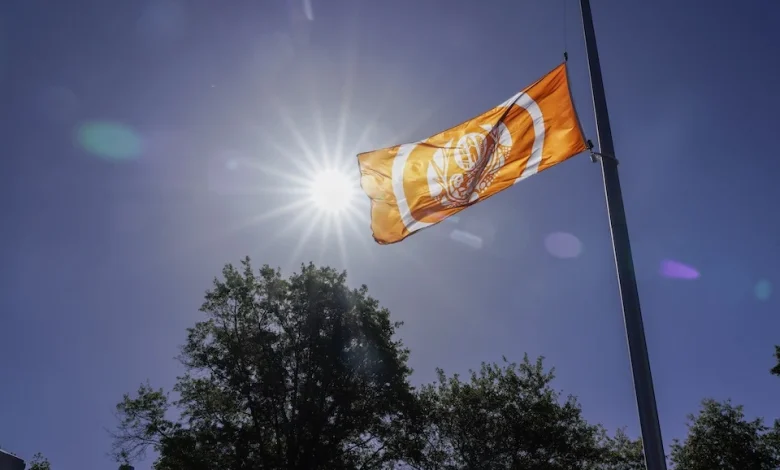
I raise my hands with the deepest of respect – Huy tseep q’u Siem – thank you to all the respected ones who showed up to turn their backs on a potentially harmful unsanctioned event at UVic earlier today. The sea of orange that surrounded the Survivor’s Flag is an undeniable validation of our communities’ commitment to the local Indigenous Teachings that ground our Indigenous Plan.
I want to acknowledge that harms have been done to members of our community. To Indigenous students, staff, faculty and community – we stand with you against those who seek to divide us. We honour the lost children and Survivors of residential schools, their families and communities.
At the University of Victoria, the Teachings along with our commitment to equity, diversity and belonging underpin our approach to fostering a welcoming and inclusive university. These principles form the fabric of our community and help to create the conditions in which academic freedom, civil and informed debate, and open inquiry can thrive.
Recent events on our campus and attempts at denying the history of residential schools are part of a growing narrative that attempts to distort the values and the core mission of higher education institutions—commitment to truth, critical inquiry, and knowledge dissemination. This hurtful and divisive rhetoric should not be confused for academic inquiry and debate.
UVic is a leader in Indigenization and reconciliation for university campuses across Canada. I know that our community is hurting. As I shared in my message yesterday, in moments like this, our strength lies in unity and in living our values. We must support one another and affirm the inclusive, respectful culture we can only build together. We uphold our pledge to ʔetalnəw̓əl̓ | ÁTOL,NEUEL | respecting the rights of one another and being in right relationship with all things.
At a time like this, please know that resources and supports are available on campus and in our community (linked below).
Huy tseep q’u Siem,
Qwul’sih’yah’maht
Dr. Robina Thomas
Acting President & Vice-Chancellor
Supports and resources
Education
The university community provides a wealth of research, expertise and lived experience to draw from as we continue our commitments to education on truth and reconciliation. We encourage everyone to review the UVic Libraries Resources for Truth and Reconciliation, or enroll in Indigenous Acumen Training. We encourage students to engage in some of our many academic courses focussed on Indigenous history, knowledge and ways of being. Another excellent resource is the University’s Indigenous Plan which is grounded in extensive consultation with Indigenous students, staff, faculty, Elders and local community leaders.
Support
As posts and dialogue related to these events are impactful, please know that resources, supports and opportunities for connection are available for Indigenous students including drop-In spaces. For more information, please connect with [email protected]. In addition to event-specific resources, a range of supports are available to Indigenous students.
Counselling for Indigenous students
Indigenous counsellors provide individual and group counselling that treat the heart, body, mind and spirit for Indigenous students. Indigenous counselling sessions are flexible in length, you are seen on the spot for emergency appointments and in general, you can meet with the Indigenous counsellor without having to wait too long.
Hope for Wellness Helpline
A 24-hour resource available across Canada, supports are available about a whole range of issues which can include mental health concerns, anxiety, coping with stories in the media and getting connected with supports in your area. The counsellors are available to talk to you about any topic or concern that you are facing. Both telephone and online chat services are available in English and French. Telephone support is also available upon request in: Cree; Ojibway (Anishinaabemowin) and Inuktitut.
KUU-US Crisis Line Society
The KUU-US Crisis Line Society operates a 24-hour provincial Aboriginal crisis line for adults/Elders and youth.
Adults/Elders: 250-723-4050
Children/Youth: 250-723-2040
Toll-free Line: 1-800-588-8717
SupportConnect
SupportConnect is a free, confidential mental-health support service for UVic students. You can connect with qualified counsellors, consultants and life coaches by phone or online 24/7. Video or in-person options are available.
Toll-free (calls from North America): 1-844-773-1427
International collect calls: 1-250-999-7621
Indian Residential School Survivors Society Crisis Line
24-hour crisis line for survivors and family of survivors. Toll-Free: 1-866-925-4419
First Nations Health Authority (FNHA) Mental Health Benefits
FNHA partners with Indigenous Services Canada to offer a comprehensive mental-health plan to First Nations in BC. The plan covers counselling services from qualified mental-health providers, including psychologists, clinical counsellors and social workers.
Here2Talk
Connects students to mental-health support when they need it. Through this program, all students currently registered in a BC post-secondary institution have access to free, confidential counselling and community-referral services, conveniently available 24/7 via app, phone and web. The Vancouver Island Crisis Line
24-hour crisis line service to Vancouver Island, the islands of the Georgia Strait, and the mainland communities between Powell River and Rivers Inlet, as defined by Island Health. It operates 365 days a year. Crisis workers provide short-term, non-judgmental emotional, support, crisis intervention, information and resources. Toll-free: 1-888-494-3888