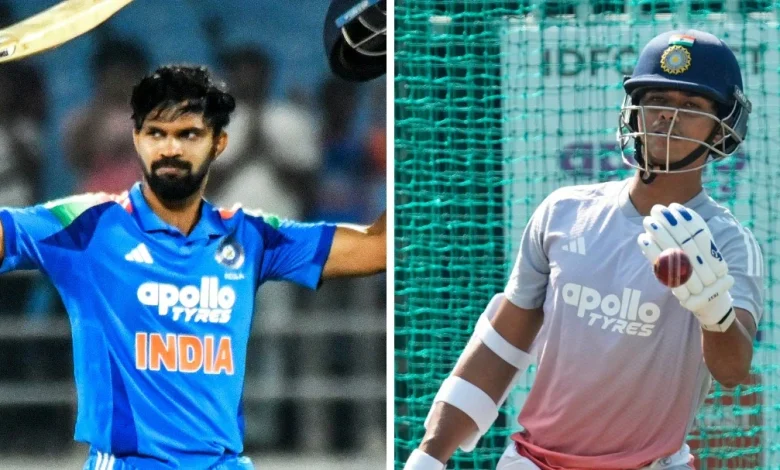
Every young Indian batter eventually arrives at a crossroads where promise stops being enough. For Yashasvi Jaiswal and Ruturaj Gaikwad, that moment has come sooner than expected, carved open by injuries and the urgent need for bench strength as India look to build knowledge of their alternative batting options for the ODI World Cup in 2027.
It is no secret that the injuries to ODI captain Shubman Gill and vice-captain Shreyas Iyer have created the ideal window to test newer faces in the 50-over format. And South Africa can be the ideal opponent to deliver against, considering their quality and where conditions punish technical flaws and reward mental clarity. India may have no shortage of talent waiting in the wings, but talent without preparation can often be exposed in environments like these. That is the concern heading into this series, and it is one that both Jaiswal and Gaikwad must confront head-on.
IND vs SA 2nd ODI: Preview
With vacancies opening up and expectations rising, both batters know they must turn opportunities into evidence. A few strong scores will not only boost their confidence but also show the management that they have the temperament and adaptability to handle the demands of the format. Yet, as this audition begins, it is clear that the spotlight burns brighter for one of them.
CAN JAISWAL CUT THROUGH?
Jaiswal, despite his explosive potential, enters the series with a question mark hovering stubbornly over his game. And like many great players before him — Virat Kohli with the fifth-stump line delivery, Sachin Tendulkar with the cover drive in 2004 — the weakness that threatens him the most is linked to his favourite stroke.
For weeks, perhaps months, teams have known exactly where to bowl to Jaiswal. Left-arm pacers have troubled him consistently, and the numbers paint an unforgiving picture. Across formats, he has fallen to left-arm pace 15 times in 53 matches, managing a meagre average of 8.6 against them. In the modern era of data-driven matchups, that is a glaring vulnerability — one that opponents will gladly exploit.
Jaiswal has been struggling against left-arm pacers (Courtesy: PTI)
Now there are two ways Jaiswal can respond. The first is technical: to ensure he judges the length right and picks his moments to play the cut shot, and plays later than he currently does. The second is psychological: to avoid the shot altogether, much like what Tendulkar famously did during his iconic 241* in Sydney, when he shelved his beloved cover drive for an entire innings. The latter is possible, but it demands immense discipline and denying yourself a favourite shot is one of the hardest mental battles a batter can fight.
For Jaiswal, the challenge grows steeper because South Africa possesses not one but two left-arm quicks who thrive on bounce, angle, and discipline: Nandre Burger and Marco Jansen. Jansen, in particular, has troubled him repeatedly. During the recent Test series, he dismissed Jaiswal three times in four innings, exposing the exact fault lines in the left-hander’s game.
Former South Africa great Dale Steyn has broken it down with typical clarity.
“I think it’s his default shot. He likes playing it, and maybe he’s so used to right-arm bowlers coming across him that the stroke feels natural,” Steyn told Star Sports during the Tests.
“But with Marco Jansen being a left-arm bowler, it looks like the ball is going to angle towards first slip, giving him room to play that shot. Very often, though, it’s actually a bit tighter than he expects.”
Steyn believes Jaiswal may need to temporarily rewire his instincts.
“When you see the ball in your area, you feel, ‘That’s my bread and butter, I’m going to take it on.’ But maybe it’s something he has to work on and dial back a little.”
He even referenced Tendulkar’s Sydney masterclass.
“I remember a series where Sachin took the drive away completely maybe he has to do something similar: unless the ball is in a particular area, he goes for it; otherwise, in this zone, he gets back into his defence.”
For Jaiswal, this series could either widen the flaw or force the evolution he needs. And South Africa will waste no time testing him.
GAIKWAD’S TIME TO SHINE
If Jaiswal’s challenge is about survival and adjustment, Gaikwad’s is about affirmation. Stylish, still, and serene at the crease, Gaikwad has long seemed perfectly moulded for ODI cricket, a format that rewards pacing an innings, rotating strike, and then accelerating decisively. Yet strangely, he remains a peripheral figure in India’s 50-over plans, his opportunities scattered and his rhythm frequently disrupted.
Domestically, however, Gaikwad’s record is nothing short of elite. In 90 List A matches, he has amassed 4542 runs at an average of 56.77 and a strike rate touching 101. His tally of 17 centuries and 18 fifties is the hallmark of a batter who not only scores big but scores consistently. His highest score, a commanding 220 not out, reinforces his ability to dominate an innings from start to finish.
Ruturaj has got elite numbers on the domestic circuit (Courtesy: PTI)
These are not the numbers of a fringe batter fighting for relevance; they are the numbers of a player who thrives in the very format he has been unable to fully inhabit at the international level.
What India wants to see now is whether that domestic excellence can translate onto South African soil. Gaikwad’s gifts, be it his balance, his timing, his calmness, give him a solid foundation. But South Africa will test him differently, and India will hope he can adjust early, control the middle overs with his natural rhythm, and then find the gears required in the back end.
More than anything, Gaikwad needs continuity. And this series may finally offer him the platform he has waited for.
The road to 2027 is long, but it begins now. For Jaiswal, the question is whether he can conquer a flaw threatening to define him. For Gaikwad, it is whether he can turn promise into performance. Two batters, two different crossroads and a series that may shape India’s future far more than it appears on paper.
– Ends
Published On:
Dec 3, 2025